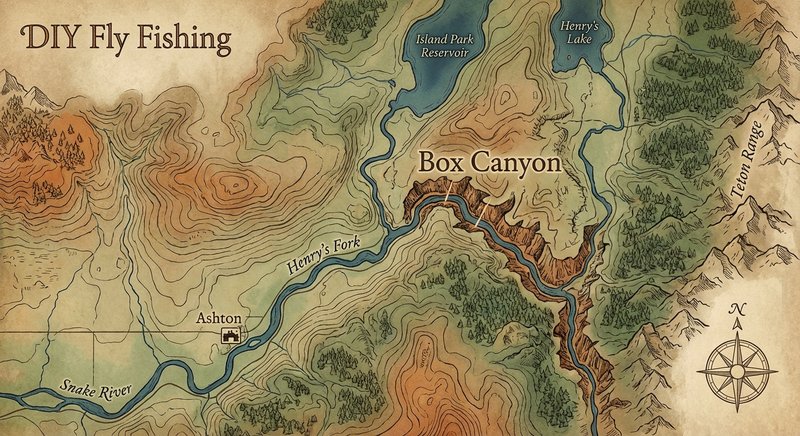
Box Canyon (Henry's Fork)
Fly fishing in Idaho · Advanced · Best seasons: Spring, Summer, Fall, Winter
Target Species
Rainbow Trout, Brown Trout
About This Water
Below Island Park Dam on Henry's Fork. Trophy rainbow trout in crystal-clear spring water.
Fishing Recommendations
Welcome to the Box Canyon of the Henry’s Fork of the Snake River. As a guide, I consider this stretch one of the most productive, exhilarating, and technically demanding "tailwaters" in the American West. Located just below Island Park Dam, the "Box" is roughly three miles of high-gradient, boulder-strewn pocket water that serves as the engine room for the entire river system.
🎣 Location Overview
The Box Canyon is a rugged, scenic canyon where the Henry’s Fork transitions from a reservoir into a powerful, high-volume river. Unlike the slow, glassy glides of the Railroad Ranch downstream, the Box is a classic pocket-water fishery.
What makes it special is the sheer density of fish. It acts as a nursery and a sanctuary for massive Rainbow Trout. The water is nutrient-rich, crystal clear, and stays relatively cool even in the heat of summer. Anglers love it because it offers high catch rates and "heavy" fish that use the fast current to their advantage. Be prepared for a physical day; the wading is notoriously difficult due to "slick-as-ice" basalt boulders.
🐟 Target Species & Behavior
- Rainbow Trout: This is the primary resident. These are hard-fighting, wild fish with deep girths. They hold in the soft pockets behind large boulders, in the "seams" where fast and slow water meet, and right in the "cushion" in front of rocks.
- Brown Trout: While less common than the Rainbows, some truly trophy-sized Browns move up from the lower reaches or inhabit the deeper, darker undercut banks near the bottom of the canyon.
- Behavior: These fish are opportunistic but position-oriented. Because the water moves fast, they have a split second to decide to eat. They are less "leader shy" than Ranch fish but extremely sensitive to "drag" in the complex currents.
📅 Best Times to Fish
The Box is a year-round fishery, but its character changes drastically with the seasons.
- Spring (April - May): Excellent nymphing. This is when the Mother’s Day Caddis hatch can be epic. Water levels can be high, so heavy weight is required.
- Summer (June - August): The "Prime Time." The Golden Stonefly hatch in June and July is legendary. This is followed by Salmonflies and Yellow Sallies. Morning and late afternoon are best to avoid the midday sun and boat traffic.
- Fall (September - October): My personal favorite. The crowds thin out, and the Blue Winged Olives (BWO) emerge. Large Browns become more aggressive as they prepare to spawn.
- Winter (November - March): Cold but productive. Focus on the slow deep pools and mid-day Midge hatches. You’ll have the canyon to yourself.
🪰 Recommended Flies & Techniques
Nymphing (The Bread & Butter)
90% of the fish in the Box are caught on nymphs. A "Double Nymph Rig" under a high-vis indicator is the standard.
- Stonefly Patterns: Pat’s Rubber Legs (Size 6-10) in brown/black or olive.
- Attractors: Prince Nymphs, Flashback Pheasant Tails, and Zebra Midges (Size 18-22).
- The "Box" Special: The Perdigon or any heavy tungsten jig nymph. These get down fast in the turbulent pockets.
Dry Fly (The Glory)
- Stoneflies: Rogue Foam Stone, Chubby Chernobyl (Orange or Gold).
- Caddis: Elk Hair Caddis (Tan/Olive).
- Mayflies: Parachute Adams or Sparkle Duns (for BWO and PMD hatches).
Streamers
If you want a trophy Brown, swing or strip large articulated patterns.
- Patterns: Sex Dungeon (Olive/White), Sparkle Minnow, or Wooly Buggers.
Presentation Tip
The "High Stick": Because of the conflicting currents, keep as much fly line off the water as possible. Use a long leader (9-12ft) and focus on short, precise drifts in the pockets.
💡 Pro Tips & Local Knowledge
- The "Buffer" Rule: When nymphing, if you aren't ticking the bottom occasionally, you aren't deep enough. But in the Box, if you stay on the bottom too long, you’re snagged. Use SSG split shot and adjust your indicator depth constantly.
- Focus on the Tail-outs: At the very end of a fast run, before it drops into the next pool, fish often stack up to intercept insects. Don't skip these transitions.
- The "Rubber Legs" Secret: Even if there are no stoneflies hatching, a black Pat’s Rubber Legs works 365 days a year here. It looks like a stonefly, a crane fly larva, or a small crawfish.
- Wading Safety: Studded wading boots and a wading staff are non-negotiable. The rocks are covered in "snot" (didymo/algae) and are extremely slippery.
⚠️ Important Information
- Access: The primary access is at the Island Park Dam (Boaters/Walk-in) and the Buffalo Campground (Lower Box). There is a well-maintained trail that runs along the western bank of the canyon.
- Regulations:
- The Box Canyon is generally Catch and Release only for trout (check current Idaho Fish & Game booklets for seasonal specificities).
- Artificial lures and flies only (no bait).
- An Idaho Fishing License is required.
- Boat Traffic: This is a very popular drift boat run. If you are a wade angler, be courteous to rowers, and rowers should give wade anglers a wide berth.
- Wildlife: This is Grizzly Bear country. Always carry bear spray and be aware of your surroundings, especially when hiking the trail in the early morning or late evening.
Guide’s Final Word: The Box is a "Blue Ribbon" challenge. It will test your nymphing skills and your physical endurance, but the reward is holding a 20-inch wild Idaho Rainbow in one of the most beautiful canyons in the world. Tight lines!
Bug Hatches & Matching Flies
| Hatch | Type | Peak months | Time of day | Hook sizes | Matching flies |
|---|---|---|---|---|---|
| Salmonfly Pteronarcys californica | stonefly | June | All Day | #4-8 | Pat's Rubber Legs #4-8, Sofa Pillow #6-8, Cat Puke #6-8 |
| Golden Stonefly Hesperoperla pacifica | stonefly | June, July | Morning/Afternoon | #8-12 | Gold 20-Incher #8-12, Chubby Chernobyl (Gold) #8-12, Water Walker #10-12 |
| Pale Morning Dun (PMD) Ephemerella excrucians | mayfly | June, July | Late Morning/Afternoon | #16-18 | Split Case PMD #16-18, Last Chance Cripple #16-18, Sparkle Dun #16-18 |
| Blue Winged Olive (BWO) Baetis | mayfly | April, May, September, October | Mid-day | #18-22 | RS2 #18-22, Pheasant Tail #18-20, Parachute Adams #18-22 |
| Mother's Day Caddis Brachycentrus occidentalis | caddis | May | Afternoon/Evening | #14-16 | Peacock Caddis #14-16, Z-Wing Caddis #14-16, LaFontaine's Deep Sparkle Pupa #14-16 |
| Yellow Sally Isoperla | stonefly | July, August | Afternoon/Evening | #14-16 | Yellow Sally Dropper #14-16, Little Yellow Sloan #14-16 |
| Midges Chironomidae | midge | March, April, September, October | Morning | #18-24 | Zebra Midge #18-22, Griffith's Gnat #18-22, Top Secret Midge #20-24 |
| Small Western Dark Drake (Flav) Drunella coloradensis | mayfly | August | Afternoon | #12-14 | Flav Sparkle Dun #14, Hares Ear #12-14 |