Boise River
Fly fishing in Idaho · Beginner · Best seasons: Spring, Summer, Fall, Winter
Target Species
Rainbow Trout, Brown Trout
About This Water
Urban fishing opportunity below Lucky Peak Dam. Stocked with rainbows and browns, offering year-round fishing.
Fishing Recommendations
The Boise River is a unique and remarkable fishery. It is one of the few places in the United States where you can hook a 20-inch wild Brown Trout in the morning and be sitting at a downtown brewery by lunch. Running directly through the heart of Idaho’s capital, the Boise River offers a diverse range of water—from the technical tailwater of the South Fork to the surprisingly productive "Town Stretch."
As your guide, here is the breakdown of how to find success on the Boise.
🎣 Location Overview
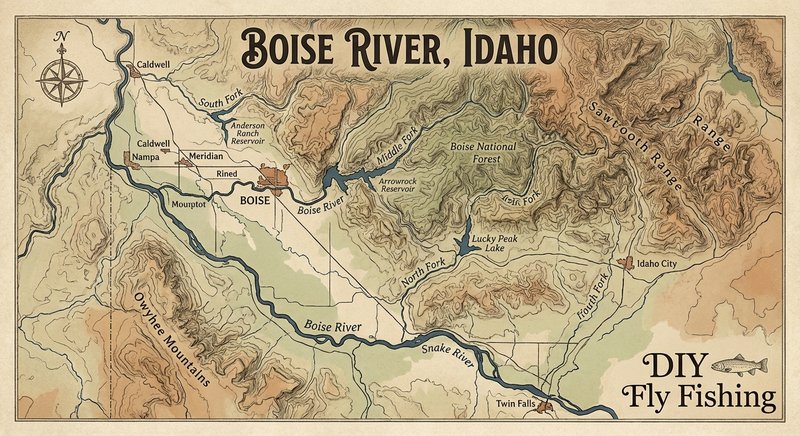
The Boise River is primarily managed as a tailwater fishery. It is divided into several distinct sections, but most fly anglers focus on two main areas:
- The South Fork (SFB): A classic, high-desert tailwater canyon below Anderson Ranch Dam known for big, powerful Rainbows.
- The Lower Boise (Town Stretch): Running from Lucky Peak Dam through the city of Boise.
What makes the Boise special is its accessibility and temperature stability. Because it is bottom-fed from reservoirs, the water stays cold in the summer and relatively warm in the winter, providing a year-round growth cycle for trout. The river features classic freestone characteristics: riffles, deep runs, cut banks, and plenty of woody debris.
🐟 Target Species & Behavior
- Rainbow Trout: These are the "workhorses" of the river. In the South Fork, they are exceptionally strong due to the heavy flows. In town, you’ll find a mix of wild fish and Idaho Fish & Game (IDFG) supplementals. They tend to hold in the "seams" (where fast and slow water meet) and at the heads of riffles.
- Brown Trout: The "Town Stretch" is legendary for its wild Brown Trout. They are nocturnal and predatory. Look for them in "frog water," under overhanging brush, or tight against the rip-rap and cut banks. They feed heavily on sculpins and smaller trout.
- Mountain Whitefish: Often overlooked but incredibly fun on light tackle, these native fish are abundant and congregate in deep winter holes.
📅 Best Times to Fish
Winter (Dec – Feb)
- Conditions: Low, clear flows.
- Window: 11:00 AM – 3:00 PM (warmest part of the day).
- Highlights: Exceptional midge fishing. This is the "technical" season.
Spring (March – May)
- Conditions: Variable. Watch for "March Brown" and Skwala Stonefly hatches.
- Window: Early afternoon.
- Note: Flows increase significantly in May for irrigation/runoff, which can make wading dangerous.
Summer (June – August)
- Conditions: High flows for irrigation.
- Window: Early morning or late evening to avoid the "floatilla" (recreational tubers in town).
- Highlights: Pale Morning Duns (PMDs) and Caddis. Terrestrial (hoppers/ants) fishing picks up in August.
Fall (Sept – Nov) — The Prime Season
- Conditions: Flows drop and stabilize. Water clarity is perfect.
- Window: All day.
- Highlights: Blue Winged Olives (BWOs) and the Brown Trout pre-spawn. The colors of the trees and the fish make this the best time to be on the water.
🪰 Recommended Flies & Techniques
Nymphing (80% of your success)
The Boise is a subsurface river. A two-fly nymph rig under an indicator or Euro-nymphing is the gold standard.
- Patterns: Zebra Midges (#18-22 in red or black), Pheasant Tails (#16-20), Pat’s Rubber Legs (orange/brown), and Perdigons (Spanish Bullet).
- Pro Tip: Use small, slim profiles. If you aren't hitting the bottom, you aren't catching fish.
Dry Fly Fishing
- Patterns: Parachute Adams (#14-22), Elk Hair Caddis (#14-16), and Stimulators. In late summer, use Morrish Hoppers or Chernobyl Ants.
- Presentation: A "dead drift" is mandatory. Use a 9ft 5x or 6x leader for the technical midges.
Streamer Fishing (For the Trophies)
- Patterns: Sex Dungeon (White or Olive), Gold Sparkle Minnows, and Sculpin Helmets.
- Technique: Swing streamers through deep pools or "strip and pause" near cut banks for big Browns.
💡 Pro Tips & Local Knowledge
- The "Greenbelt" Strategy: Use the 25-mile paved Greenbelt path to scout. If you see a spot with a deep "bucket" or a fallen log, it likely holds a Brown Trout.
- The Skwala Hatch: In late March, the South Fork sees a Skwala Stonefly hatch. It’s the first big bug of the year, and the fish lose their minds for them.
- The "Town" Secret: Don't overlook the stretch between Barber Park and Glenwood Bridge. This area gets stocked with "Steelhead" (surplus hatchery fish) in the late fall, providing a chance for a 5-10lb fish in the middle of the city.
- Watch the Gauges: Always check the USGS flows for "Boise River at Glenwood." If it's over 1,500 CFS (cubic feet per second), wading becomes very difficult and dangerous. Ideal wading is 250–600 CFS.
⚠️ Important Information
- Regulations: Rules change depending on the section. Generally, the Lower Boise (in town) allows for bait and harvesting, but most fly anglers practice Catch and Release. On the South Fork, specific gear restrictions (barbless hooks) and limit rules apply. Always check the current IDFG Season and Rules booklet.
- Safety: The Boise River has several low-head dams and "sweepers" (fallen trees). If you are floating in a drift boat or raft, know your route.
- Licenses: You can purchase an Idaho fishing license online or at many local shops (Anglers, Idaho Angler, or Lost River Outfitters).
- Ethics: During the Fall (Oct-Nov), Brown Trout spawn. Avoid walking on "redds" (light-colored gravel patches in shallow water) to protect the next generation of fish.
The Boise River is a treasure. Respect the water, keep the fish wet, and you’ll find some of the best urban trout fishing in the world. Tight lines!
Bug Hatches & Matching Flies
| Hatch | Type | Peak months | Time of day | Hook sizes | Matching flies |
|---|---|---|---|---|---|
| Blue Winged Olive (BWO) Baetis spp. | mayfly | March, April, September, October | Late Morning/Afternoon | #18-22 | Parachute Adams #18-22, RS2 #20-22, Pheasant Tail Nymph #18-20 |
| Midges Chironomidae | midge | January, February, March, December | All Day | #18-24 | Zebra Midge #18-22, Griffith's Gnat #18-22, Morgan's Midge #20-22 |
| Pale Morning Dun (PMD) Ephemerella excrucians | mayfly | June, July | Morning/Early Afternoon | #16-18 | Sparkle Dun #16-18, PMD Emerger #16-18, Frenchie #14-16 |
| Spotted Sedge / Tan Caddis Hydropsyche | caddis | June, July, August | Evening | #14-18 | Elk Hair Caddis #14-18, LaFontaine's Deep Sparkle Pupa #14-16, Goddard Caddis #14-16 |
| Skwala Stonefly Skwala americana | stonefly | March, April | Afternoon | #8-12 | Skwala Stone #10-12, Pat's Rubber Leg #8-12, Bullet Head Skwala #10-12 |
| Trico Tricorythodes spp. | mayfly | August, September | Early Morning | #20-24 | Trico Spinner #20-24, Sunken Trico Spinner #20-22, Drowned Trico #20-22 |
| Golden Stonefly Hesperoperla pacifica | stonefly | June, July | All Day/Evening | #6-10 | Chubby Chernobyl #8-12, Golden Stone Nymph #6-10, Cat Puke #8-10 |
| Terrestrials (Hoppers/Ants/Beetles) Various | terrestrial | July, August, September | Afternoon | #8-18 | Morrish Hopper #8-12, Cinnamon Ant #14-18, Black Foam Beetle #12-16 |