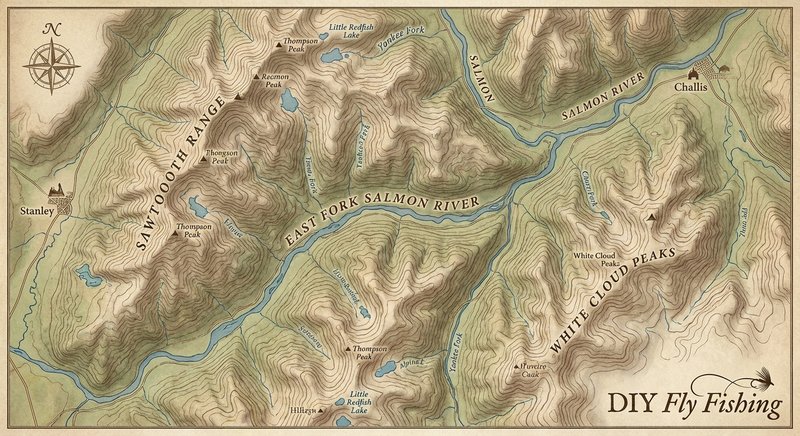
East Fork Salmon River
Fly fishing in Idaho · Intermediate · Best seasons: Summer, Fall
Target Species
Rainbow Trout, Bull Trout
About This Water
Tributary of the main Salmon with wild trout. Remote central Idaho fishing.
Fishing Recommendations
The East Fork of the Salmon River is one of Idaho’s hidden gems, carving through a dramatic landscape between the White Cloud Mountains and the Boulder Mountains. It offers a raw, high-desert canyon fishing experience that feels worlds away from the busier waters of the main Salmon or the Big Wood.
Here is your comprehensive guide to fishing the East Fork.
🎣 Location Overview
The East Fork is a major tributary of the Salmon River, located southeast of Stanley and southwest of Challis. What makes this water special is its transition from high-alpine meadows to rugged, basalt-walled canyons.
The river is characterized by "pocket water"—a classic freestone environment filled with boulders, plunge pools, and short, fast runs. Because it is less frequented than the main Salmon, the fish are often less pressured and more willing to rise to a well-presented dry fly. The scenery is world-class, featuring jagged peaks and sagebrush-covered hillsides where you’re as likely to see an elk or a mountain goat as another angler.
🐟 Target Species & Behavior
While the East Fork holds several species, the primary draws for the fly angler are:
- Rainbow and Westslope Cutthroat Trout: You will find a mix of wild Rainbows and Westslope Cutthroats (and their hybrids, "Cutbows"). These fish are opportunistic. In the fast water, they have a split second to decide to eat, so they strike aggressively. They hold in the "cushion" in front of boulders, the seams on the sides, and the tail-outs of pools.
- Bull Trout: These are the apex predators of the system. They are migratory and can reach impressive sizes (20–30 inches). They are piscivorous (fish-eaters) and tend to hold in the deepest, darkest holes or at the mouths of cold-water tributaries.
- Mountain Whitefish: Plentiful and often very large. They congregate in the deeper riffles and are excellent sport on light nymph rigs.
📅 Best Times to Fish
Summer (July – August)
- Conditions: This is the prime window. Runoff typically recedes by late June or early July.
- Time of Day: Mid-morning until dusk. The canyon walls provide shade in the late afternoon, which can trigger prolific hatches.
- Window: July is peak for stoneflies and mayflies; August is the "Hopper" month.
Fall (September – October)
- Conditions: Water levels are low and crystal clear. The cottonwoods turn gold, and the crowds disappear.
- Time of Day: 11:00 AM to 4:00 PM. The water needs to warm up slightly to get the bugs moving.
- Window: This is the best time for Bull Trout as they move through the system, and for technical dry fly fishing with small BWO (Blue Winged Olive) patterns.
🪰 Recommended Flies & Techniques
Dry Flies (The "Main Event")
- Attractors: Chubby Chernobyl (Size 8-12) in gold, orange, or purple. Stimulators (Size 10-14).
- Terrestrials: Morrish Hopper, Panty Dropper Hopper, or any foam ant/beetle pattern.
- Mayflies/Caddis: Parachute Adams (14-18), Elk Hair Caddis (12-16), and PMDs.
Nymphs (For the Deep Slots)
- Trailers: Use a "Hopper-Dropper" rig. Hang a Bead-head Prince Nymph, Copper John, or Pheasant Tail (Size 14-16) about 2–3 feet below your large dry fly.
- Stonefly Nymphs: Large Pat’s Rubber Legs in coffee/black are essential for deeper runs.
Streamers (For Bull Trout)
- Patterns: Large, articulated streamers like the Sex Dungeon or Galloup's Bottom Feeder in white, olive, or black.
- Technique: Swing these through deep pools or strip them aggressively through "fishy" looking undercut banks.
💡 Pro Tips & Local Knowledge
- The "Pocket Water" Approach: Don't spend too much time in one spot. The East Fork is about coverage. High-stick your rod and keep as much line off the water as possible to avoid "drag" in the complex currents.
- Bull Trout Etiquette: Bull Trout are a protected species in Idaho. If you hook one, keep it in the water, use barbless hooks, and release it immediately. Targeting them specifically is legal in some areas but restricted in others—always check the current year’s IDFG manual.
- The Lower Canyon vs. Upper Meadows: The lower sections (near the confluence with the Main Salmon) are canyon-like and rugged. The upper sections (near the Sawtooth National Forest boundary) flatten out into beautiful meadow bends where the water slows down—perfect for sight-casting to rising trout.
- Stealth Matters: Because the water is so clear, especially in the fall, wear natural-colored clothing (tan/green) and avoid "lining" the fish with a heavy fly line splash.
⚠️ Important Information
- Access: Much of the East Fork is flanked by the East Fork Road. While there is a lot of BLM and National Forest land, there are also significant private ranch holdings. Look for "Public Access" signs and respect "No Trespassing" markers.
- Regulations: Idaho Department of Fish and Game (IDFG) rules apply. The Salmon River drainage often has specific rules regarding barbless hooks and bait. Note: All Bull Trout are catch-and-release only.
- Safety: This is remote country. Cell service is non-existent once you turn off the main highway. Carry a spare tire, plenty of water, and bear spray (both black bears and the occasional grizzly roam this corridor).
- Rattlesnakes: The lower canyon sections are prime rattlesnake habitat in the summer. Watch your step when hiking between holes.
Guide’s Final Word: The East Fork isn't a place where you go to catch 50 fish a day; it’s a place where you go to experience the solitude of Idaho and the thrill of a wild trout smashing a terrestrial in a remote canyon. Bring your 5-weight for the rainbows and an 8-weight if you're hunting for the "ghosts" (Bull Trout).
Bug Hatches & Matching Flies
| Hatch | Type | Peak months | Time of day | Hook sizes | Matching flies |
|---|---|---|---|---|---|
| Salmonfly Pteronarcys californica | stonefly | June, July | All day | #4-8 | Rogue River Stone #4-6, Pats Rubber Legs #6-8, Chubby Chernobyl (Orange) #6-8 |
| Golden Stonefly Hesperoperla pacifica | stonefly | July | Morning/Afternoon | #8-12 | Norm Wood Special #8-10, Golden Pat's Rubber Legs #8-12, Half-Back Stone #10-12 |
| Western Green Drake Drunella doddsii | mayfly | July | Afternoon | #10-12 | Green Drake Sparkle Dun #10-12, Quigley's Green Drake Hackle Stacker #10-12, Drake Cripple #12 |
| Pale Morning Dun (PMD) Ephemerella excrucians | mayfly | July, August | Late Morning/Early Afternoon | #16-18 | PMD Parachute #16-18, Pheasant Tail #16-18, RS2 (PMD Color) #16-18 |
| Blue Winged Olive (BWO) Baetis tricaudatus | mayfly | April, May, September, October | Mid-day | #18-22 | BWO Sparkle Dun #18-20, Baetis Barr Emerger #20-22, JujuBaetis #18-22 |
| Spotted Sedge Hydropsyche | caddis | July, August, September | Evening | #14-18 | Elk Hair Caddis (Tan) #14-16, LaFontaine's Deep Sparkle Pupa #14-18, Godzilla Caddis #14-16 |
| Yellow Sally Isoperla | stonefly | July, August | Afternoon/Evening | #14-16 | Yellow Sally Parachute #14-16, Little Yellow Sloan #14-16, Iron Lotus (Yellow) #16 |
| Western Grasshopper Melanoplus | terrestrial | August, September | Late Morning/Afternoon | #8-12 | Morrish Hopper (Tan) #10-12, Parachute Hopper #12, Letort Hopper #10-14 |
| Trico Tricorythodes | mayfly | August, September | Early Morning | #20-24 | Trico Spinner #20-24, Drowned Trico Spinner #22, CDC Trico Dun #20-22 |