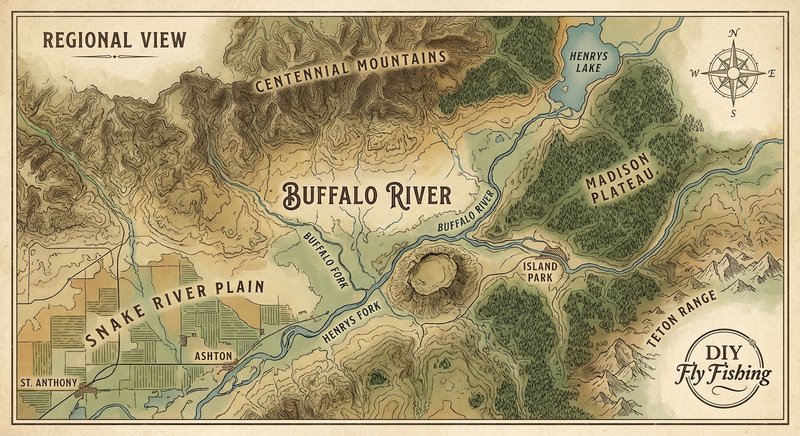
Buffalo River
Fly fishing in Idaho · Beginner · Best seasons: Summer, Fall
Target Species
Rainbow Trout, Brook Trout
About This Water
Near Island Park with rainbow and brook trout. Gateway to Yellowstone fishing.
Fishing Recommendations
Welcome to one of the most charming and unique spring-fed systems in the Rocky Mountain West. As your guide, I’m excited to walk you through the Buffalo River.
Located in the Island Park area of Eastern Idaho, the Buffalo is a major tributary to the Henry’s Fork of the Snake River. While it is a short river, it is a vital spawning ground and a "sanctuary" stream that offers a different pace than the big water of the Henry's Fork.
🎣 Location Overview
The Buffalo River is a classic spring creek that originates from a series of massive springs bubbling out of the ground near the base of Sawtell Peak. Because it is spring-fed, the water remains a constant, cool temperature year-round and stays remarkably clear even when other rivers are "blown out" by snowmelt or rain.
The river meanders through lush meadows and lodgepole pine forests before dropping over a small dam into the Henry's Fork near Mack’s Inn. It is characterized by deep, slow-moving glassy pools, undercut banks, and thick beds of aquatic vegetation (elodea and ranunculus). This is "technical" water; the fish see everything, and the slow current requires a perfect drift.
🐟 Target Species & Behavior
The Buffalo River is a gem for those seeking variety in a small-water setting.
- Rainbow Trout: These are the primary residents. You’ll find small to medium-sized residents (8–12 inches) year-round, but in the late summer and fall, massive "bows" move up from the Henry’s Fork to find cooler water or prepare for spawning cycles.
- Brook Trout: The Buffalo holds a very healthy population of Brookies, especially in the upper reaches and the "Ponds" area. In the fall, these fish take on spectacular spawning colors (deep oranges and reds).
- Behavior: These fish are highly "surface-oriented" due to the massive insect biomass in the spring water. However, they are incredibly "spooky." If they see your shadow or a heavy splash, they will dive into the weed beds and stay there for an hour.
📅 Best Times to Fish
Optimal Seasons
- Summer (July – August): This is the prime window for dry fly action. When the heat of July hits, the Buffalo stays cool, making it a refuge for trout.
- Fall (September – October): My personal favorite. The crowds thin out, the Brook Trout are aggressive and colorful, and the larger Rainbows begin to move into the system from the Henry's Fork.
Best Times of Day
- Morning (9 AM – 12 PM): Great for Trico and Baetis hatches.
- Late Afternoon/Evening: This is the "Golden Hour" on the Buffalo. The wind usually dies down, and the "spent wing" spinner falls can cover the water, creating a feeding frenzy.
🪰 Recommended Flies & Techniques
Because the water is so clear and slow, your gear and presentation are more important than the specific fly.
Top Fly Patterns
- Dry Flies:
- Hoppers/Terrestrials: Fat Albert (size 12), Dave’s Hopper, or Foam Beetles and Ants (size 16-18) during August.
- Mayflies: Parachute Adams (size 18-22), CDC Blue Winged Olive, and Tricos.
- Nymphs:
- Scuds: Since it’s a spring creek, Scuds are the primary food source. Use Olive or Orange Scuds (size 16-18).
- Midges: Zebra Midges (Black or Red, size 20).
- Streamers:
- Small Olive Woolly Buggers or Pine Squirrel Leeches. These work wonders for the Brookies in the deeper holes.
Presentation Tips
- The Reach Cast: You must learn to cast across the current and "reach" your rod tip upstream to prevent the fly line from dragging your fly faster than the current.
- Light Tackle: Use a 3-weight or 4-weight rod with a long leader (12–15 feet) tapering down to 6X or 7X tippet. If you use 4X, these fish will likely ignore you.
💡 Pro Tips & Local Knowledge
- The Buffalo Campground Stretch: The river runs right through the Forest Service campground. This area is easily accessible and holds surprisingly good fish. Focus on the undercut banks on the opposite side of the walking paths.
- The "Fish Ladder": Near the confluence with the Henry's Fork, there is a fish ladder. This area often holds the largest fish in the river as they transition between systems.
- Stealth is Mandatory: Do not wade if you don't have to. The vibrations from walking in the water will alert fish 50 feet away. Stay on the bank, keep a low profile (kneeling helps), and wear drab-colored clothing to blend in with the pines.
- Target the "Buckets": Look for light-colored sandy patches in the middle of dark weed beds. These "buckets" are where trout sit to intercept nymphs.
⚠️ Important Information
- Access: Much of the river is accessible via the Buffalo Campground (Highway 20 near Island Park). There is also access at the Forest Service bridge on the way to Sawtell Peak.
- Regulations: Idaho fishing regulations apply. A standard Idaho fishing license is required. Note that certain sections near the dam may have specific seasonal closures to protect spawning fish—always check the current IDFG seasons and rules.
- Wildlife: This is Grizzly Bear and Moose country. Always carry bear spray, especially if you are bushwhacking into the upper sections away from the campground.
- Respect the Vegetation: The weed beds are the lungs of this river. Try not to trample them while wading, as they house the insects the fish depend on.
Guide’s Final Word: The Buffalo isn't a river where you'll catch 50 fish a day, but it's a river that will make you a better angler. It rewards patience, stealth, and a delicate touch. Tight lines!
Bug Hatches & Matching Flies
| Hatch | Type | Peak months | Time of day | Hook sizes | Matching flies |
|---|---|---|---|---|---|
| Midges Chironomidae | midge | January, February, March, April | Late Morning to Afternoon | #18-24 | Zebra Midge #18-22, Griffith's Gnat #20-24, Morgan's Midge #20-22 |
| Blue-Winged Olive Baetis | mayfly | March, April, September, October | Mid-day (Cloudy days) | #16-22 | BWO Sparkle Dun #18-20, Pheasant Tail #18-20, RS2 #18-22 |
| Pale Morning Dun Ephemerella excrucians | mayfly | June, July, August | Late Morning to Early Afternoon | #14-18 | PMD Parachute #16-18, Split Case PMD #16-18, Rusty Spinner #16-18 |
| Spotted Sedge Hydropsyche | caddis | June, July | Late Afternoon/Evening | #14-18 | Elk Hair Caddis #14-16, LaFontaine's Deep Sparkle Pupa #14-18, X-Caddis #16-18 |
| Tricos Tricorythodes | mayfly | August, September | Early Morning | #20-24 | Trico Spinner #20-24, Trico Parachute #20-22 |
| Terrestrials (Ants and Beetles) Formicidae / Coleoptera | terrestrial | July, August, September | Late Morning to Evening | #12-18 | Cinnamon Ant #14-18, Black Beetle #12-16, Chernobyl Ant #8-12 |
| Yellow Sally Isoperla | stonefly | June, July | Afternoon/Evening | #14-16 | Yellow Sally Parachute #14-16, Little Yellow Sloan #14-16 |
| Brown Drake Ephemera simulans | mayfly | June | Late Evening/Dusk | #10-12 | Brown Drake Cripple #10-12, Brown Drake Spinner #10-12 |