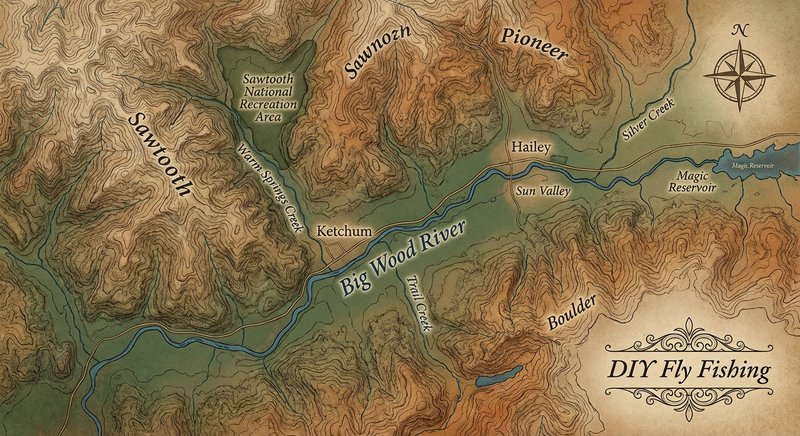
Big Wood River
Fly fishing in Idaho · Beginner · Best seasons: Summer, Fall
Target Species
Rainbow Trout, Brown Trout
About This Water
Flowing through Sun Valley, this river offers excellent fishing with beautiful mountain scenery and easy access.
Fishing Recommendations
As your guide for the Big Wood River in south-central Idaho, I can tell you that this is one of the most beloved freestone rivers in the Rocky Mountains. Flowing through the Wood River Valley past the towns of Ketchum, Sun Valley, Hailey, and Bellevue, "The Wood" offers classic western fly fishing with exceptional dry fly opportunities.
🎣 Location Overview
The Big Wood River is a high-desert freestone stream characterized by its crystal-clear water, cobble bottom, and classic riffle-run-pool structure. What makes it special is its accessibility and the sheer density of fish. Unlike the slow-moving spring creeks nearby (like Silver Creek), the Big Wood is punchy and athletic.
Anglers love it because it is a "working man’s" river—you can park your car at a public access point and find productive water within a five-minute walk. It feels intimate, yet it holds surprisingly large fish for its size. The backdrop of the Smoky and Pioneer Mountains makes every cast feel like a postcard.
🐟 Target Species & Behavior
- Rainbow Trout: These are the primary residents. They are wild, hard-fighting, and incredibly opportunistic. In the faster water, they are not particularly leader-shy but require a dead drift.
- Brown Trout: Found more frequently in the lower sections (below Hailey) where the water slows and deepens. They are more nocturnal and predatory, often lurking under undercut banks or in deep woody debris.
Behavior: These fish are highly keyed into surface activity. Because it is a freestone river with limited nutrients compared to a tailwater, the fish are eager to look up. They hold in "textbook" spots: the heads of pools, the seams where fast and slow water meet, and behind large boulders.
📅 Best Times to Fish
Optimal Seasons
- Summer (Late June – August): This is prime time. Once the spring runoff subsides (usually by late June), the river becomes a dry-fly paradise. The Green Drake hatch in late June/early July is legendary.
- Fall (September – October): My personal favorite. The crowds thin out, the Cottonwoods turn gold, and the fish feed aggressively before winter. You’ll see prolific Trico and Blue Winged Olive (BWO) hatches.
Best Times of Day
- Summer: Early morning for nymphing; evening (the "magic hour") for caddis and spinner falls.
- Fall: Mid-morning to late afternoon. There is no need to be on the water at dawn; wait for the sun to warm the water and trigger insect activity.
🪰 Recommended Flies & Techniques
Top Fly Patterns
- Dries:
- Green Drake: Quigley’s Cripple or Sparkle Dun (#10-12).
- Caddis: Elk Hair Caddis or Peacock Caddis (#14-18).
- Terrestrials: Parachute Hoppers, foam ants, and beetles (August/September).
- Attractors: Stimulators and Royal Wulffs.
- Nymphs:
- The "Wood River Special": Red or Copper John (#14-18).
- Classic: Zebra Midge (#18-22), Pheasant Tail (#14-18), and Pat’s Rubber Legs (for high water).
- Streamers:
- Wooly Buggers (Olive/Black) or small Sculpin patterns for the deeper holes near Bellevue.
Effective Techniques
- Dry-Dropper: The gold standard here. A high-visibility hopper or stimulator with a small beaded nymph (like a Zebra Midge) 18–24 inches below it.
- Short-Line Nymphing: Because the river is full of pockets, a long cast usually results in drag. High-sticking or Euro-nymphing the pocket water is deadly.
- Skittering: During the evening caddis hatch, don’t be afraid to give your dry fly a little twitch to mimic an egg-laying adult.
💡 Pro Tips & Local Knowledge
- The "Hailey Shuffle": When you walk through the river, you kick up nymphs. Fish will often move downstream of you to grab the drift. While "shuffling" on purpose is frowned upon, it highlights how important it is to fish the water below a disturbed area.
- Watch the Banks: In the late summer, the biggest rainbows often sit inches from the bank under overhanging grass waiting for grasshoppers. Don't wade into the river until you've fished the edges.
- Go Small in the Fall: By September, the fish have seen every #12 fly in the box. Switch to 6X tippet and #20-22 Tricos or BWOs to fool the veterans.
- Hidden Stretches: Most people fish the Ketchum area. For bigger fish and fewer crowds, explore the stretches between Hailey and Bellevue, but be prepared for more technical wading and thicker brush.
⚠️ Important Information
Access
Idaho has excellent stream access laws. You can fish anywhere below the high-water mark, but you must enter through public access points (bridges, marked BLM/Forest Service trailheads).
Regulations & Permits
- License: An Idaho fishing license is required (available online or at local shops like Silver Creek Outfitters or Lost River Outfitters).
- Barbless Hooks: Most of the river is catch and release only or has very specific slot limits. Most local guides and conservationists strongly advocate for barbless hooks and keeping the fish in the water.
- Wading: The rocks are notoriously slick (rhyolite and basalt). Studded wading boots and a wading staff are highly recommended, especially for the swifter sections in Ketchum.
Special Considerations
Keep an eye on water temperatures in late July. If the water hits 70°F, stop fishing to protect the trout. Also, be "Bear Aware"—while rare right in town, black bears frequent the river corridors in the fall looking for berries.
Bug Hatches & Matching Flies
| Hatch | Type | Peak months | Time of day | Hook sizes | Matching flies |
|---|---|---|---|---|---|
| Western Green Drake Drunella grandis | mayfly | June, July | Afternoon | #10-12 | Green Drake Sparkle Dun #10-12, Hares Ear Nymph #10-12, Quigley Critical Weight Drake #10-12 |
| Blue Winged Olive (BWO) Baetis tricaudatus | mayfly | March, April, September, October | Late Morning/Afternoon | #18-22 | RS2 #20-22, Parachute Adams #18-22, Pheasant Tail Nymph #18-20 |
| Pale Morning Dun (PMD) Ephemerella invaria | mayfly | June, July, August | Morning/Early Afternoon | #16-18 | PMD Sparkle Dun #16-18, Split Case PMD #16-18, Trigger Finger PMD #16 |
| Trico Tricorythodes | mayfly | August, September | Morning | #20-24 | Trico Spinner #20-24, Sunken Trico Spinner #22, Drowned Trico #20-22 |
| Spotted Sedge / Cased Caddis Hydropsyche | caddis | July, August | Evening | #14-18 | Elk Hair Caddis #14-18, LaFontaine's Deep Sparkle Pupa #16, Godzilla Caddis #14-16 |
| Golden Stonefly Hesperoperla pacifica | stonefly | June, July | All Day | #8-12 | Pat's Rubber Leg #8-12, Chubby Chernobyl (Gold) #8-12, Cat Puke #10-12 |
| Yellow Sally Isoperla | stonefly | July, August | Afternoon/Evening | #14-16 | Yellow Sally Stimulator #14-16, Iron Lotus #16, Sally Girl #14-16 |
| Western March Brown Rhithrogena morrisoni | mayfly | April, May | Afternoon | #12-14 | March Brown Dun #12-14, Gold Ribbed Hare's Ear #12-14, Soft Hackle March Brown #14 |
| Midges Chironomidae | midge | January, February, March, December | Late Morning | #20-24 | Zebra Midge #20-22, Griffith's Gnat #20-24, Morgan's Midge #22 |
| Terrestrials Orthoptera / Formicidae | terrestrial | August, September | All Day | #10-18 | Morrish Hopper #10-14, Cinnamon Ant #16-18, Black Beetle #14-16 |