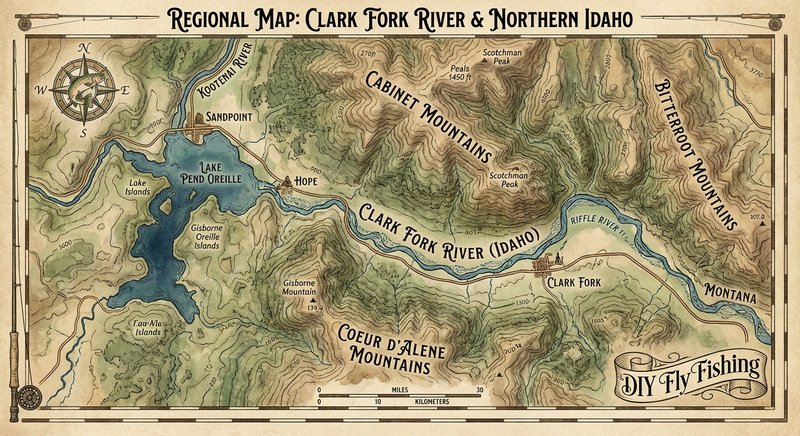
Clark Fork River (Idaho)
Fly fishing in Idaho · Intermediate · Best seasons: Spring, Summer, Fall
Target Species
Rainbow Trout, Brown Trout
About This Water
Below Lake Pend Oreille with large rainbow and brown trout. Recovering fishery with big fish potential.
Fishing Recommendations
The Clark Fork River in Idaho is a powerful, big-water fishery that serves as the primary artery flowing into Lake Pend Oreille. While the Montana side is famous for its long riffles and dry fly banks, the Idaho section—stretching from Cabinet Gorge Dam to the delta at the lake—is a different beast entirely. It is a world of deep plunges, massive eddies, and some of the largest "adfluvial" (lake-migrating) trout in the Pacific Northwest.
🎣 Location Overview
The Idaho reach of the Clark Fork is relatively short (roughly 15 miles), but it carries an immense volume of water. Flanked by the Cabinet and Bitterroot Mountains, the scenery is dramatic.
What makes this water special is its connection to Lake Pend Oreille. Unlike most rivers where the trout live their entire lives in the current, many of the fish here move back and forth between the deep, nutrient-rich lake and the river. This results in Rainbows and Browns that are exceptionally thick, powerful, and often reach "trophy" proportions. It is primarily a "big boat" river; while some wading is possible, it is best navigated by drift boat or a jet boat due to its size and depth.
🐟 Target Species & Behavior
- Rainbow Trout: Expect hard-fighting fish, often displaying the "Kamloops" genetics common in the region. They hold in the heavy riffles during the summer and move into the slower, deeper "seams" during the shoulder seasons.
- Brown Trout: The Clark Fork holds some truly monstrous Brown Trout. These are predatory and secretive. They tend to hold tight to wood debris, undercut banks, and deep rock walls. They are most active during low-light conditions and the fall spawning run.
- Westslope Cutthroat: While you asked for Rainbows and Browns, you will catch beautiful, native Cutthroats here, often rising to dry flies in the back-eddies.
- Bull Trout: You may encounter these (they are protected); they must be released immediately without being removed from the water.
📅 Best Times to Fish
- Spring (March – April): Before the snowmelt hits, the Skwala Stonefly hatch is the first major event. This is the best time for early-season dry fly action.
- Summer (July – August): Once the spring runoff subsides, the river stabilizes. This is the time for terrestrial fishing (hoppers/ants) and late-evening caddis hatches. The water stays cooler here than in Montana due to the depth and dam release.
- Fall (September – October): This is "Trophy Season." As the lake-run Browns move into the river to spawn and the Rainbows follow to eat eggs, the streamer fishing becomes world-class.
- Prime Window: Early morning for Browns; mid-afternoon for hatch-driven surface activity.
🪰 Recommended Flies & Techniques
Dry Flies
- Skwalas (Spring): Size 8-10 Olive Bullet Head Skwala.
- Terrestrials (Summer): Chubby Chernobyls (Gold/Pink), Morrish Hoppers, and Carpenter Ants.
- Mayflies/Caddis: Purple Haze (size 14-16), Elk Hair Caddis (Tan), and Tilt-Wing PMDs.
Nymphs
- The "Bread & Butter": Pat’s Rubber Legs (Black/Olive or Brown/Orange).
- Attractors: Prince Nymphs, San Juan Worms (especially after rain), and Perdigons for fast-sinking action in deep slots.
Streamers (The Local Favorite)
- Patterns: Galloup’s Dungeon (White or Olive), Sparkle Minnows, and any pattern mimicking a Kokanee salmon or a sculpin.
- Technique: "Bank Banging." Cast heavy sink-tip lines toward the shore, logs, or rock faces and strip aggressively.
💡 Pro Tips & Local Knowledge
- Watch the Flows: The river is controlled by Cabinet Gorge Dam. Flows can fluctuate wildly based on power demand. Check the Avista Utilities flow site before heading out. High flows make wading dangerous; low flows can expose tricky rock bars for boats.
- The "Reverse" Eddy: Because the Clark Fork is so large, it creates massive circular eddies. Fish often sit in these eddies facing downstream because the current is actually moving back up-river. Treat these like small lakes within the river.
- The Delta: The area where the river enters Lake Pend Oreille is a maze of channels. This is a prime spot for big Browns to ambush baitfish. If the main river is too heavy, explore the slower water of the delta.
- The "Two-Fly" Rig: Always run a "Hopper-Dropper" in the summer. A big foam hopper with a small beaded nymph 3 feet below is the most consistent producer for Rainbows.
⚠️ Important Information
- Access: Primary boat ramps include Johnson Creek, Foster Bar, and the Denton Slough area. Wading access is available near the Cabinet Gorge Dam (below the bridge) and at various pull-offs along Highway 200, but be extremely careful of rising water levels.
- Regulations: Idaho fishing regulations are specific. Barbless hooks are highly recommended for easy release. Note that certain sections may have "no-kill" rules or specific season dates for certain species. Always check the current Idaho Fish & Game (IDFG) booklet.
- Safety: This is a high-volume river. Cold water and powerful undercurrents make life jackets a must for boaters. If wading, never venture deeper than your knees unless you are certain the flow is stable.
- Invasive Species: Clean, drain, and dry your gear. This region is under high alert for quagga/zebra mussels.
Bug Hatches & Matching Flies
| Hatch | Type | Peak months | Time of day | Hook sizes | Matching flies |
|---|---|---|---|---|---|
| Skwala Stonefly Skwala americana | stonefly | March, April | Midday | #8-12 | Skwala Chubby Chernobyl #10-12, Pat's Rubber Leg #8-12, Olive Bullet Skwala #12 |
| March Brown Rhithrogena morrisoni | mayfly | April, May | Afternoon | #12-14 | March Brown Western Red #12-14, Hare's Ear Nymph #12-14, March Brown Cripple #14 |
| Blue Winged Olive Baetis | mayfly | April, May, September, October | Midday/Afternoon | #16-20 | RS2 #18-20, Parachute Adams #16-20, Pheasant Tail Nymph #16-20 |
| Salmonfly Pteronarcys californica | stonefly | June | All Day | #4-8 | Cat Puke #4-6, Fluttering Salmonfly #6-8, Bitch Creek Nymph #4-8 |
| Pale Morning Dun Ephemerella excrucians | mayfly | June, July, August | Morning/Early Afternoon | #16-18 | PMD Sparkle Dun #16-18, Split Case PMD #16-18, Last Chance Cripple #16-18 |
| Spotted Sedge Hydropsyche | caddis | June, July, August | Evening | #14-18 | Elk Hair Caddis #14-16, LaFontaine's Deep Sparkle Pupa #14-16, X-Caddis #14-18 |
| Trico Tricorythodes | mayfly | July, August, September | Early Morning | #20-24 | Trico Spinner #20-22, Sunken Trico Spinner #20-22, Drowned Trico #20-22 |
| Mahogany Dun Paraleptophlebia | mayfly | September, October | Afternoon | #16-18 | Mahogany Sparkle Dun #16-18, Mahogany Parachute #16-18, Pheasant Tail #16-18 |
| Grasshoppers Acrididae | terrestrial | August, September | Late Morning/Afternoon | #8-12 | Morrish Hopper #8-12, Rainy's Grand Hopper #10-12, Parachute Hopper #10-14 |