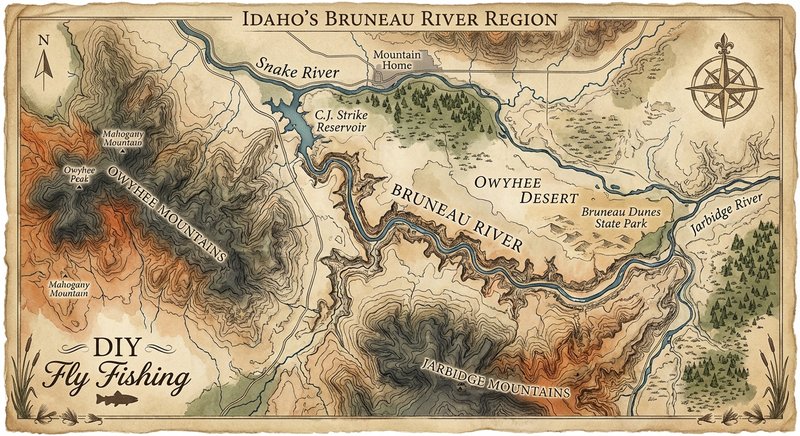
Bruneau River
Fly fishing in Idaho · Intermediate · Best seasons: Spring, Summer, Fall
Target Species
Smallmouth Bass, Rainbow Trout
About This Water
Desert canyon river with smallmouth bass. Remote southwestern Idaho fishing adventure.
Fishing Recommendations
The Bruneau River is one of the most rugged, remote, and visually stunning fly fishing destinations in the American West. Carving a deep, jagged basalt canyon through the high desert of the Owyhee Plateau in Southwest Idaho, it offers a true wilderness experience for those willing to work for their fish.
Here is your comprehensive guide to fly fishing the Bruneau.
🎣 Location Overview
The Bruneau River is defined by its isolation. Running through the Bruneau-Jarbidge Rivers Wilderness, the river flows through canyons that reach depths of 800 feet. It is a "freestone" system, meaning its flows are entirely dependent on snowpack and rainfall, making it highly seasonal.
What makes it special is the transition of ecosystems. The upper reaches and the West/East forks offer classic high-desert trout water, while the lower reaches—as the canyon opens up toward C.J. Strike Reservoir—become a premier destination for aggressive Smallmouth Bass. This is not a "manicured" fishing experience; it is a raw, boulder-choked, and physically demanding river that rewards adventurous anglers.
🐟 Target Species & Behavior
Rainbow Trout (Interior Redband)
- Behavior: These are native Redband trout, known for their resilience in warmer water and incredible fighting spirit. They are opportunistic feeders because food in the desert can be scarce.
- Where they hold: Look for them in the oxygenated "bubbles" at the head of pools, behind large basalt boulders, and in the deep undercut banks of the canyon walls.
- Diet: Stoneflies, caddis, and terrestrial insects (grasshoppers/ants) during the summer months.
Smallmouth Bass
- Behavior: The lower Bruneau is a Smallmouth factory. These fish are highly competitive and will often chase streamers or topwater poppers with reckless abandon.
- Where they hold: Bass prefer the slower, warmer water of the lower canyon. Look for "slack water" eddies, submerged rocky ledges, and the tail-outs of long pools.
- Diet: Crayfish are the primary protein source here, followed by sculpins and damselflies.
📅 Best Times to Fish
- Spring (Late April – June): This is primarily the "Float Season" for rafters. Fishing can be excellent if the runoff isn't too high. Look for the Salmonfly hatch in late May/early June—it is legendary but short-lived.
- Summer (July – September): The "Prime Window" for the lower river Smallmouth. As the water drops and warms, the bass become extremely active. For trout, head higher up the drainage where the water remains cooler.
- Fall (September – October): Perhaps the best time for a "Grand Slam" (Trout and Bass). The air cools, the crowds (already small) vanish, and the fish feed heavily before winter.
- Time of Day: In the heat of summer, the "Golden Hour" (first and last two hours of light) is critical. The canyon shadows provide relief for the fish, bringing them out of the deep pockets to feed on the surface.
🪰 Recommended Flies & Techniques
For Smallmouth Bass
- Topwater: Boogle Bugs, Murdich Minnows, or foam poppers in yellow, chartreuse, or black.
- Sub-surface: Crayfish patterns (Clouser Crayfish, Near Nuff Crayfish) are essential.
- Streamers: Woolly Buggers (olive/black) and Sparkle Minnows.
- Technique: "Swing and Strip." Cast toward the bank, let the fly sink near the rocks, and use aggressive, erratic strips.
For Redband Trout
- Dry Flies: Chubby Chernobyls (Size 8-12), Morrish Hoppers, and Elk Hair Caddis.
- Nymphing: Pat’s Rubber Legs (stonefly nymph) followed by a Copper John or Pheasant Tail dropper.
- Technique: "Hopper-Dropper" is the gold standard here. The high-buoyancy dry fly helps you track your fly in the turbulent pocket water while the nymph gets down to the fish.
💡 Pro Tips & Local Knowledge
- The "Basalt Bounce": When fishing for Smallmouth, don't be afraid to bounce your crayfish patterns right off the canyon walls into the water. The vibration often triggers an immediate strike from bass waiting in the shadows.
- Hike-In Access: Most of the river is inaccessible by car. For the best fishing, use the Black Rock Crossing or Indian Hot Springs access points. Be prepared for steep, rocky descents.
- Water Levels are Key: Always check the USGS gauge for "Bruneau River near Hot Springs." If it’s over 1,000 CFS, it’s a whitewater river (dangerous for wading). For the best fishing, you want it dropping below 500–300 CFS.
- The "Bass-Trout Line": Generally, the further south (upstream) you go toward the Nevada border, the more trout you'll find. The further north (downstream) toward the town of Bruneau, the more bass-dominant it becomes.
⚠️ Important Information
Access & Logistics
- High Clearance/4WD Required: The roads to access the canyon (like the road to Indian Hot Springs) are notorious for shredding tires. Bring two spares and high-clearance 4WD.
- Self-Sufficiency: There is zero cell service and no services for 50+ miles. Carry extra fuel, water, and a first-aid kit.
Regulations & Permits
- Licensing: An Idaho fishing license is required.
- Specific Rules: Follow general Southwest Region rules. Note that some sections may have "Barbless Hook" or "Catch and Release" restrictions depending on the specific wilderness management year—always check the current Idaho Fish & Game Booklet.
Safety Considerations
- Rattlesnakes: The Bruneau Canyon is prime rattlesnake habitat. Watch your step, especially when climbing over basalt talus slopes.
- Heat: Summer temps can exceed 100°F. Hydrate aggressively.
- Flash Floods: Be aware of weather upstream; desert canyons can flood rapidly during summer thunderstorms.
Guide’s Final Word: The Bruneau is a "quality over quantity" river. You may not catch 50 fish a day, but the fish you do catch will be wild, beautiful, and set against one of the most dramatic backdrops in the United States. Respect the desert, and it will reward you.
Bug Hatches & Matching Flies
| Hatch | Type | Peak months | Time of day | Hook sizes | Matching flies |
|---|---|---|---|---|---|
| Salmonfly Pteronarcys californica | stonefly | May, June | All Day | #4-8 | Sofa Pill #4-8, Pat's Rubber Legs #4-8, Chubby Chernobyl #6-10 |
| Golden Stonefly Hesperoperla pacifica | stonefly | June, July | Afternoon/Evening | #8-12 | Golden Stimulator #8-12, 20 Incher #8-12 |
| Blue Winged Olive Baetis | mayfly | March, April, October, November | Late Morning/Afternoon | #18-22 | Parachute Adams #18-22, Pheasant Tail #18-20, RS2 #20-22 |
| Pale Morning Dun Ephemerella inermis | mayfly | June, July | Late Morning | #14-18 | Sparkle Dun #14-18, PMD Crack Back #16-18 |
| Spotted Sedge Hydropsyche | caddis | June, July, August | Evening | #14-18 | Elk Hair Caddis #14-16, LaFontaine's Deep Sparkle Pupa #14-18 |
| Yellow Sally Isoperla spp. | stonefly | June, July | Afternoon | #14-16 | Yellow Sally Foam #14-16, Iron Lotus #16 |
| Grasshoppers Orthoptera | terrestrial | July, August, September | Midday | #6-12 | Morrish Hopper #8-12, Dave's Hopper #10-12 |
| Trico Tricorythodes | mayfly | August, September | Early Morning | #20-24 | Trico Spinner #20-24, Zebra Midge #20-22 |