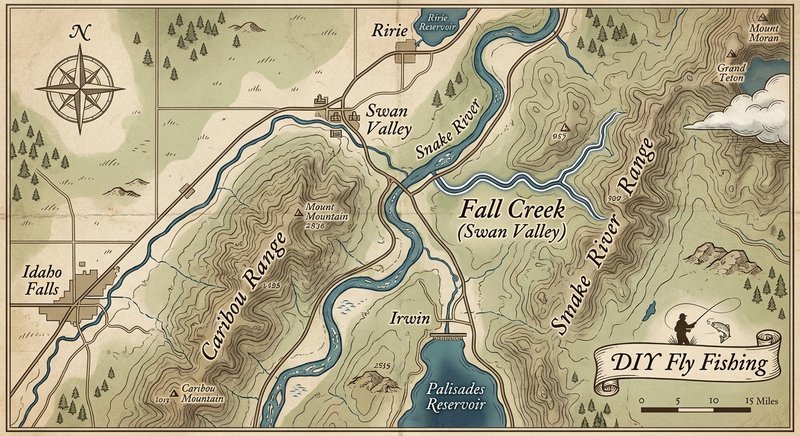
Fall Creek (Swan Valley)
Fly fishing in Idaho · Beginner · Best seasons: Summer, Fall
Target Species
Cutthroat Trout, Rainbow Trout
About This Water
Near Swan Valley with cutthroat and rainbow trout. Beautiful eastern Idaho fishing.
Fishing Recommendations
Welcome to one of the most picturesque small-stream gems in the Greater Yellowstone Ecosystem. As your guide, I’m excited to break down Fall Creek. Located in the scenic Swan Valley of Southeast Idaho, this tributary of the South Fork of the Snake River is famous for its dramatic waterfall at the confluence, but for the intrepid angler, the real magic lies upstream in the canyon.
🎣 Location Overview
Fall Creek is a classic freestone mountain stream that winds through tight canyons, lush meadows, and timbered pockets before plunging over a massive travertine curtain into the South Fork of the Snake River.
What makes it special is the contrast. While the South Fork is a "big water" drift boat fishery, Fall Creek is an intimate, "blue-line" wading experience. The water is crystal clear, cold, and highly oxygenated. It features a classic pool-riffle-run structure with plenty of pocket water created by fallen timber and boulders. Anglers love it because it offers a reprieve from the wind and crowds of the main river, providing a "pure" mountain trout experience where the fish are wild and often eager to rise to a dry fly.
🐟 Target Species & Behavior
The primary residents are Yellowstone Cutthroat Trout and Rainbow Trout, along with the occasional "Cutbow" hybrid.
- Yellowstone Cutthroat: These are the stars of the show. They are opportunistic feeders but can be spooky in the clear, shallow glides. They tend to hold in the slower water at the tails of pools or right against the undercut banks.
- Rainbow Trout: These fish prefer the faster, more oxygenated "bubble curtains" at the heads of pools and in the pocket water behind large boulders.
- Behavior: Because the growing season is short and the water is nutrient-poor compared to the main river, these fish are "upward-looking." They are aggressive towards terrestrials and attractor patterns, but they require a stealthy approach—if they see your shadow or a sloppy splash of line, they will bolt for the undercut banks.
📅 Best Times to Fish
While you can find fish in late spring, the high elevation and snowpack usually keep this creek blown out or too cold until mid-summer.
- Optimal Seasons:
- Mid-July through August: Peak dry fly season. The water levels drop to manageable wading heights, and the terrestrial bite (hoppers/ants) turns on.
- September to October: My personal favorite. The crowds vanish, the Cottonwoods turn gold, and the fish are feeding aggressively to bulk up for winter.
- Best Times of Day:
- 10:00 AM – 4:00 PM: Unlike big rivers where you want to be out at dawn, Fall Creek benefits from the sun hitting the water to activate insect life.
- Prime Conditions: Look for slightly overcast days in the fall for BWO (Blue Winged Olive) hatches, or hot, windy afternoons in August for the best grasshopper action.
🪰 Recommended Flies & Techniques
Top Fly Patterns
- Dry Flies:
- Attractors: Royal Wulff (size 14-16), Purple Haze (size 16), Humpy (Yellow or Red).
- Terrestrials: Amy’s Ant (size 12), Morrish Hopper (Pink or Tan), Cinnamon Ants (size 18).
- Match the Hatch: Parachute Adams (size 16-20), Elk Hair Caddis (Tan, size 14-16).
- Nymphs:
- Tactical jigs like the Perdigon (size 16) or a classic Bead-head Prince Nymph. A Zebra Midge (Red or Black) is a killer dropper.
- Streamers:
- Small Woolly Buggers (Olive or Black, size 10) for the deeper canyon holes.
Techniques
- Dry-Dropper: This is the "bread and butter" technique here. Run a high-visibility foam hopper or a Royal Wulff on top, with a small unweighted nymph or midge 18 inches below it.
- The "Short Game": You rarely need to cast more than 20–30 feet. Focus on accuracy and mending to ensure a drag-free drift in the complex currents.
- Stealth Wading: Move slowly upstream. Cast to the "near" water first before reaching for the far bank so you don't line the fish closest to you.
💡 Pro Tips & Local Knowledge
- Go Upstream: Most people fish the first half-mile above the falls. If you have the lungs for it, hike 2-3 miles upstream into the canyon. The fishing pressure drops significantly, and the fish become much less selective.
- The "Clover" Effect: Fall Creek has many "braided" sections where the creek splits around islands. Don't bypass the smaller side channels; the largest Cutthroats often hide in skinny water under overhanging brush where they feel protected from ospreys.
- Light Tackle: Leave the 6-weight at home. A 7.5 to 8.5-foot 3-weight or 4-weight rod is perfect. It allows for delicate presentations and makes a 12-inch Cutthroat feel like a trophy.
- Mind the Shadows: Because the canyon is tight, the sun creates sharp shadows. Try to stay in the shadows yourself to avoid casting a "frightening silhouette" over the pools.
⚠️ Important Information
- Access: Access is via Fall Creek Road (Forest Service Road 077) off Highway 26. The road follows the creek for several miles. There are numerous pull-offs, but some sections require a steep scramble down into the canyon.
- Regulations: Always check the current Idaho Department of Fish and Game (IDFG) seasons and rules. Generally, this area falls under the Southeastern Region general rules, but be aware of "Catch and Release" sections or bait restrictions that may apply to specific tributaries.
- Wildlife & Safety: This is Grizzly Bear country. While less common than in Teton Park, they are present. Carry bear spray and make noise if you are pushing through thick brush.
- Wading Safety: The rocks in Fall Creek can be incredibly slick due to "didymo" (rock snot) or algae. Felt-soled boots or studs are highly recommended.
Guide’s Final Word: Fall Creek isn't about chasing 25-inch monsters; it's about the soul of fly fishing. It’s about crisp mountain air, the smell of pine, and wild trout that look like they were painted by hand. Enjoy the solitude!
Bug Hatches & Matching Flies
| Hatch | Type | Peak months | Time of day | Hook sizes | Matching flies |
|---|---|---|---|---|---|
| Blue Winged Olive Baetis spp. | mayfly | April, May, September, October | Late Morning/Afternoon | #18-22 | BWO Sparkle Dun #18-22, RS2 #20-22, Parachute Adams #18-20 |
| Pale Morning Dun Ephemerella excrucians | mayfly | June, July, August | Late Morning/Early Afternoon | #16-18 | PMD Sparkle Dun #16-18, Pheasant Tail Nymph #16-18, PMD Emerger #16-18 |
| Yellow Sally Isoperla spp. | stonefly | June, July | Afternoon/Evening | #14-16 | Yellow Sally Foam Stone #14-16, Iron Lotus #16, Little Yellow Sloan #14-16 |
| Golden Stonefly Hesperoperla pacifica | stonefly | June, July | All Day | #8-12 | Chubby Chernobyl (Gold) #8-12, Pat's Rubber Leg #8-12, Golden Rogue Stone #10-12 |
| Spotted Sedge Hydropsyche spp. | caddis | July, August | Evening | #14-18 | Elk Hair Caddis #14-18, LaFontaine's Deep Sparkle Pupa #14-16, X-Caddis #16-18 |
| Grasshoppers Acrididae | terrestrial | August, September | Afternoon | #8-12 | Morrish Hopper #10-12, Rainy's Grand Hopper #8-12, Parachute Hopper #12 |
| Ants and Beetles Formicidae / Coleoptera | terrestrial | July, August, September | All Day | #12-18 | Cinnamon Ant #16-18, Black Foam Beetle #14-16, Chernobyl Ant #12-14 |
| Trico Tricorythodes spp. | mayfly | August, September | Early Morning | #20-24 | Trico Spinner #20-24, Sunken Trico Spinner #22, CDC Trico #20-22 |
| Midges Chironomidae | midge | March, April, October, November | All Day | #18-24 | Zebra Midge #18-22, Griffith's Gnat #18-22, Morgan's Midge #20-22 |