Big Lost River
Fly fishing in Idaho · Beginner · Best seasons: Summer, Fall
Target Species
Rainbow Trout
About This Water
Central Idaho stream that disappears into lava fields. Wild rainbow trout in unique landscape.
Fishing Recommendations
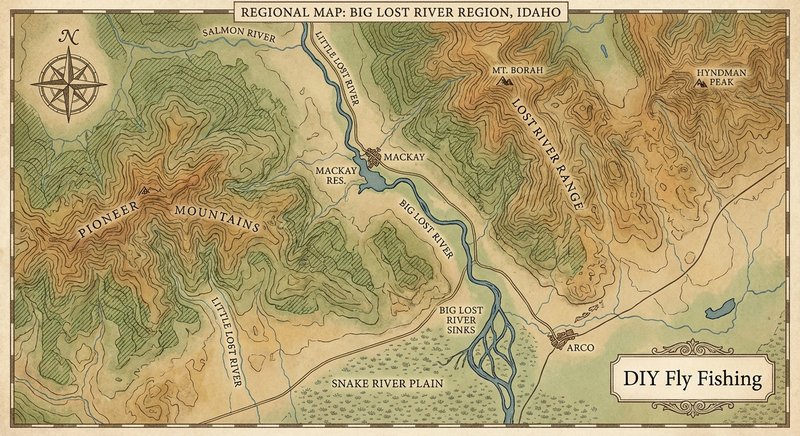
The Big Lost River is one of Idaho’s "crown jewel" fisheries, though it remains somewhat enigmatic to those who haven’t spent time on its banks. Located near the town of Mackay, it is famous for its disappearing act—the river eventually sinks into the lava beds of the Snake River Plain—but before it does, it offers some of the finest technical trout fishing in the West.
🎣 Location Overview
The Big Lost is divided into two distinct personalities: the Copper Basin (Upper) and the Tailwater (Below Mackay Reservoir).
While the Copper Basin offers classic freestone meadow fishing, it is the Tailwater section that has earned a legendary reputation. This stretch flows through a high-desert canyon and agricultural valley, characterized by crystal-clear water, intricate currents, and massive boulders. What makes it special is the nutrient-rich water from the reservoir, which produces an incredible biomass of insects, allowing Rainbow Trout to grow large, strong, and exceptionally "phi-educated." It is a technical river that demands precision but rewards it with some of the hardest-fighting wild rainbows in the state.
🐟 Target Species & Behavior
Species: Primarily wild Rainbow Trout. You may encounter the occasional Mountain Whitefish or Brook Trout in the upper reaches.
Behavior:
- The "Big Lost" Rainbow: These fish are remarkably healthy, often deep-bodied with vivid coloring. Unlike many tailwater fish, they are aggressive fighters but extremely wary of poor drifts.
- Holding Patterns: In the tailwater, fish hold in the "buckets" behind large boulders, along deep cut banks, and in the "glides" during hatch cycles.
- Feeding: They are highly opportunistic during the Trico and Baetis (BWO) hatches. Because the water is so clear, they have plenty of time to inspect your fly. If your drift isn't perfect, they will simply slide an inch to the side and let your fly pass.
📅 Best Times to Fish
The Big Lost is highly dependent on water releases from Mackay Dam for irrigation.
- Summer (July – August): This is prime time for the famous Trico hatch. These tiny mayflies bring every fish in the river to the surface. You’ll want to be on the water at dawn. As the sun gets high, terrestrial fishing (hoppers/ants) becomes effective.
- Fall (September – October): This is arguably the best window. Flows stabilize and drop, making the river easier to wade. The Blue Winged Olive (BWO) hatches can be prolific on cloudy afternoons. The fish are eager to bulk up before winter.
- Prime Window: 8:00 AM to 2:00 PM for hatches; late afternoon for nymphing deep slots.
🪰 Recommended Flies & Techniques
Dry Flies
- Tricos (Size 20-24): Trico Spinners (sunken or dry) are mandatory in summer.
- BWOs (Size 18-22): Parachute Adams or Sparkle Duns for the fall.
- Terrestrials: Chubby Chernobyls (Size 10-14), Morrish Hoppers, and Black Ants for the summer afternoons.
- Crane Flies: Large orange/tan patterns can provide explosive surface takes in late summer.
Nymphs (The Bread & Butter)
- Zebra Midges (Size 18-22): Red, Black, or Olive.
- Pheasant Tails (Size 16-20): Flashback or slim profiles.
- Rainbow Warriors (Size 18-20): Works wonders in the faster oxygenated water.
- Rubber Leg Stonefly (Size 8-12): Use as a lead fly to get your smaller midge down to the zone.
Techniques
- Technical Nymphing: A "Dry-Dropper" rig is excellent in the summer. In the fall, switch to an indicator rig with plenty of weight to reach the bottom of the deep holes.
- The Reach Cast: Essential for dry fly fishing. You must manage the micro-drifts caused by the swirling currents around boulders.
- Sight Fishing: On sunny days, use polarized glasses to spot fish in the glides. Don't blind cast; pick a target and work it.
💡 Pro Tips & Local Knowledge
- Watch the Flows: The Big Lost is flow-sensitive. If the dam is releasing over 600-700 CFS, wading becomes dangerous and the fishing difficult. The "sweet spot" for wading is typically 150 to 350 CFS. Check the USGS gauge for "Big Lost River Bl Mackay Res."
- 6X is Your Friend: The fish see a lot of flies and the water is gin-clear. Don't be afraid to drop down to 6X or even 7X fluorocarbon for nymphs and 6X nylon for dries.
- The "Refrigerator" Holes: Look for the deepest, darkest blue water behind the largest boulders. These "refrigerators" hold the trophy-sized rainbows that rarely come to the surface.
- Stealth Matters: The canyon walls reflect sound. Approach the bank quietly and try to keep a low profile. If you can see the fish, they can likely see you.
⚠️ Important Information
- Access: Much of the river below the dam is public (Bureau of Land Management/Forest Service), but there are pockets of private land. Always look for access signs and stay within the high-water marks.
- Regulations: Rules can change. Generally, the tailwater has specific limits or is catch-and-release only depending on the time of year and specific reach. Check the current Idaho Fish & Game (IDFG) seasons and rules booklet.
- Safety: The boulders in the Big Lost are notoriously slick. Studded wading boots and a wading staff are highly recommended.
- Environment: This is high-altitude desert. Bring plenty of water, sunscreen, and be prepared for sudden temperature swings.
Guide’s Final Word: The Big Lost isn't about high fish counts; it’s about the quality of the pursuit. When you land a 20-inch, slab-sided Idaho rainbow on a size 22 Trico, you’ll understand why this river is whispered about in fly shops across the country.
Bug Hatches & Matching Flies
| Hatch | Type | Peak months | Time of day | Hook sizes | Matching flies |
|---|---|---|---|---|---|
| Midges Chironomidae | midge | January, February, March, December | Late Morning/Afternoon | #18-24 | Zebra Midge #18-22, Griffith's Gnat #20-22, Morgan's Midge #20-24 |
| Blue Winged Olives Baetis | mayfly | March, April, September, October | Midday | #18-22 | RS2 #20-22, Sparkle Dun #18-22, BWO CDC Emerger #18-20 |
| Pale Morning Duns Ephemerella excrucians | mayfly | June, July | Late Morning/Afternoon | #16-18 | Pink Albert #16-18, Quigley Cripple #16-18, Pheasant Tail Nymph #16-18 |
| Tricos Tricorythodes | mayfly | August, September | Early Morning | #20-24 | Trico Spinner #20-24, Sunken Trico Spinner #20-22, Drowned Trico #22-24 |
| Spotted Sedges Hydropsyche | caddis | June, July, August | Evening | #14-18 | Elk Hair Caddis #14-18, LaFontaine's Sparkle Pupa #16-18, Godzilla Caddis #14-16 |
| Golden Stoneflies Hesperoperla pacifica | stonefly | June, July | Morning/Afternoon | #8-12 | Chubby Chernobyl #8-12, Pat's Rubber Legs #8-12, Golden Stone Nymph #10-12 |
| Terrestrials Formicidae / Orthoptera | terrestrial | July, August, September | Afternoon | #10-16 | Morrish Hopper #10-14, Cinnamon Ant #14-16, Black Beetle #12-16 |
| Yellow Sallies Isoperla | stonefly | June, July | Afternoon/Evening | #14-16 | Yellow Sally Dry #14-16, Little Yellow Sloan #14-16, CDC Yellow Sally #14-16 |