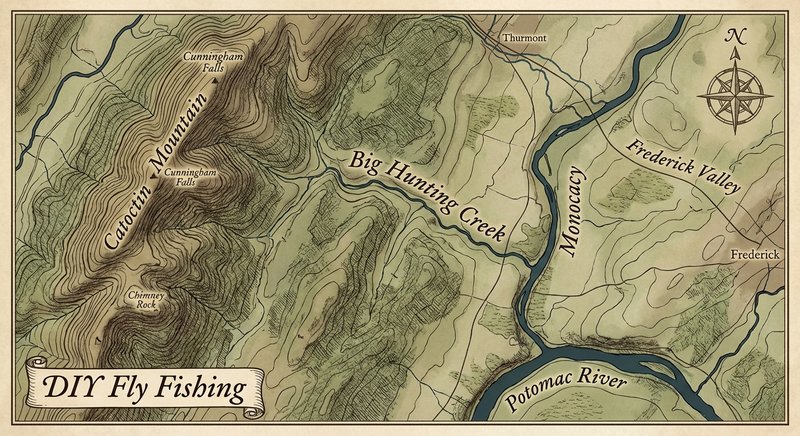
Big Hunting Creek
Fly fishing in Maryland · Intermediate · Best seasons: Spring, Summer, Fall
Target Species
Brown Trout, Brook Trout
About This Water
Catoctin Mountain stream in Frederick County. Fly fishing only with wild brown trout.
Fishing Recommendations
Welcome to Big Hunting Creek, the crown jewel of Maryland fly fishing. Located in the Catoctin Mountains near Thurmont, this is a place of historic significance—it was the first stream in Maryland designated as "Fly Fishing Only" in the 1930s and has been fished by presidents (due to its proximity to Camp David).
As your guide, I’m going to break down how to tackle this technical, beautiful freestone stream.
🎣 Location Overview
Big Hunting Creek is a classic Appalachian freestone stream characterized by its plunge pools, massive boulders, and crystal-clear pocket water. It flows through Cunningham Falls State Park and Catoctin Mountain Park, offering a scenic, canopy-covered environment that feels much more remote than its proximity to D.C. and Baltimore suggests.
What makes it special is its character. This isn't a "drift boat" river; it is a "boots-on-the-ground" tactical challenge. The water is highly oxygenated by the constant drops, but the fish are notoriously "educated" due to the stream's popularity and the clarity of the water.
🐟 Target Species & Behavior
- Brown Trout: The primary residents. These are wild or long-naturalized fish. They are incredibly wary. They tend to hold in the "cushion" in front of boulders, under the bubble lines of waterfalls, or tucked deep into undercut banks.
- Brook Trout: You will find Maryland’s state fish—the native Brookie—primarily in the upper reaches and smaller tributaries. They are smaller (often 4–8 inches), brilliantly colored, and reside in the coldest, most oxygenated headwaters.
- Behavior: These fish are "shadow-shy." Because the water is clear and the stream is relatively small, they have a high "spook factor." If they see your silhouette or a sloppy line slap, the pool is finished for the next hour.
📅 Best Times to Fish
- Spring (Late March – June): This is prime time. Water levels are usually optimal, and the major hatches (Hendricksons, Quill Gordons, and Sulphurs) occur.
- Summer (July – August): While many MD streams get too warm, the canopy cover and bottom-release from the Hunting Creek Lake dam keep sections of this creek fishable. Focus on the mornings. Terrestrial fishing (ants/beetles) is spectacular now.
- Fall (September – November): The Brown Trout become more aggressive as they prepare to spawn. The foliage is world-class, and the cooling water temperatures trigger a secondary feeding frenzy.
- Prime Window: Early morning (first light) is best to beat the crowds and find the fish most relaxed.
🪰 Recommended Flies & Techniques
Top Fly Patterns
- Dry Flies:
- Elk Hair Caddis (Size 14-18) - The local staple.
- Parachute Adams (Size 16-22) - Essential for picky fish.
- Royal Wulff/Stimulator (Size 12-14) - Great for the faster, "bubbly" pocket water.
- Terrestrials: Black foam ants and beetles (Size 16-18) are mandatory in summer.
- Nymphs:
- Pheasant Tail (Size 18-20) - Beaded and non-beaded.
- Zebra Midge (Size 20-22) - In red or black.
- Copper John (Size 16-18) - For faster runs.
- Streamers:
- Woolly Buggers (Size 10-12) in olive or black. Fish these deep in the larger pools below the falls.
Effective Techniques
- The Dry-Dropper: This is arguably the most effective way to fish Big Hunting Creek. Use a buoyant dry fly (like a Stimulator) and hang a small Zebra Midge or Pheasant Tail 18 inches below it.
- High-Sticking/Euro Nymphing: Because the current is complex with many "micro-seams," keeping your fly line off the water is vital to avoid drag.
- The Bow-and-Arrow Cast: The rhododendrons and trees are tight. Mastering this cast will allow you to reach pockets that other anglers bypass.
💡 Pro Tips & Local Knowledge
- Stealth is Everything: Wear drab colors (greens/browns) to blend into the forest. Approach pools from downstream and stay low—crouching or even kneeling makes a massive difference here.
- Focus on the "Small" Pockets: Most anglers walk past the tiny pockets between large boulders. These often hold the best fish because they are overlooked.
- The "Falls" Area: The section below Cunningham Falls is stunning but heavily pressured. For a more "wild" experience, hike further downstream or upstream away from the main parking lots.
- Light Tackle: A 2-weight or 3-weight rod (7.5 to 8 feet) is perfect. You don't need long casts; you need accuracy and a delicate presentation. Use 6X or 7X tippet—anything heavier will likely be spotted.
⚠️ Important Information
- Access: Most access is found along MD Route 77. There are numerous pull-offs. The area near the Manor Area of Cunningham Falls State Park is very popular.
- Regulations: Big Hunting Creek is Catch and Release Only and Fly Fishing Only (no bait, no spinning lures) from the dam at Hunting Creek Lake downstream to the edge of the state park.
- Permits: You need a Maryland Non-Tidal Fishing License and a Trout Stamp.
- Safety: The rocks here are notoriously slippery (green "slime" algae). Wading boots with felt soles or studs are highly recommended. Be mindful of copperheads during the summer months near the rock piles.
Good luck out there. Tight lines, and remember to leave the creek better than you found it!
Bug Hatches & Matching Flies
| Hatch | Type | Peak months | Time of day | Hook sizes | Matching flies |
|---|---|---|---|---|---|
| Blue-Winged Olive Baetis | mayfly | March, April, October, November | Mid-day/Afternoon | #18-22 | RS2 #20-22, Parachute BWO #18-20, Pheasant Tail #18-20 |
| Quill Gordon Epeorus pleuralis | mayfly | March, April | Mid-day | #12-14 | Quill Gordon #12-14, Hare's Ear #12-14, Quill Gordon Wet Fly #12-14 |
| Hendrickson Ephemerella subvaria | mayfly | April, May | Afternoon | #12-14 | Red Quill #12-14, Hendrickson Nymph #12-14, Snowshoe Emerger #14 |
| Sulfur Ephemerella invaria/dorothea | mayfly | May, June | Late Afternoon/Evening | #14-18 | Sulfur Parachute #14-18, Pupa-style Sulfur Emerger #16-18, Pheasant Tail #16-18 |
| Tan Caddis Hydropsyche | caddis | May, June, July | Evening | #14-16 | Elk Hair Caddis #14-16, LaFontaine Sparkle Pupa #14-16, Gold Ribbed Hare's Ear #14-16 |
| Light Cahill Stenonema/Stenacron | mayfly | June, July | Evening | #12-14 | Light Cahill #12-14, Cahill Wet Fly #14, Cream Nymph #14 |
| Trico Tricorythodes | mayfly | July, August, September | Morning | #22-26 | Trico Spinner #22-24, Trico Dun #22-24 |
| Terrestrials (Ants & Beetles) Formicidae / Coleoptera | terrestrial | June, July, August, September | All Day | #12-18 | Cinnamon Ant #14-18, Black Foam Beetle #12-16, Chernobyl Ant #12-14 |
| Early Brown Stonefly Strophopteryx | stonefly | February, March | Mid-day | #14-16 | Little Brown Stone #14-16, Copper John #14-16, Prince Nymph #14-16 |
| Midges Chironomidae | midge | January, February, December | Mid-day | #18-24 | Zebra Midge #18-22, Griffith's Gnat #18-22, Top Secret Midge #20-22 |