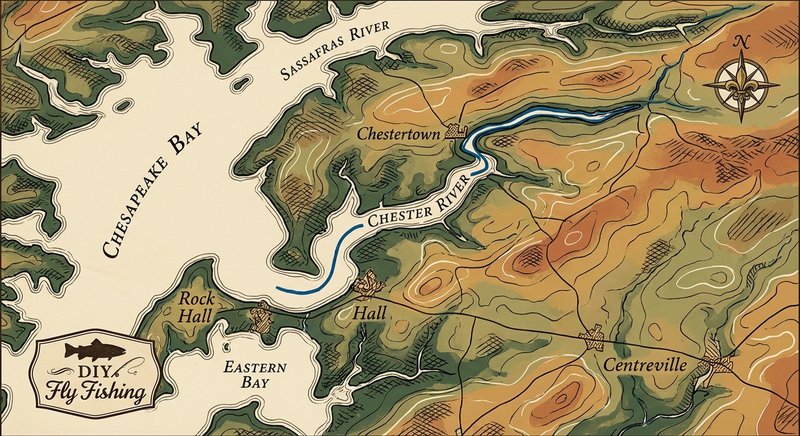
Chester River
Fly fishing in Maryland · Intermediate · Best seasons: Spring, Summer, Fall
Target Species
Largemouth Bass, White Perch, Striped Bass
About This Water
Eastern Shore river with bass and perch. Scenic tidal fishing.
Fishing Recommendations
The Chester River is one of the crown jewels of Maryland’s Eastern Shore. A major tributary of the Chesapeake Bay, it offers a classic "tidewater" fly fishing experience. It is a slow-moving, brackish system characterized by expansive marshes, spatterdock fields, downed timber, and historical town waterfronts like Chestertown.
What makes the Chester special is its diversity. You can catch a slab White Perch on a 3-weight in the morning and a 30-inch Striped Bass on a 9-weight in the evening, all within the same river system.
🎣 Location Overview
The Chester River is a transition zone. The upper reaches (above Chestertown toward Millington) are primarily freshwater/low-salinity, while the lower river (near Love Point and Kent Island) is true salt.
The water is generally "tannic" or stained, meaning visibility is often limited to 1–3 feet. This makes it an ideal environment for ambush predators. Anglers love it because it is less crowded than the main Chesapeake Bay and offers plenty of shoreline structure that protects you from the wind, making it very "fly-rod friendly."
🐟 Target Species & Behavior
Striped Bass (Rockfish)
- Behavior: These are the apex predators of the river. They move in schools, often following the tide to push baitfish against points, drop-offs, or submerged rock piles.
- Holding Spots: Look for "rip lines" where the tide moves around a point, bridge pilings (the Route 213 bridge is iconic), and shadowed docks at night.
- Feeding: Primarily juvenile menhaden (bunker), silversides, and small blue crabs.
Largemouth Bass
- Behavior: Found mostly from Chestertown upstream. They are tide-dependent; they move into the shallow vegetation (spatterdock) on high tide and retreat to the outer edges or downed wood on low tide.
- Holding Spots: Spatterdock (lily pad) fields, cypress knees, and fallen trees.
- Feeding: Frogs, dragonflies, and small sunfish.
White Perch
- Behavior: The "bluegill of the bay." They are aggressive, school in massive numbers, and provide incredible action on light tackle.
- Holding Spots: Shaded docks, oyster bars, and "pickerel weed" edges.
- Feeding: Grass shrimp, grasshoppers, and small minnows.
📅 Best Times to Fish
Optimal Seasons
- Spring (April – June): The "Post-Spawn" window. Stripers are moving back down from the upper river, and Largemouth Bass are aggressive in the shallows. White Perch run up the creeks in late March/April.
- Summer (July – August): Best for topwater Largemouth at dawn and White Perch under docks. Striped Bass move toward the cooler, deeper water near the river mouth.
- Fall (September – November): The Prime Window. Baitfish migrate out of the creeks, triggering a "feeding frenzy." Stripers return to the mid-river, and Bass feed heavily for winter.
Best Times of Day
- Low Light: Dawn and dusk are mandatory for topwater action.
- The Tides: In the Chester, moving water is everything. The two hours before and after a high tide are usually the most productive. A "slack tide" (no movement) often leads to a dead bite.
🪰 Recommended Flies & Techniques
For Striped Bass
- Patterns: Clouser Minnow (Chartreuse/White), Lefty’s Deceiver (White/Blue), and Bob’s Banger (Popper).
- Technique: Use an intermediate sinking line to get the fly down 3–5 feet. Use a "strip-strip-pause" retrieve to mimic a wounded baitfish.
For Largemouth Bass
- Patterns: Dahlberg Divers, Gurgle Pops, and Weedless Frog patterns. For sub-surface, use large black/purple Wooly Buggers.
- Technique: Focus on the edges of the spatterdock fields. Accuracy is more important than distance; you need to land the fly within inches of the stalks.
For White Perch
- Patterns: Small Clouser Minnows (Size 6-8), Grass Shrimp imitations, and "Raul’s Perch Fly."
- Technique: 3-weight or 4-weight rod. Fish around shaded dock pilings. Let the fly sink slightly and use short, erratic strips.
💡 Pro Tips & Local Knowledge
- The "Dock" Game: Many of the best Stripers in the Chester are "resident" fish that live under the deep-water docks of private estates. Skipping a fly under a dark dock can yield a trophy fish that most boaters pass by.
- Follow the Birds: If you see Seagulls or Tern diving frantically in the mid-river, Striped Bass have pushed bait to the surface. Get there immediately.
- The Color Rule: Because the water is stained, Dark Colors (Black/Purple) often work better on overcast days because they create a stronger silhouette, while Flashy/Bright Colors (Chartreuse) work better in the sun.
- Kayak Heaven: The Chester is one of the best kayak fly fishing rivers in MD. Launching at Wilmer Park in Chestertown gives you immediate access to prime water.
⚠️ Important Information
Access Information
- Chestertown (Wilmer Park): Excellent public ramp and kayak launch.
- Millington: Good for upper river freshwater access.
- Crumpton: A mid-river ramp that is great for reaching the transition zones.
Regulations & Permits
- Licensing: You need a Maryland Bay & Coastal Sport Fishing License. This covers both the tidal freshwater and the saltwater sections.
- Striped Bass Regs: Maryland DNR frequently changes "Keep" limits and "No-Target" seasons to protect the population. Always check the current DNR "Blue Chart" before heading out.
Special Considerations
- Oysters: Be careful wading. The Chester has oyster bars with shells that are razor-sharp. Hard-soled wading boots are a must if you step out of a boat.
- Wind: A strong West wind can make the mid-river very choppy. If it's blowing, head into the smaller creeks like Morgan Creek or Southeast Creek for shelter.
Bug Hatches & Matching Flies
| Hatch | Type | Peak months | Time of day | Hook sizes | Matching flies |
|---|---|---|---|---|---|
| Midges Chironomidae | midge | March, April, October, November | All Day | #18-24 | Zebra Midge #18-22, Griffith's Gnat #18-20 |
| Hexagenia (White Mayfly) Hexagenia limbata | mayfly | July, August | Evening/Night | #6-10 | White Wulff #8-10, Hexagenia Nymph #6-8 |
| Damselflies Enallagma | terrestrial | June, July, August | Afternoon | #10-14 | Adult Damselfly #10-12, Marabou Damsel #12-14 |
| Spotted Sedge Hydropsyche | caddis | May, June | Evening | #14-16 | Elk Hair Caddis #14-16, Pupa Emerger #14-16 |
| Terrestrial Ants Formicidae | terrestrial | July, August, September | All Day | #14-20 | Black Foam Ant #14-18, Cinnamon Ant #16-20 |
| Dragonflies Anisoptera | terrestrial | June, July, August | Morning/Afternoon | #4-10 | Dragonfly Nymph #4-8, Deer Hair Dragonfly #6-10 |
| Blue Winged Olive Baetis | mayfly | April, October | Afternoon | #18-22 | BWO Sparkle Dun #18-22, Pheasant Tail #18-20 |
| Grasshoppers Acrididae | terrestrial | August, September | Afternoon | #8-12 | Dave's Hopper #10-12, Rainy's Hopper #8-10 |