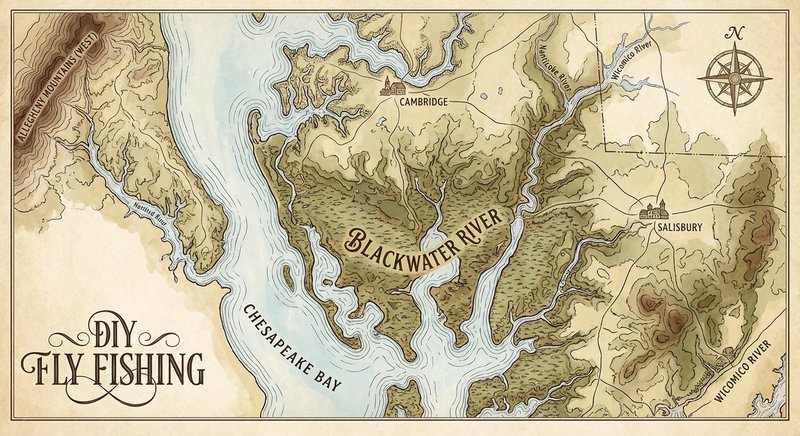
Blackwater River
Fly fishing in Maryland · Intermediate · Best seasons: Spring, Summer, Fall
Target Species
Largemouth Bass, Chain Pickerel, Crappie
About This Water
Eastern Shore river through wildlife refuge. Bass and pickerel in unique habitat.
Fishing Recommendations
The Blackwater River, snaking through the Dorchester County marshlands on Maryland’s Eastern Shore, is one of the most hauntingly beautiful and productive fly fishing destinations in the Mid-Atlantic. Often referred to as the "Everglades of the North," this tidal, tea-colored system offers a wilderness experience unlike anywhere else in the region.
Here is your comprehensive guide to fly fishing the Blackwater.
🎣 Location Overview
The Blackwater River is characterized by its dark, tannic "black" water, vast expanses of needle rush, and iconic "ghost forests"—stands of loblolly pines killed by rising sea levels.
What makes it special is its shallow, tidal nature. This is not a river of rushing currents; it is a slow-moving labyrinth of marshes, "guts" (small tidal creeks), and expansive flats. Anglers love it because it feels prehistoric. It is a world of eagles, ospreys, and silence, where a 5-pound Bass or a 30-inch Snakehead can explode on a surface fly in six inches of water.
🐟 Target Species & Behavior
Largemouth Bass
Blackwater bass are hardy and ambush-oriented. Because the water is dark, they rely heavily on their lateral lines. They hold tight to "spatterdock" (yellow water lilies) and the submerged root systems of dead trees. They feed on mummichogs (mud minnows), bluegill, and frogs.
Chain Pickerel
The "Water Wolf" of the marsh. These fish are highly active in the cooler months of Spring and Fall. They are aggressive, visual hunters that love flashy movements. They typically hold on the edges of weed beds and will slash at a fly multiple times if they miss.
Crappie
Found in deeper holes and around bridge pilings or fallen timber. In the Blackwater, they grow to "slab" proportions. They are school-oriented; if you find one, you’ve found twenty.
The "Bonus" Species: Northern Snakehead
While not in your initial list, no guide can mention the Blackwater without the Snakehead. They occupy the same water as Bass and Pickerel and are arguably the premier fly-rod target in the river today due to their size and explosive topwater strikes.
📅 Best Times to Fish
- Spring (March – May): This is prime time for Chain Pickerel and Crappie. As the water warms in April and May, the Largemouth Bass move into the shallows to spawn.
- Summer (June – August): Best for topwater Bass. However, the heat and insects (biting flies/mosquitoes) can be brutal. Fish the "low light" windows—dawn and dusk are essential.
- Fall (September – November): Many guides consider this the best overall season. The humidity drops, the "nuisance" grass begins to die back, and fish feed aggressively to prepare for winter.
- The Tidal Factor: This is the most important "time" variable. Generally, a falling tide is best. As water leaves the marsh, it forces baitfish out of the grass and into the main channels where predators are waiting in ambush at the mouths of "guts."
🪰 Recommended Flies & Techniques
Top Patterns
- Topwater: BoogleBugs (size 4), foam frogs, and Deer Hair Poppers in white, chartreuse, or black.
- Streamers: Clouser Minnows (Chartreuse/White or Red/White) are the gold standard here. For Pickerel, use something with flash (Flashabou).
- Sub-surface: Weedless "Gamechangers" or large Woolly Buggers.
- Crappie: Small (size 8-10) weighted nymphs or micro-streamers under a strike indicator.
Techniques & Presentation
- Go Weedless: The Blackwater is full of "snags"—underwater wood and thick grass. Always tie or buy flies with a mono or wire weed guard.
- The "Strip-Set": Because you are fishing for warm-water species with bony mouths, avoid the "trout lift." When a fish hits, pull the line hard with your stripping hand to set the hook.
- The Shadow Cast: Cast your fly into the dark pockets created by the ghost trees or under the overhanging marsh grass. Bass will rarely be sitting in the middle of the channel.
💡 Pro Tips & Local Knowledge
- Stealth is Key: The water is shallow (often 1–3 feet). If you bang your paddle against the boat or make a large splash, the fish will spook. Long casts are your friend.
- Target the "Guts": Look for small openings in the marsh grass where water is flowing out. Position yourself downstream and cast into the flow.
- Gear Up: Use a 6-weight or 7-weight rod. You need the backbone to pull a 4-pound Bass out of thick vegetation. Use a heavy fluorocarbon leader (12lb–20lb test) as the Pickerel’s teeth and the abrasive marsh grass will snap light trout tippet instantly.
- Color Palette: In the dark, stained water, use high-contrast colors. Black/Purple works great on overcast days, while Chartreuse/White excels in the sun.
⚠️ Important Information
Access
- Shorter’s Wharf: The most popular boat ramp for accessing the heart of the Blackwater.
- Key Wallace Drive: Offers some bank fishing opportunities and easy kayak launches.
- Vessel Choice: A kayak, canoe, or stand-up paddleboard is the best way to fish the Blackwater. Large fiberglass bass boats can struggle with the shallow depths and hidden stumps.
Regulations & Permits
- A Maryland Tidal Sport Fishing License is required.
- If fishing within the Blackwater National Wildlife Refuge boundaries, check for specific seasonal closures (some areas close to protect migratory waterfowl in winter).
- Snakehead Policy: If you catch a Northern Snakehead, Maryland law encourages harvest. If you intend to keep it, it must be killed immediately. It is illegal to transport a live snakehead.
Safety
- The Wind: The marsh is wide open. A 15mph wind can make paddling back to the ramp nearly impossible. Always check the wind forecast.
- Bugs: From June through September, the "Deer Flies" and "Marsh Mosquitoes" are legendary. Bring high-quality repellent and wear long sleeves/buffs.
Bug Hatches & Matching Flies
| Hatch | Type | Peak months | Time of day | Hook sizes | Matching flies |
|---|---|---|---|---|---|
| Chironomids (Midges) Family Chironomidae | midge | March, April, October, November | All day | #18-24 | Zebra Midge #18-22, Griffith's Gnat #20-24 |
| Blue Damselfly Enallagma cyathigerum | terrestrial | June, July, August | Mid-day | #10-14 | Braided Butt Damsel #10-12, Marabou Damsel Nymph #12-14 |
| Angler's Curse (Caenis Mayfly) Caenis spp. | mayfly | July, August | Early Morning | #22-26 | Caenis Spinner #22-24, Micro-Mayfly Nymph #22-26 |
| Common Meadow Grasshopper Orchelimum vulgare | terrestrial | August, September | Afternoon | #6-12 | Dave's Hopper #8-10, Rainy's Grand Hopper #6-12 |
| Green Darner Dragonfly Anax junius | terrestrial | July, August | Afternoon | #4-8 | Dragonfly Popper #4-8, Gumdrop Dragonfly #6-10 |
| Cinnamon Ant Camponotus castaneus | terrestrial | August, September | Afternoon | #14-18 | McMurray Ant #14-16, Fur Ant #16-18 |
| Water Boatman Family Corixidae | terrestrial | September, October | Evening | #14-18 | Water Boatman #14-16, Prince Nymph (modified) #14-18 |
| Backswimmer Family Notonectidae | terrestrial | August, September, October | All day | #12-16 | Backswimmer #12-14, Floating Beetle (fished wet) #14-16 |