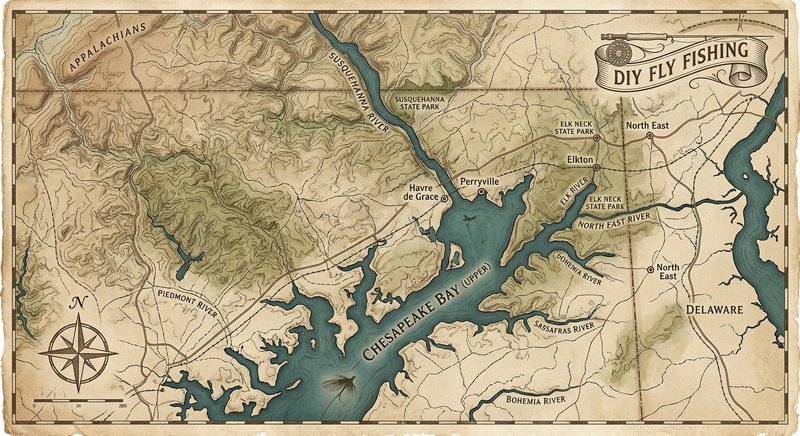
Chesapeake Bay (Upper)
Fly fishing in Maryland · Intermediate · Best seasons: Spring, Summer, Fall
Target Species
Striped Bass, Bluefish, White Perch
About This Water
World-famous estuary with striped bass and other species. Diverse fishing year-round.
Fishing Recommendations
Welcome to the Upper Chesapeake Bay, a unique and dynamic fly fishing destination. As your guide, I can tell you that this region—defined roughly as the waters north of the Bay Bridge up to the Susquehanna Flats—is one of the most storied fisheries on the Atlantic Coast.
This is the birthplace of many modern fly fishing patterns (including the world-famous Clouser Minnow) and offers a rare opportunity to catch trophy-sized fish in remarkably shallow water.
🎣 Location Overview
The Upper Chesapeake is a "mixing bowl" of freshwater from the Susquehanna River and the saltier tides of the Mid-Bay. The crown jewel here is the Susquehanna Flats, a massive, 10,000-acre submerged plateau of wild celery and grasses.
What makes this area special is the depth. Unlike the ocean, much of your fishing here happens in 2 to 10 feet of water. Anglers love it because it bridges the gap between freshwater bass tactics and saltwater power. When the tide is moving, the Upper Bay becomes a high-energy hunting ground; when it's still, it’s a serene landscape of grass beds and lighthouse vistas.
🐟 Target Species & Behavior
Striped Bass (Rockfish)
The undisputed king of the Bay. In the Upper Bay, their behavior changes with the season. In the spring, they are here to spawn, hovering in the shallow "Flats." In the summer and fall, "schoolies" (18–28 inch fish) haunt bridge pilings, rock jetties, and grass edges. They are opportunistic predators feeding on Atlantic Menhaden (bunker), River Herring, and Bay Anchovies.
Bluefish
Known as "Yellow-eyed Devils," these arrive in late summer and fall. They are aggressive, fast-moving, and will destroy a fly. They often push bait to the surface in "blitzes." If you see water boiling, it’s likely Blues.
White Perch
Often overlooked but a joy on a 3-weight or 4-weight rod. They behave much like small bass, holding tight to structure like fallen trees in tidal creeks, docks, and rip-rap. They feed heavily on grass shrimp and small minnows.
📅 Best Times to Fish
- Spring (Mid-April to May): This is the Trophy Season on the Susquehanna Flats. Large post-spawn females (30–50 inches) linger in the shallows. This is "sight fishing" territory on calm days.
- Summer (June to August): Focus on the "Low Light" windows. Dawn and dusk are essential as the water warms. Focus on the Bay Bridge pilings or the mouths of the rivers (Gunpowder, Bush, Sassafras).
- Fall (September to November): The Fall Blitz. As water temperatures drop, fish gorge themselves for the winter. This is the most consistent time for fly anglers to find surface-breaking action.
The Golden Rule: Always fish the moving tide. A "slack" tide (no movement) usually means a dead bite. The two hours before and after a high tide are generally most productive.
🪰 Recommended Flies & Techniques
Top Fly Patterns
- Clouser Deep Minnow: (Chartreuse/White or Tan/White). Created by Bob Clouser specifically for the Susquehanna. It is the most effective fly in the Bay.
- Lefty’s Deceiver: (White/Blue or All White). Named after MD local Lefty Kreh. Perfect for when fish are keyed in on larger baitfish.
- Bob’s Banger / Gurgler: For heart-stopping topwater action. Use these in the early morning or during a fall blitz.
- Half-and-Half: A cross between a Deceiver and a Clouser—great for deep-water striped bass.
- Grass Shrimp Patterns: Size #8–10 for White Perch in the tidal creeks.
Techniques & Presentation
- The Strip Set: Never "trout set" (lifting the rod). Keep the rod tip low, pointing at the fly, and pull the line hard with your stripping hand to set the hook in the Striped Bass’s bony mouth.
- Intermediate Lines: A slow-sinking (Intermediate) line is the workhorse here. it keeps the fly in the "strike zone" (3–6 feet deep) without snagging grass.
- The "Pause": When fishing Clousers, use a strip-strip-pause cadence. The pause allows the weighted eyes to dive, mimicking a wounded baitfish.
💡 Pro Tips & Local Knowledge
- The "Birds" are Your Radar: In the fall, look for hovering and diving Seagulls or Terns. They are picking up scraps from Striped Bass and Bluefish feeding below. If you find the birds, you’ve found the fish.
- Structure is King: In the Upper Bay, if you aren't fishing the Flats, look for "hard" structure. The Pooles Island area and the Knolls are classic spots. Even a single submerged rock can hold a dozen fish.
- The Stealth Factor: On the Susquehanna Flats, big stripers are incredibly spooky. If you have a trolling motor, use it on low. If you have a push pole, use it. Loud hull slap or a dropped pliers can clear a flat in seconds.
- Match the Hatch: In early summer, the bait is tiny (Bay Anchovies). If you aren't getting hits, downsize your fly to a 2-inch pattern.
⚠️ Important Information
Access & Logistics
- Boating: A boat is highly recommended for the Upper Bay. Popular ramps include Rocky Point Park (Essex) and Tydings Park (Havre de Grace).
- Kayaking: The Susquehanna Flats and the Gunpowder River delta are world-class kayak fly fishing spots.
Regulations & Permits
- Maryland Bay & Coastal Sport License: This is required for all anglers over 16.
- Striped Bass Regulations: Maryland DNR has very strict, frequently changing "Slot Limits" and closed seasons to protect the spawning population. Always check the current MD DNR "Striped Bass Recovery" page before heading out.
- Circle Hooks: If you decide to switch to bait, Maryland law requires the use of non-offset circle hooks.
Safety
The Upper Bay can go from glass-calm to 3-foot chops in minutes when a North wind meets an incoming tide. Always check the wind forecast. If it's blowing over 15 knots, the Flats can become dangerous for small craft.
Tight lines, and remember: if you want to catch fish in the Bay, find the current!
Bug Hatches & Matching Flies
| Hatch | Type | Peak months | Time of day | Hook sizes | Matching flies |
|---|---|---|---|---|---|
| Giant Mayfly (Hex) Hexagenia limbata | mayfly | June, July | Evening/Night | #4-8 | Hexagenia Spinner #6-8, Burrowing Mayfly Nymph #6-10 |
| Bay Midge Chironomidae | midge | April, May, October | Morning/Evening | #18-24 | Zebra Midge #18-22, Griffith's Gnat #20-24 |
| White Miller Nymphula spp. | caddis | July, August | Evening | #12-16 | White Elk Hair Caddis #12-14, White Wulff #14 |
| Trico Tricorythodes spp. | mayfly | August, September | Morning | #20-24 | Trico Spinner #22-24, RS2 #20-22 |
| Blue-Winged Olive Baetis spp. | mayfly | March, April, October, November | Afternoon | #18-22 | BWO Sparkle Dun #18-20, Pheasant Tail Nymph #18-22 |
| Damselfly Enallagma spp. | terrestrial | June, July, August | All Day | #10-14 | Adult Damselfly #10-12, Marabou Damsel Nymph #12-14 |
| Japanese Beetle Popillia japonica | terrestrial | July, August | Afternoon | #12-14 | Foam Beetle #12-14 |
| Annual Cicada Neotibicen canicularis | terrestrial | August, September | Afternoon | #4-8 | Cicada Foam Pattern #6-8 |