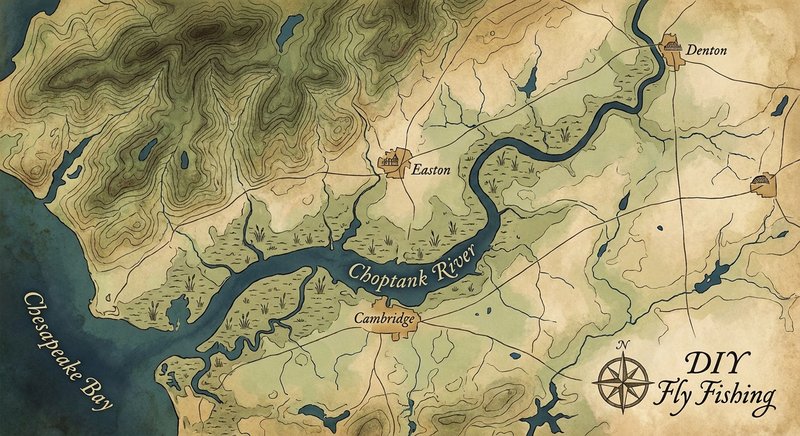
Choptank River
Fly fishing in Maryland · Beginner · Best seasons: Spring, Summer, Fall
Target Species
Largemouth Bass, White Perch, Catfish
About This Water
Eastern Shore river with bass and perch. Scenic tidal fishing.
Fishing Recommendations
The Choptank River is a crown jewel of Maryland’s Eastern Shore. As an expert guide, I can tell you that the Choptank offers a unique "low-country" fly fishing experience. It is a slow-moving, tidal river characterized by tea-colored (tannic) water, lily pad fields, and extensive woody debris.
What makes it special is the transition from freshwater to brackish environments, allowing a fly angler to target a "mixed bag" of species in a single afternoon.
🎣 Location Overview
The Choptank begins in Delaware and flows southwest through Maryland into the Chesapeake Bay. For the fly angler, the "Upper Choptank"—roughly from the Red Bridges area down through Greensboro and Denton—is the prime territory.
The river is heavily influenced by the tide, even in the freshwater sections. The water is generally murky to stained (tannic), meaning vibration and profile are more important than exact color matching. You’ll find yourself casting toward fallen oak trees, expansive "spatterdock" (lily pad) fields, and steep mud banks. It is a quiet, scenic river that feels far removed from the bustle of the Western Shore.
🐟 Target Species & Behavior
Largemouth Bass
The Choptank bass are "structure-oriented." Because the river is tidal, these fish are incredibly efficient hunters. They hold tight to fallen logs and deep in the lily pads, waiting for the tide to wash baitfish or crayfish past their noses. They are hardy, aggressive, and tend to have very dark coloration due to the tannic water.
White Perch
These are the "panfish of the Chesapeake." In the spring, they migrate upriver in massive numbers to spawn. In summer and fall, they reside in the brackish stretches. They school up near bridge pilings, fallen timber, and deep holes. They are aggressive hitters and, pound-for-pound, one of the best fights on a 3-weight or 4-weight rod.
Catfish (Channel and Blue Catfish)
While traditionally thought of as bait-fishing targets, the Choptank is currently seeing an explosion of Invasive Blue Catfish. These are apex predators that will absolutely smash a fly. They hold in deeper channels during the day but move into the shallows and grass edges to hunt during low-light conditions.
📅 Best Times to Fish
- Spring (March – May): This is the season of the "Perch Run." White perch (and yellow perch) move into the Greensboro area in massive schools. April and May are also prime for Largemouth Bass as they move into the shallows to spawn.
- Summer (June – August): Focus on the "Golden Hours." Topwater bass action is world-class at dawn and dusk. During the heat of the day, perch move to deeper, shaded wood cover.
- Fall (September – November): This is arguably the best time for trophy Largemouth. As the water cools, the fish feed heavily on baitfish to prepare for winter. The "Blue Cat" activity also spikes in the shallower flats.
The Golden Rule: Fish the Tides. On the Choptank, the two hours before and after a high tide are usually the most productive. "Slack water" (when the tide isn't moving) often results in a complete pause in fish activity.
🪰 Recommended Flies & Techniques
For Largemouth Bass
- Topwater: BoogleBugs or foam poppers in black, yellow, or frog green. The Choptank is a "popper-dropper" paradise.
- Subsurface: Game Changers or clouser minnows in chartreuse/white or orange/brown (to mimic crayfish).
- Technique: Cast into the pockets of lily pads. Let the ripples dissipate, then give it two sharp "chugs." For streamers, strip them slowly along the edges of downed timber.
For White Perch
- Patterns: Small Clouser Minnows (Size 8-10) in pink/white or "Electric Chicken" (pink/chartreuse). Small Wooly Buggers in gold or olive.
- Technique: Use a sinking tip line. Cast toward bridge pilings or the downstream side of fallen trees. Use a fast, erratic "strip-strip-pause" retrieve.
For Catfish
- Patterns: Large, heavy Dumbbell-eyed Streamers (Size 1/0) in dark colors like black or purple.
- Technique: You must get the fly to the bottom. Use a heavy sink-tip or full-sinking line. "Bounce" the fly slowly along the bottom of the channel edges. When a Blue Cat hits, it won't be a nibble—it will be a freight train.
💡 Pro Tips & Local Knowledge
- The "Greensboro Trick": Launch a kayak or canoe at the Greensboro boat ramp and paddle upstream toward Red Bridges. This stretch is narrow, shaded, and holds a high density of fish.
- Color Selection: In the tea-colored water of the Choptank, Gold and Chartreuse are the "money" colors. They provide the flash and contrast needed for fish to track the fly.
- Don't Fear the Blue Cat: If you hook a 10lb+ Blue Catfish on a fly rod, hold on! They are invasive in Maryland; the DNR encourages anglers to keep and eat them (they are delicious) rather than releasing them.
- Beed-Head Flies: Always carry flies with a bit of weight. Even in the upper sections, the tidal current can be surprisingly strong, and you need to get your fly down to the "strike zone" quickly.
⚠️ Important Information
- Access:
- Red Bridges Park: Great for wade fishing or launching a small kayak.
- Greensboro Boat Ramp: Best for small skiffs and kayaks.
- Martinak State Park: Excellent shore access and camping facilities.
- Regulations: You generally need a Maryland Tidal Fish License for most of the Choptank from the Delaware line downward. Check the MD DNR website for the specific "dividing line" between tidal and non-tidal water.
- Safety: The bottom of the Choptank is often soft "pluff mud." Be very careful when wading; it is easy to sink up to your knees. Fishing from a kayak or small boat is highly recommended.
- Conservation: While Bass are catch-and-release by preference for many fly anglers, be mindful of the spawning season (typically April 15–June 15) and minimize handling time.
Bug Hatches & Matching Flies
| Hatch | Type | Peak months | Time of day | Hook sizes | Matching flies |
|---|---|---|---|---|---|
| Midges Chironomidae | midge | March, April, October, November | All Day | #18-24 | Zebra Midge #18-22, Griffith's Gnat #20-22 |
| Great White Mayfly (White Miller) Ephoron leukon | mayfly | August, September | Evening/Night | #12-14 | White Wulff #12, White Miller Nymph #14 |
| Giant Michigan Mayfly (Hex) Hexagenia limbata | mayfly | June, July | Dusk | #6-10 | Hexagenia Spinner #8, Hexagenia Nymph #8-10 |
| Cinnamon Caddis Hydropsyche | caddis | May, June, September | Evening | #14-18 | Elk Hair Caddis (Tan) #14-16, Pupa-Le-Do #16 |
| Damselfly Enallagma | terrestrial | June, July, August | Afternoon | #10-12 | Marabou Damsel Nymph #10-12, Adult Damsel (Blue) #10 |
| Trico (White Winged Curse) Tricorythodes | mayfly | July, August, September | Early Morning | #20-24 | Trico Spinner #22-24 |
| Terrestrial Ants and Beetles Formicidae / Coleoptera | terrestrial | July, August | Midday | #12-18 | Chernobyl Ant #12-14, Foam Beetle #14-16 |
| Blue-Winged Olive Baetis | mayfly | April, October | Afternoon | #18-22 | BWO Sparkle Dun #20, Pheasant Tail #18-20 |