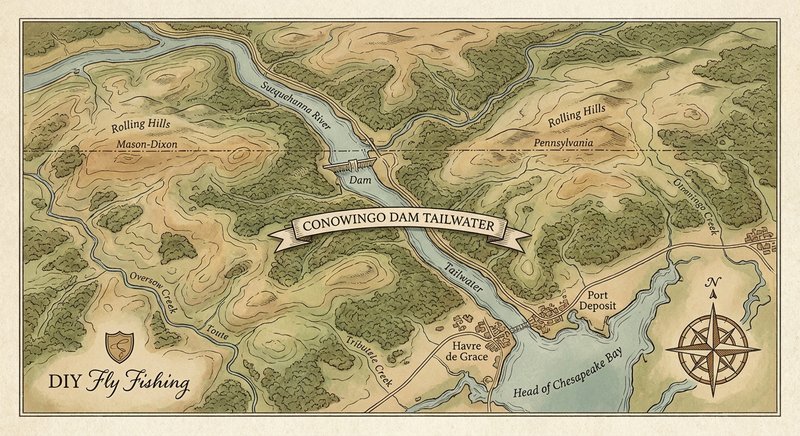
Conowingo Dam Tailwater
Fly fishing in Maryland · Intermediate · Best seasons: Spring, Fall
Target Species
Striped Bass, Smallmouth Bass, Channel Catfish
About This Water
Susquehanna River below dam with striped bass. Famous spring migration fishery.
Fishing Recommendations
The Conowingo Dam Tailwater, located on the lower Susquehanna River in Maryland, is one of the most powerful and productive freshwater-to-brackish fisheries on the East Coast. As the final barrier before the Susquehanna meets the Chesapeake Bay, it serves as a massive collection point for migratory species and a fertile home for residents.
Here is your guide to mastering these turbulent, rewarding waters.
🎣 Location Overview
The Conowingo Tailwater is a high-volume, "big water" fishery. What makes it special is the sheer concentration of biomass. The dam acts as a physical stop for migratory fish and a "chum line" for residents, as baitfish (gizzard shad, herring) are often swept through the turbines.
The water characteristics are diverse: deep pools, massive boulders, fast-moving chutes, and expansive flats further downstream. It is a tailwater in the truest sense, but unlike a placid trout stream, this is a rugged, powerful river that demands respect and heavy-duty gear.
🐟 Target Species & Behavior
Striped Bass (Rockfish)
The stars of the show. In the spring, they push up from the Chesapeake Bay to spawn. In the fall, they follow baitfish schools.
- Behavior: They hold in the seams where fast water meets slow water and behind large "biscuit" boulders. They are aggressive predators, often keying in on injured baitfish.
- Feeding: Primarily Gizzard Shad, Blueback Herring, and Alewives.
Smallmouth Bass
While the Stripers get the glory, the Susquehanna is world-class Smallmouth territory.
- Behavior: They prefer the rocky shelves and eddies away from the main torrent. They are exceptionally strong here due to living in constant current.
- Feeding: Crayfish, hellgrammites, and small shiners.
Channel (and Blue) Catfish
Don't scoff—on a fly rod, a 15-pound Channel Cat in moving water is a freight train.
- Behavior: They sit in deep depressions and at the base of the "boils" near the dam.
- Feeding: They are highly predatory here, often taking large streamers swung deep.
📅 Best Times to Fish
Spring (April – June)
- The Window: This is the prime migration. April sees the arrival of Hickory and American Shad (great fun on light tackle), followed closely by the big "trophy" Striped Bass in May.
- Conditions: High water is common. Watch the dam release schedules closely.
Fall (September – November)
- The Window: As water temperatures drop, Stripers move back up-river to gorge before winter. Smallmouth fishing peaks as they move to deeper wintering holes.
- Conditions: Generally more stable flows than spring.
Best Time of Day
- Low Light: Dawn and dusk are paramount for Stripers, who move into shallower water to hunt.
- Generation Cycles: Fishing is often best when the dam starts or stops generating. The change in flow "rings the dinner bell" for predators.
🪰 Recommended Flies & Techniques
Top Fly Patterns
- For Striped Bass:
- Clouser Minnow: (Chartreuse/White or Gray/White) - The gold standard. Use heavy lead eyes to get down.
- Lefty’s Deceiver: (White/Blue) - For when fish are higher in the water column.
- Gamechangers: Large articulated patterns that mimic the erratic swim of a stunned shad.
- For Smallmouth:
- Hellgrammite patterns: (Black/Olive) - Heavily weighted.
- Murdich Minnow: Great for swinging through riffles.
- For Catfish:
- Woolly Buggers: (Black or Purple) - Size 2-4, fished deep on a sinking line.
Techniques
- The "Susquehanna Swing": Cast 45 degrees downstream with a fast-sinking tip (Type 5 or 7). Let the fly sink, then mend to allow it to swing through the current seams. Striped Bass often hit at the "hang" (the end of the swing).
- Two-Handed Strategy: Many locals use 11-foot switch or trout spey rods to gain extra distance and manage heavy sinking lines without tiring their shoulders.
💡 Pro Tips & Local Knowledge
- The "Shad Kill": After a period of heavy turbine generation, keep an eye out for "stunned" baitfish. If you see gulls diving near the boils, use a white, unweighted streamer and fish it with an erratic, dying action.
- Footing is Everything: The rocks at Conowingo are notoriously slick and uneven. Studded wading boots are mandatory. A wading staff is highly recommended.
- Watch the Gauges: Check the Exelon Generation Schedule or the USGS gauge at Marietta. If the flow is over 100,000 cfs, wading is dangerous and fishing is difficult. Ideal wading flows are generally below 40,000 cfs.
⚠️ Important Information
Access
- Fisherman’s Park: Located on the west bank (Darlington side) directly below the dam. It offers paved parking and easy access to the shoreline.
- Susquehanna State Park: Located a few miles downstream, offering better access for Smallmouth and wading when the dam isn't generating.
Regulations
- Maryland Bay & Coastal Sport License: You typically need this rather than a standard freshwater license because the area is considered tidal.
- Striped Bass Seasons: Maryland DNR has very specific "no-targeting" dates in the spring to protect spawning fish. Always check the current COMAR regulations before heading out, as they change annually.
Safety Warning
The sirens at the dam are not a suggestion. When the siren blares, the water level can rise several feet in minutes. If you hear the horn, immediately move toward the high shore, not just to a higher rock.
Bug Hatches & Matching Flies
| Hatch | Type | Peak months | Time of day | Hook sizes | Matching flies |
|---|---|---|---|---|---|
| White Miller Caddis Nectopsyche | caddis | July, August | Evening/Night | #12-16 | White Miller Dry #14, White Elk Hair Caddis #12-16, White Zonker #10-14 |
| White Fly Ephoron leukon | mayfly | August, September | Dusk/Evening | #12-14 | White Wulff #12-14, Ephoron Spinner #12-14, White Sparkle Dun #14 |
| Hellgrammite Corydalus cornutus | stonefly | June, July | All Day | #2-8 | Murray's Hellgrammite #4-8, Bitch Creek Nymph #6-10, Rubber Legged Stonefly #4-8 |
| Blue-Winged Olive Baetis | mayfly | April, October | Midday | #18-22 | RS2 #20-22, BWO Parachute #18-20, Pheasant Tail Nymph #18-22 |
| Great Western Leadwing Isonychia bicolor | mayfly | June, September | Late Afternoon/Evening | #10-14 | Iso Parachute #12, Prince Nymph #10-14, Zug Bug #12-14 |
| Trico Tricorythodes | mayfly | July, August, September | Early Morning | #20-24 | Trico Spinner #22-24, Griffith's Gnat #20-22 |
| Damselfly Zygoptera | terrestrial | June, July, August | Midday | #10-14 | Adult Damselfly #12, Marabou Damsel Nymph #12-14 |
| Periodical Cicada Magicicada | terrestrial | May, June | All Day | #4-8 | Project Cicada #6-8, Chernobyl Ant #6-10 |
| Tan Caddis Hydropsyche | caddis | May, June | Evening | #14-18 | Elk Hair Caddis (Tan) #14-16, LaFontaine's Deep Sparkle Pupa #14-16 |