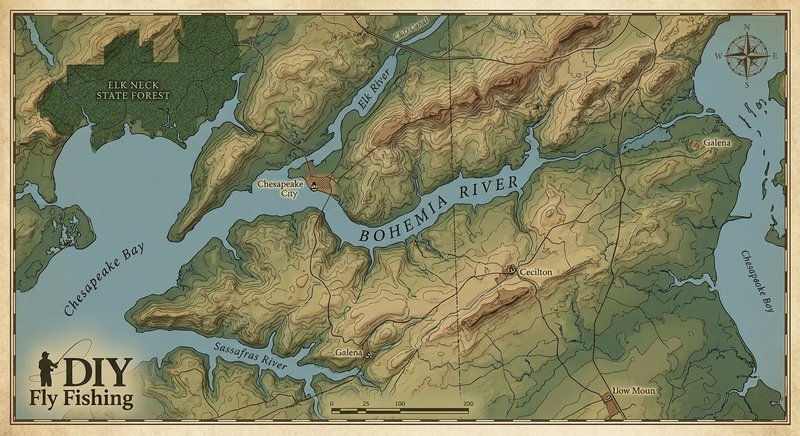
Bohemia River
Fly fishing in Maryland · Beginner · Best seasons: Spring, Summer, Fall
Target Species
Largemouth Bass, White Perch, Catfish
About This Water
Cecil County tidal river with bass fishing. Quiet fishing away from crowds.
Fishing Recommendations
Tight lines! As an expert guide familiar with the upper Chesapeake tributaries, I can tell you that the Bohemia River is one of the hidden gems of Cecil County, Maryland. While many fly anglers head to the mountains for trout, those in the know head to the "Bo" for some of the best tidal fly fishing in the Mid-Atlantic.
Here is your comprehensive guide to fly fishing the Bohemia River.
🎣 Location Overview
The Bohemia River is a short, wide, brackish tributary of the Elk River, located on the Eastern Shore of Maryland. What makes it special is its tidal diversity. It transitions from narrow, winding creeks at its headwaters to a broad, scenic expanse as it meets the Elk.
The water is generally murky to stained (typical of the upper Bay), which actually works in the fly angler's favor as fish are less "leader shy." The shoreline is a mix of high sandy bluffs, dense marsh grass, and an abundance of man-made structures like private docks and pilings. Because it is more sheltered than the open Chesapeake, it is a paradise for kayak anglers and skiffs.
🐟 Target Species & Behavior
Largemouth Bass
These are the kings of the Bohemia. Unlike pond bass, tidal largemouths are "athletes." They are accustomed to moving water and are highly opportunistic.
- Behavior: They hold tight to "hard" structure (docks, fallen logs) during high tide and move to the edges of grass beds or drop-offs during low tide to intercept bait being flushed out.
- Feeding: Their diet consists of mummichogs (killifish), bluegill, crayfish, and the occasional juvenile river herring.
White Perch
Pound for pound, one of the most fun species on a 3-weight or 4-weight rod.
- Behavior: They are schooling fish. If you catch one, you’ll likely catch twenty. They love "hard" bottoms (gravel/shell) and are almost always found around bridge pilings and deep dock shadows.
- Feeding: They focus on grass shrimp and very small minnows.
Catfish (Channel and Blue)
Yes, you can target these on the fly! The Bohemia has a growing population of invasive Blue Catfish, which are aggressive predators.
- Behavior: They sit in the deeper channels and holes during the day but move into the shallows of the flats at night or on overcast days to hunt.
- Feeding: They rely on vibration and scent. Large, dark-colored streamers that move a lot of water will trigger a strike.
📅 Best Times to Fish
Optimal Seasons
- Spring (April – June): This is prime time. As the water hits 55°F, bass become aggressive pre-spawn. White perch run up the river in massive numbers to spawn in the fresh headwaters.
- Summer (July – August): Best for topwater action at dawn and dusk. During the day, fish move deeper or under the thickest dock cover.
- Fall (September – November): The "Second Spring." As temperatures drop, bass gorge on baitfish to prepare for winter. The clarity often improves this time of year.
The Tidal Window (Critical!)
In the Bohemia, the tide matters more than the time of day.
- Best Window: The last two hours of the falling tide and the first hour of the rising tide.
- Why: A falling tide drains the marshes, forcing baitfish and shrimp into concentrated channels where predators wait to ambush them.
🪰 Recommended Flies & Techniques
For Largemouth Bass
- Patterns:
- BoogleBugs (Poppers): Size 4, in Chartreuse or Black.
- Gamechangers: White or Shad patterns (3-4 inches).
- Clouser Minnows: Chartreuse/White or Red/White with lead eyes to get deep.
- Technique: Cast as tight to the structure as possible. If you aren't hitting the wooden pilings with your fly, you aren't close enough. Use a "strip-strip-pause" retrieve.
For White Perch
- Patterns:
- Chesapeake Sabiki Fly: Very small, flashy streamers (Size 8-10).
- Glass Minnows: Simple epoxy-head flies.
- Grass Shrimp patterns: Tan or translucent.
- Technique: Use a sinking-tip line. Cast near docks or bridge pilings and use short, erratic strips.
For Catfish
- Patterns:
- Black Bunny Leeches: Large (Size 1/0) with heavy dumbbell eyes.
- Wooly Buggers: Oversized, in dark purple or black.
- Technique: You must get the fly to the bottom. "Slow-roll" the fly across the bottom of channel edges.
💡 Pro Tips & Local Knowledge
- The "Iron Bridge" Area: The area near the MD Route 213 bridge (Bohemia River Bridge) is a biological highway. The pilings here create eddies that hold perch all summer long.
- Focus on the "Shadow Line": In the summer, bass will hide in the shade of the docks. Even a 6-inch strip of shade is enough to hold a 4lb bass. Skip your fly under the docks like you would a plastic worm.
- Watch the Ospreys: If you see Ospreys diving, they are targeting menhaden or perch. Fish that immediate area; the bass are likely underneath the school picking up the scraps.
- The Scotchman Creek: This branch of the river is shallower and more "fishy" for kayak anglers looking to avoid the wind and larger boat traffic.
⚠️ Important Information
- Access:
- Bohemia Harbor & Marinas: There are several private marinas. Ensure you have permission or use public ramps.
- Elk Neck State Park: Nearby, providing a good jumping-off point for boaters.
- Regulations:
- You need a Maryland Tidal Sport Fishing License.
- Invasive Species: If you catch a Blue Catfish, the MD DNR encourages you to keep it (they are delicious) rather than releasing it, as they are invasive.
- Safety: The Bohemia can get "choppy" quickly if a West wind blows up the river from the Chesapeake. Always check the wind forecast before heading out in a small craft.
The Bohemia is a rewarding, soulful river. Approach it with patience, respect the tides, and you'll find some of the best warm-water fly fishing Maryland has to offer. Tight lines!
Bug Hatches & Matching Flies
| Hatch | Type | Peak months | Time of day | Hook sizes | Matching flies |
|---|---|---|---|---|---|
| Midges Chironomidae | midge | March, April, October, November | All day | #18-24 | Zebra Midge #18-22, Griffith's Gnat #20-22 |
| Giant Yellow Mayfly Hexagenia limbata | mayfly | June, July | Evening/Night | #6-10 | Hexagenia Spinner #6-8, Burrowing Mayfly Nymph #8-10 |
| Blue-Winged Olive Baetis spp. | mayfly | April, May, September, October | Afternoon | #18-22 | RS2 #20-22, BWO Sparkle Dun #18-20 |
| Common Blue Damselfly Enallagma cyathigerum | terrestrial | June, July, August | Mid-day | #10-14 | Adult Damsel #10-12, Marabou Damsel Nymph #12-14 |
| White Miller Nectopsyche spp. | caddis | July, August | Evening | #12-16 | White Elk Hair Caddis #14-16, White LaFontaine Emerger #14 |
| Terrestrial Ants Formicidae | terrestrial | July, August, September | Afternoon | #12-18 | Black Foam Ant #14-16, Cinnamon Ant #16-18 |
| Green Darner Anax junius | terrestrial | July, August | All day | #4-8 | Dragonfly Nymph #6-8, Blue Bottle/Large Poppers #4-8 |
| Japanese Beetle Popillia japonica | terrestrial | July, August | Afternoon | #10-14 | Foam Beetle #12-14, Coffee's Sparkle Beetle #12 |