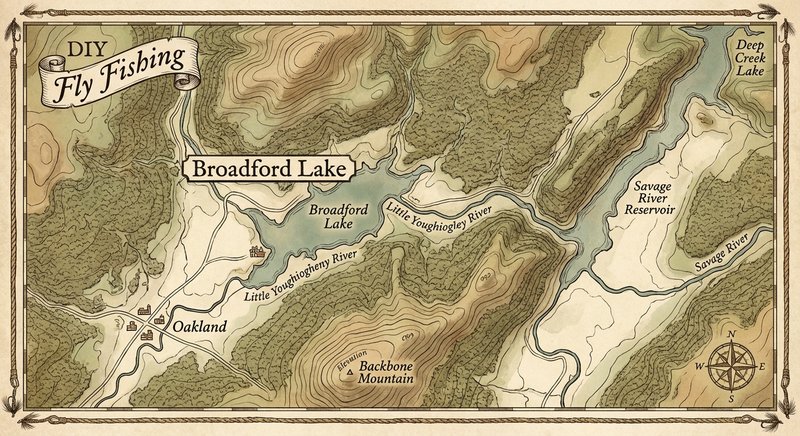
Broadford Lake
Fly fishing in Maryland · Beginner · Best seasons: Spring, Summer, Fall
Target Species
Largemouth Bass, Crappie, Bluegill
About This Water
Garrett County lake with bass and panfish. Western Maryland recreational fishing.
Fishing Recommendations
Broadford Lake is a hidden gem tucked away in the mountains of Garrett County, near Oakland, Maryland. At roughly 140 acres, this municipal reservoir offers a tranquil, "electric-only" environment that is perfect for fly anglers seeking a high-quality experience without the chaos of large powerboats.
As your guide, here is the breakdown for tackling Broadford Lake.
🎣 Location Overview
Broadford Lake is a high-altitude reservoir (approx. 2,400 ft) characterized by exceptionally clear water and a diverse underwater topography. Unlike the siltier lakes of the lowlands, Broadford has significant submerged vegetation, lily pad fields, and stands of drowned timber.
What makes it special is the tranquility. Because internal combustion engines are prohibited, the water remains calm, allowing for stealthy approaches and delicate presentations. It is an ideal "small water" destination where a float tube, kayak, or small boat can cover the entire lake in a single day.
🐟 Target Species & Behavior
Largemouth Bass
The bass here are healthy and lean. Due to the clear water, they are highly visual hunters.
- Behavior: They utilize the extensive weed beds and lily pads as ambush points.
- Holdings: Look for the "drop-off" edges where the shallow shelf meets the deeper channels. During the heat of the day, they tuck deep into the shadows of the floating docks and fallen timber.
- Forage: They primary feed on bluegill, crayfish, and occasional frog activity near the banks.
Crappie
Broadford holds a very respectable population of Black Crappie.
- Behavior: They are school-oriented. If you catch one, there are likely twenty more nearby.
- Holdings: They love vertical structure. Look for them around the submerged timber near the dam and under the larger fishing piers.
- Forage: Small minnows and zooplankton.
Bluegill
These are the "workhorses" of the lake. They are abundant and grow to impressive "dinner plate" sizes.
- Behavior: Highly opportunistic. They will rise to a dry fly even in the middle of a sunny day.
- Holdings: Shallow flats and around any man-made structure.
📅 Best Times to Fish
- Spring (May – June): This is the prime window. As the water warms, the fish move into the shallows to spawn. The bass become aggressive and territorial.
- Summer (July – August): Best during the "Golden Hours"—dawn and dusk. Mid-day can be tough as fish retreat to deeper, cooler water or deep under the weed mats.
- Fall (September – October): The "Second Spring." As temperatures drop, fish move shallow again to gorge themselves before winter. The colors of the Garrett County foliage make this the most scenic time to fish.
- Prime Window: 6:00 AM to 10:00 AM and 6:00 PM until dark. Overcast, drizzly days are "magic" for topwater bass action here.
🪰 Recommended Flies & Techniques
For Largemouth Bass
- Flies:
- Topwater: BoogleBugs or Umpqua Swimming Frogs (Size 2-4) in Green or Yellow.
- Subsurface: Game Changers or Woolly Buggers (Olive or Black) to mimic crayfish and baitfish.
- Technique: "Pounce and Pause." Cast a popper into a pocket in the lily pads. Let the rings disappear. Give it one sharp pop, then wait 5-10 seconds. Most strikes happen when the fly is stationary.
For Crappie
- Flies:
- Micro-streamers: Crappie Candy or small White Clouser Minnows (Size 8-10).
- Nymphs: Bead-head Prince Nymphs.
- Technique: Use a slow, rhythmic strip-strip-pause retrieve. Use a sink-tip line or a long leader to get the fly down 5-8 feet near submerged wood.
For Bluegill
- Flies:
- Dries: Foam Spiders (Black or Chartreuse) or White Miller Moths.
- Droppers: A size 14 Pheasant Tail Nymph tied 18 inches below a foam popper.
- Technique: The "Dry-Dropper" is lethal. The popper acts as an indicator, and the nymph catches the fish too shy to break the surface.
💡 Pro Tips & Local Knowledge
- The "High Altitude" Factor: Because Broadford is in the mountains, the "spring" spawn often starts 2-3 weeks later than in Baltimore or DC. Don't rush the season; wait for a string of 70-degree days in May.
- Focus on the West End: The western end of the lake (opposite the dam) features shallower water and more lily pads. This is the "nursery" and is usually the most productive area for fly anglers.
- Stealth is Key: In the clear water of Broadford, a heavy splash or a shadow can spook a trophy bass. Use longer leaders (9ft to 12ft) than you would usually use for bass.
- The "Pier" Strategy: The public fishing piers attract baitfish. Even if people are fishing off them, the areas underneath and around the piers are prime real estate for big crappie.
⚠️ Important Information
- Access: Entry is via Broadford Park. There is a modest seasonal gate fee for non-residents of Oakland.
- Vessel Rules: Electric Motors Only. If you have a gas outboard on your boat, you must keep it tilted up and out of the water at all times.
- Permits: A valid Maryland Non-Tidal Fishing License is required for everyone 16 and older.
- Environment: The lake is a primary water source for the town. Keep it pristine—pack out all spent tippet and trash.
- Winds: Being in the mountains, the wind can whip up quickly across the open water near the dam. Always check the mountain weather forecast before heading out in a kayak.
Guide’s Final Word: Broadford is where I go when I want to slow down. It’s not about "power fishing"; it’s about precision casts into lily pad pockets and enjoying the mountain air. Tight lines!
Bug Hatches & Matching Flies
| Hatch | Type | Peak months | Time of day | Hook sizes | Matching flies |
|---|---|---|---|---|---|
| Chironomids (Midges) Chironomidae | midge | March, April, October | All Day | #18-24 | Zebra Midge #18-22, Griffith's Gnat #18-22, Chan's Chironomid Pupa #16-18 |
| Speckled Spinner (Callibaetis) Callibaetis ferrugineus | mayfly | May, June, September | Late Morning | #14-16 | Parachute Adams #14-16, Hare's Ear Nymph #14-16, Callibaetis Spinner #16 |
| Blue-Winged Olive Baetis | mayfly | April, October | Afternoon | #18-22 | BWO Sparkle Dun #18-20, Pheasant Tail Nymph #18-20 |
| Damselfly Enallagma | terrestrial | June, July | Midday | #10-14 | Marabou Damsel Nymph #10-12, Adult Blue Damsel #12-14 |
| Giant Yellow Drake (Hex) Hexagenia limbata | mayfly | June, July | Dusk/Night | #6-10 | Hexagenia Parachute #6-8, Hex Nymph #6-10 |
| Black Ants Formicidae | terrestrial | July, August | Afternoon | #14-18 | Black Foam Ant #14-18, Fur Ant #16-18 |
| Cinnamon Caddis Hydropsyche | caddis | May, June | Evening | #14-16 | Elk Hair Caddis #14-16, LaFontaine's Emergent Pupa #14-16 |
| Dragonfly Anisoptera | terrestrial | July, August | All Day | #4-10 | Dragonfly Nymph (Olive) #6-10, Woolly Bugger #4-8 |
| Scuds Gammarus | terrestrial | April, May, September | All Day | #14-18 | Ray Charles #14-16, Olive Scud #14-18 |