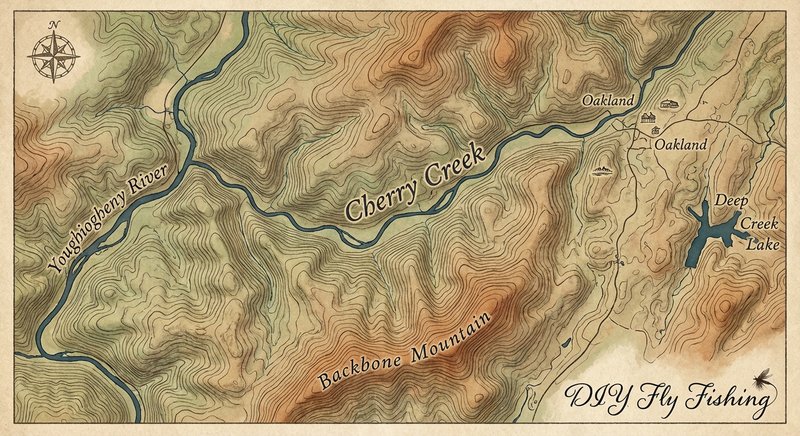
Cherry Creek
Fly fishing in Maryland · Intermediate · Best seasons: Spring, Summer, Fall
Target Species
Brook Trout, Brown Trout
About This Water
Western Maryland stream with wild brook and brown trout. Scenic mountain setting.
Fishing Recommendations
As an expert guide familiar with the wild waters of Western Maryland, I can tell you that Cherry Creek in Garrett County is a hidden gem for the angler who values solitude and wild fish over easy access and trophy sizes. This is a classic Appalachian freestone stream that demands stealth, precision, and an appreciation for the rugged beauty of the Allegheny Highlands.
Here is your comprehensive guide to fly fishing Cherry Creek.
🎣 Location Overview
Cherry Creek is located in the far western reaches of Maryland, near McHenry and the Deep Creek Lake area. It is primarily a tributary to the Youghiogheny River. What makes this water special is its character: it is a high-elevation stream that winds through dense rhododendron thickets, hemlock forests, and open mountain bogs (including parts of the Cranberry Swamp).
The water is generally tea-colored due to tannins from the surrounding wetlands and is quite acidic—a characteristic of the region. It is a small-to-medium-sized stream where "tight-quarters" fishing is the norm. Anglers love it because it offers one of the few opportunities in Maryland to catch truly wild, stream-born Brook and Brown trout in a setting that feels much more like remote Canada than the Mid-Atlantic.
🐟 Target Species & Behavior
- Native Brook Trout: These are the crown jewels of Cherry Creek. They are opportunistic feeders but incredibly wary. They hold in the coldest, most oxygenated water—usually right at the head of pools or tucked under undercut banks.
- Wild Brown Trout: The Browns here are crafty. They tend to dominate the larger, deeper pools and the undercut banks in the lower reaches. Unlike the aggressive Brookies, the Browns require a more methodical approach and often wait for low-light conditions to feed heavily.
Behavior: Because the water is nutrient-poor compared to limestone streams, these fish are not "selective" in the traditional sense, but they are "spook-sensitive." If they see your shadow or your fly line, the pool is finished for the next hour.
📅 Best Times to Fish
Optimal Seasons
- Spring (April – June): This is the prime window. Water levels are stable, and the major hatches (Quill Gordons, Hendricksons, and March Browns) occur. The fish are hungry after the cold mountain winter.
- Early Fall (September – October): A magical time. The Brook trout take on their brilliant spawning colors (be careful not to step on redds/spawning beds in late October). The Brown trout become more aggressive as they prepare to spawn.
Best Times of Day
- Late Spring/Summer: Early morning and "the witching hour" (last 60 minutes of light) are best.
- Early Spring: Mid-day when the sun warms the water slightly, activating insect life.
Prime Conditions
Cloudy, overcast days are superior on Cherry Creek. The low light gives the trout a sense of security, pulling them out from under the heavy cover of rhododendrons.
🪰 Recommended Flies & Techniques
Top Fly Patterns
- Dry Flies:
- Royal Wulff or Royal Coachman (Size 14-18): Excellent "attractor" patterns that are easy to see in the shadows.
- Elk Hair Caddis (Size 14-16): A staple for the heavy caddis activity in the gorge sections.
- Yellow Stimulator (Size 12-16): Mimics stoneflies and is buoyant enough to hang a dropper.
- Nymphs:
- Pheasant Tail (Size 16-20): Mimics almost any mayfly nymph in the system.
- Bead-head Hare’s Ear (Size 14-16): Great for the deeper runs.
- Terrestrials (Summer):
- Black Ants and Foam Beetles (Size 16-18): Essential when the hatches thin out in July and August.
Effective Techniques
- The "Bow and Arrow" Cast: You will need this. Overhanging brush is constant; often, a traditional backcast is impossible.
- Dry-Dropper: Use a buoyant dry fly (like a Stimulator) with a small, unweighted Pheasant Tail nymph tied 12–18 inches below it. This covers both levels of the water column in shallow pools.
- Stealth Approach: Always fish upstream. Approach pools on your knees if necessary.
💡 Pro Tips & Local Knowledge
- Watch the "Tannin" Tint: The water can look dark, making it hard to judge depth. Always probe the "black holes" near logs—that’s where the 12-inch+ Browns hide.
- The "Bog" Factor: Parts of Cherry Creek flow through soft, silty bottom areas near the wetlands. Be careful wading; you can sink to your waist in muck. Stick to the rocky/gravelly sections for safer footing.
- Short Rods are King: Leave your 9-foot 5-weight at home. A 7-foot to 7.5-foot 3-weight or 4-weight rod is the perfect tool for navigating the tight canopy.
- Local Secret: Focus on the confluence areas where smaller cold springs enter the creek; during the heat of July, Brookies will stack up in these "thermal refuges."
⚠️ Important Information
Access
Most of Cherry Creek runs through private land or rugged state forest areas. Much of the best fishing is within the Garrett State Forest or near the Cranberry Swamp. Always check for "Posted" signs.
Regulations & Permits
- License: A Maryland Non-Tidal Fishing License and a Trout Stamp are mandatory.
- Regulations: Significant portions of Cherry Creek are managed under Wild Trout Management regulations. This often means Catch and Release Only or very restrictive creel limits. Use barbless hooks to ensure the survival of these wild gems.
- Special Considerations: This is bear country. While they generally avoid humans, be mindful of your surroundings. Also, cell service is spotty to non-existent in the Cherry Creek drainage—download your maps for offline use before heading out.
Bug Hatches & Matching Flies
| Hatch | Type | Peak months | Time of day | Hook sizes | Matching flies |
|---|---|---|---|---|---|
| Blue Winged Olive Baetis tricaudatus | mayfly | March, April, September, October | Mid-day/Afternoon | #18-22 | RS2 #20-22, Parachute BWO #18-20, WD-40 #20-22 |
| Quill Gordon Epeorus pleuralis | mayfly | April | Mid-day | #12-14 | Quill Gordon Dry #12-14, Hare's Ear Nymph #12-14 |
| Hendrickson Ephemerella subvaria | mayfly | April, May | Afternoon | #12-14 | Hendrickson Parachute #14, Red Quill #12-14, Pheasant Tail Nymph #12-14 |
| Sulphur Ephemerella invaria | mayfly | May, June | Evening | #14-18 | Sulphur Parachute #16-18, CDC Sulphur Emerger #14-16, Sulphur Dun #16 |
| Tan Caddis Hydropsyche | caddis | May, June, July | Morning/Evening | #14-16 | Elk Hair Caddis (Tan) #14-16, LaFontaine's Deep Sparkle Pupa #14-16, Holy Grail #14-16 |
| Green Drake Ephemera guttulata | mayfly | May, June | Late Evening | #8-10 | Coffin Fly #8-10, Green Drake Nymph #8-10 |
| Light Cahill Stenacron interpunctatum | mayfly | June, July | Evening | #12-14 | Light Cahill Dry #12-14, Cream Usual #14 |
| Cinnamon Caddis Chimarra | caddis | June, July, August | Evening | #16-18 | Iris Caddis #16-18, Elk Hair Caddis (Cinnamon) #16-18 |
| Ants and Beetles Formicidae / Coleoptera | terrestrial | July, August, September | All Day | #14-20 | Black Foam Ant #16-20, Chernobyl Ant #12-14, Crowe Beetle #14-16 |
| Midges Chironomidae | midge | January, February, March, December | Mid-day | #20-24 | Zebra Midge #20-24, Griffith's Gnat #20-22 |