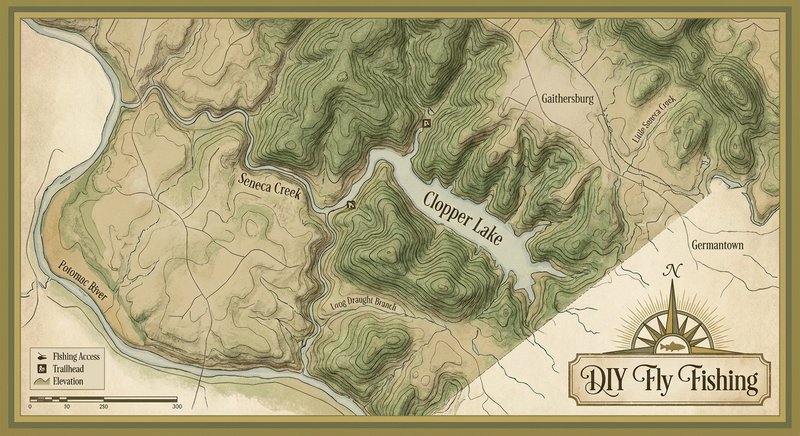
Clopper Lake
Fly fishing in Maryland · Beginner · Best seasons: Spring, Summer, Fall
Target Species
Largemouth Bass, Bluegill, Catfish
About This Water
Montgomery County lake with bass and panfish. Seneca Creek State Park.
Fishing Recommendations
As an expert guide who has spent plenty of time navigating the suburban oases of the Mid-Atlantic, I can tell you that Clopper Lake is a gem tucked away in Seneca Creek State Park (Gaithersburg, MD). It’s a 90-acre impoundment that offers some of the best warm-water fly fishing in Montgomery County.
While it is a pressured fishery due to its location, the fly angler who understands structure and timing can have incredibly productive days here.
🎣 Location Overview
Clopper Lake is a man-made reservoir characterized by its "finger" layout, providing miles of shoreline relative to its size. What makes it special for the fly fisher is the submerged structure. The lake is famous for its "standing timber"—trees that were left standing when the valley was flooded—and its extensive lily pad fields.
The water is generally stained (murky), which is actually an advantage for fly anglers; it allows you to get a bit closer to the fish without spooking them, and it makes fish more reliant on their lateral lines to sense the vibration of your fly.
🐟 Target Species & Behavior
Largemouth Bass
The king of Clopper Lake. These fish are ambush predators. They hold tight to the submerged timber, under the shade of lily pads, and along the steep drop-offs near the dam. They feed primarily on bluegill, crayfish, and leopard frogs.
Bluegill (and Pumpkinseed)
Clopper has a massive population of panfish. They are aggressive, plentiful, and perfect for introducing new anglers to the sport. They hover around the docks, shallow brush piles, and the edges of the weed beds.
Catfish (Channel Catfish)
While rarely targeted on the fly, Clopper has a healthy population of Channel Cats. They are more predatory than people realize. During the low-light hours of summer, they move into the shallows to hunt baitfish and can be caught on heavy, dark streamers stripped slowly along the bottom.
📅 Best Times to Fish
- Spring (April – June): This is prime time. As the water hits 55-60°F, bass move into the shallow coves to spawn. Look for "beds" in the sandy pockets.
- Summer (July – August): Mid-day can be tough and hot. Focus on the "Golden Hours"—the first 90 minutes of light and the last hour before sunset. This is when the topwater action explodes.
- Fall (September – early November): As temperatures drop, bass become aggressive to bulk up for winter. Fish the points and the remaining green weed lines.
Best Conditions: Overcast days are gold at Clopper Lake. The fish feel more secure moving away from deep cover, and the "topwater window" can stay open all day.
🪰 Recommended Flies & Techniques
For Largemouth Bass
- Topwater: BoogleBugs (Size 4) or any foam popper in "Frog" or "White/Red."
- Technique: Cast against the timber or into pockets in the lily pads. Let the rings dissipate completely before your first twitch.
- Sub-surface: Gamechangers or Woolly Buggers (Black or Olive, Size 4-6).
- Technique: Use a sink-tip line to get the fly down 4-6 feet near the dam or the creek channel edges.
For Bluegill
- Dry/Dropper: A Foam Spider (Yellow or Black) with a Bead-head Hare’s Ear Nymph (Size 14) tied 12 inches behind it.
- Technique: Cast near the shore. If they don't hit the spider, they'll grab the nymph on the sink.
For Catfish
- Streamers: Black Bunny Leeches or heavy Clouser Minnows.
- Technique: Fish these on a full-sinking line. "Drag" the fly across the bottom with very slow, 2-inch strips.
💡 Pro Tips & Local Knowledge
- Rent a Boat: While there is a shore path, the best fish live in the "standing timber" in the middle of the lake's fingers. Seneca Creek State Park offers boat rentals (seasonal). If you have a kayak or canoe, use it. Getting 20 feet off the bank allows you to cast toward the shore, which is much more effective.
- The "Middle Creek" Arm: The furthest finger of the lake (away from the dam) is generally shallower and woodier. This is the "Big Bass" nursery. If you want a trophy, head to the back where the creek enters the lake.
- The Dam Face: In the heat of the summer, fish the rip-rap (rocks) near the dam. The water is deepest here and holds more oxygen.
- Stealth is Key: Because Clopper is a popular park, the fish are used to seeing people. Wear earthy colors and keep your false casting to a minimum to avoid lining the fish.
⚠️ Important Information
- Access: Entry is through Seneca Creek State Park (11950 Clopper Rd, Gaithersburg, MD). Note that there is a small park entry fee ($3 per person for MD residents, $5 for non-residents).
- Regulations: A Maryland Non-Tidal Fishing License is strictly required for anyone 16 or older.
- Boating: Only electric trolling motors are allowed. No gasoline engines.
- Park Hours: The park typically opens at 8:00 AM and closes at sunset. This is important to remember because some of the best fishing happens at dusk, but you must be out of the gates on time.
- Wading: Be careful. The bottom of Clopper Lake is very silty and "mucky." If you wade, you may sink up to your knees in mud. Fishing from a vessel or the bank is highly recommended over wading.
Guide’s Final Word: Don't overthink your fly choice. At Clopper, presentation and proximity to wood are more important than the exact shade of your popper. Put it in the shadows, and hold on!
Bug Hatches & Matching Flies
| Hatch | Type | Peak months | Time of day | Hook sizes | Matching flies |
|---|---|---|---|---|---|
| Blue Damselfly Enallagma spp. | other | June, July, August | Late Morning/Afternoon | #10-14 | Marabou Damselfly Nymph #12-14, Adult Damsel Dry #12-14 |
| Green Darner Dragonfly Anax junius | other | July, August, September | All Day | #4-8 | Dragonfly Nymph (Dredge) #6-8, Deer Hair Dragonfly #4-6 |
| Speckled Spinner (Callibaetis) Callibaetis ferrugineus | mayfly | May, June, September | Morning/Evening | #12-16 | Callibaetis Nymph #14-16, Parachute Adams #14-16 |
| Midges (Chironomids) Chironomidae | midge | March, April, October, November | All Day | #18-24 | Zebra Midge #18-22, Griffith's Gnat #20-22 |
| Black Carpenter Ants Camponotus spp. | terrestrial | July, August | Afternoon/Evening | #12-16 | Black Foam Ant #14-16, Chernobyl Ant #12 |
| Angler's Curse (Caenis) Caenis latipennis | mayfly | July, August | Late Evening/Dusk | #22-26 | Caenis Spinner #24-26, White Micro-Midge #22 |
| Japanese Beetle Popillia japonica | terrestrial | June, July | Morning/Afternoon | #10-14 | Foam Japanese Beetle #12-14 |
| Freshwater Shrimp (Scuds) Gammarus spp. | other | April, May, September | All Day | #14-18 | Olive Scud #14-18, Ray Charles #16-18 |