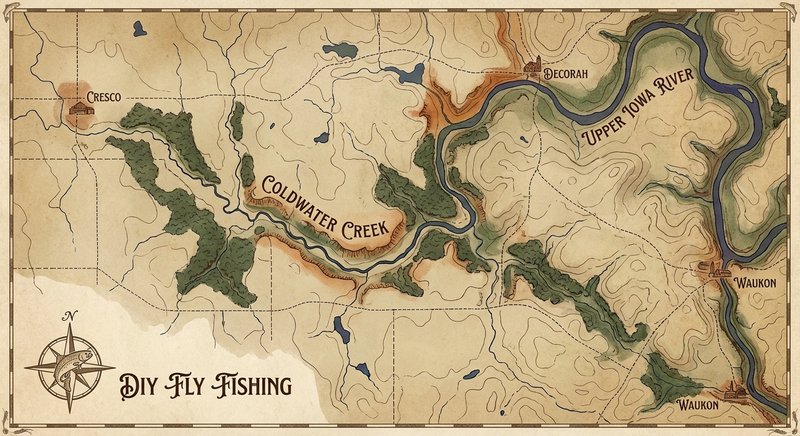
Coldwater Creek
Fly fishing in Iowa · advanced · Best seasons: spring, summer, fall
Target Species
Brook Trout, Brown Trout
About This Water
Winneshiek County spring creek with wild brookies. Small stream requires stealth.
Fishing Recommendations
As an expert guide in the Driftless Area, I can tell you that Coldwater Creek in Winneshiek County, Iowa, is one of the crown jewels of the region. It is one of the few streams in the state that supports a robust population of both wild, naturally reproducing Brown Trout and the "holy grail" of the Driftless—wild Brook Trout.
Here is your comprehensive guide to fishing Coldwater Creek.
🎣 Location Overview
Coldwater Creek is located north of Decorah, Iowa, near the Minnesota border. What makes this water truly special is its source: Coldwater Spring, which gushes from a cavern at the base of a towering limestone bluff. Because the water emerges at a constant 48–50°F, the creek stays cool enough for trout to thrive even during the humid Iowa summers and remains largely ice-free in the winter.
The creek flows through a deep, timbered valley within the Cold Water Creek State Preserve. The landscape is classic Driftless: steep limestone bluffs, rolling hills, and lush riparian corridors. The water is crystalline, with a classic "riffle-run-pool" sequence and plenty of undercut banks created by the limestone shelf.
🐟 Target Species & Behavior
- Brook Trout (Wild): These are the only trout native to Iowa. In Coldwater Creek, they tend to dominate the upper reaches closer to the spring source. They are opportunistic feeders but highly skittish. Look for them in the swifter, highly oxygenated riffles and at the heads of pools.
- Brown Trout (Wild): The Browns here are wary and sophisticated. They grow larger than the Brookies and tend to claim the deeper holes and the dark shadows under log jams or undercut limestone ledges. They are most active during low-light transitions.
- Behavior: Because the water is so clear, these fish have excellent "windows." If you can see them, they have likely already seen you. Stealth is more important here than in almost any other Iowa stream.
📅 Best Times to Fish
- Spring (March – May): This is the prime window for aquatic insect hatches. Early spring sees Blue Winged Olives (BWO) and Midges. As May approaches, the Caddis activity picks up significantly.
- Summer (June – August): This is Terrestrial Season. While many Iowa streams get too warm in July, Coldwater’s spring influence keeps it fishable. Early mornings are best to avoid the heat. The Trico hatch (tiny white/black mayflies) occurs in the mornings and can be a technical challenge for even expert anglers.
- Fall (September – October): My personal favorite. The Brookies and Browns take on brilliant spawning colors. The fish become more aggressive as they prepare for the spawn. Large streamers can move big, territorial Browns during this time.
🪰 Recommended Flies & Techniques
Top Fly Patterns
- The "Pink Squirrel" (Size 14-18): An Iowa legend. This nymph, with its flashy thorax and bead head, works year-round.
- Scuds & Sowbugs (Size 16-20): These are the primary food source in spring-fed limestone streams. Gray, olive, or tan colors are essential.
- Elk Hair Caddis (Size 14-18): The go-to dry fly for the heavy evening Caddis hatches.
- Hi-Vis Trico (Size 20-24): Necessary for the technical morning hatches in mid-to-late summer.
- Hippie Stomper or Foam Beetles: Excellent for "hopper-dropper" rigs in the summer months.
Techniques
- The "Iowa Stealth" Approach: Approach the stream from downstream and cast upstream. Stay low—crawling on your knees to the bank is often necessary to avoid "lining" the fish or casting a shadow.
- Nymphing: Use a European-style tight-line nymphing technique or a very small, sensitive strike indicator. The takes are often subtle.
- Streamer Stripping: On overcast days or when the water is slightly stained after a rain, strip a small Wooly Bugger or a Black Leech pattern through the deep undercuts.
💡 Pro Tips & Local Knowledge
- Focus on the Upper Preserve: The water within the State Preserve is generally the highest quality. As you move further downstream toward the Upper Iowa River, the water warms up and the trout density thins out.
- Match the Micro-Hatch: If you see fish rising but they ignore your Adams, they are likely on Midges or Tricos. You must go smaller than you think—size 22 or 24.
- The "Shadow" Rule: On Coldwater Creek, if your shadow hits the water, the pool is "blown" for 20 minutes. Always keep the sun in your face or cast from behind trees.
- Water Level Check: Check the USGS gauges for the nearby Upper Iowa River. If the river is flooding, Coldwater Creek might be high but will usually clear much faster than other area streams due to its spring-fed nature.
⚠️ Important Information
- Access: Much of the best fishing is within the Cold Water Creek State Preserve. There is a main parking area near the spring. Be prepared for some hiking; the terrain is steep and can be muddy.
- Regulations:
- Artificial Lures Only: In many stretches of Coldwater, you are restricted to artificial lures/flies.
- Catch and Release: Please practice 100% catch and release for Brook Trout to preserve this rare Iowa resource. Check current Iowa DNR regulations for specific length limits on Brown Trout.
- Permits: An Iowa Fishing License AND a Trout Fee are required for all anglers fishing for or possessing trout.
- Safety: The rocks are incredibly slippery limestone. Felt-soled boots or studs are highly recommended. Also, be aware that Coldwater Cave is adjacent—do not attempt to enter the cave system without professional guidance and permits, as it is dangerous and protected.
Guide's Final Word: Coldwater Creek is not a "numbers" stream for beginners; it is a "finesse" stream for the angler who appreciates wild fish and beautiful scenery. Bring your 3-weight or 4-weight rod, a long 5X or 6X leader, and your best sneaking skills.
Bug Hatches & Matching Flies
| Hatch | Type | Peak months | Time of day | Hook sizes | Matching flies |
|---|---|---|---|---|---|
| Blue-Winged Olive (BWO) Baetis spp. | mayfly | March, April, September, October | Late Morning/Afternoon | #18-24 | RS2 #18-22, Parachute Adams #18-22, Pheasant Tail Nymph #18-20 |
| Sulphur Ephemerella invaria/dorothea | mayfly | May, June | Evening | #14-18 | Sulphur Sparkle Dun #16-18, CDC Bubbleback Emerger #16-18, Pheasant Tail #14-16 |
| Grannom Caddis Brachycentrus occidentalis | caddis | April, May | Mid-day/Afternoon | #14-16 | Elk Hair Caddis (Dark) #14-16, LaFontaine's Deep Sparkle Pupa #14-16, Peacock Caddis #14-16 |
| Trico Tricorythodes spp. | mayfly | July, August, September | Early Morning | #20-26 | Trico Spinner #20-24, Sunken Trico Spinner #22-24, Griffith's Gnat #20-22 |
| Midges Chironomidae | midge | January, February, March, December | Late Morning/Mid-day | #18-24 | Zebra Midge #18-22, Griffith's Gnat #18-22, Morgan's Midge #20-22 |
| Light Cahill Stenacron interpunctatum | mayfly | June, July | Evening/Dusk | #12-14 | Light Cahill #12-14, Cream Usual #14, Gold Ribbed Hare's Ear #12-14 |
| Terrestrials (Ants & Beetles) Formicidae / Coleoptera | terrestrial | July, August, September | All Day | #12-18 | Black Foam Beetle #14-16, Cinnamon Ant #16-18, Chernobyl Ant #10-12 |
| Crane Fly Tipulidae | other | August, September | Afternoon/Evening | #10-14 | Daddy Long Legs #10-12, Crane Fly Larva #10-12 |