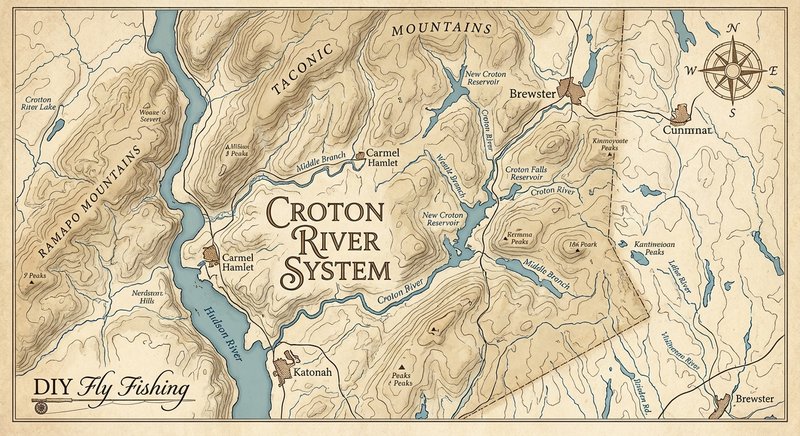
Croton River System
Fly fishing in New York · Beginner · Best seasons: Spring, Summer, Fall
Target Species
Brown Trout
About This Water
Westchester County streams with wild brown trout. Surprising fishing near NYC.
Fishing Recommendations
The Croton River System in Westchester County, New York, is a miracle of modern conservation. Located less than an hour from New York City, it offers some of the finest tailwater trout fishing in the Northeast. Primarily comprised of the East Branch, West Branch, and Main Stem (below the New Croton Dam), this system provides cold, nutrient-rich water that allows trout to thrive year-round, even when other Catskill rivers are too warm to fish.
🎣 Location Overview
The Croton is a classic "tailwater" system. The water is released from the bottom of deep reservoirs (like the Amawalk, Titicus, and Croton Falls reservoirs), meaning it stays consistently cold (around 50-60°F) even in the heat of July.
What makes it special is the accessibility juxtaposed with the technical challenge. You can take the Metro-North train from Manhattan and be standing in a pristine, hemlock-shaded stream within the hour. The water characteristics vary from tight, brushy pocket water on the West Branch to wide, sweeping pools on the Main Stem. It is a "technical" fishery—the water is often gin-clear, and the fish are highly educated.
🐟 Target Species & Behavior: Brown Trout
While there are some Rainbows (mostly stocked), the Brown Trout is the king of the Croton.
- Behavior: These fish are notorious for being "leader shy." Because of the high fishing pressure, they have seen every fly in the Orvis catalog. They hold in deep bubble curtains during the day and move into the shallow tail-outs of pools during low-light hours.
- Feeding: They are opportunistic but selective. They focus heavily on midge larvae and tiny mayfly nymphs (Size 18-22). In the fall, they become highly aggressive as they prepare for the spawn.
- Holdings: Look for "seams" where fast water meets slow water. In the Main Stem, they love to tuck under overhanging branches or tight against the rip-rap stone walls.
📅 Best Times to Fish
Spring (April – June)
- Window: This is the prime time for hatches. The Hendrickson hatch in late April/early May is legendary.
- Conditions: Water levels can be high due to reservoir "spills," so check USGS gauges. If the water is clear, the dry fly fishing is world-class.
Summer (July – August)
- Window: Early morning (dawn to 10 AM) and "the magic hour" (last 60 minutes of light).
- Conditions: This is when the Croton shines. While other rivers are hitting 70°F, the Croton remains a cool 55°F. This is "Terrestrial Season"—think ants and beetles.
Fall (September – November)
- Window: Mid-day as the water warms slightly.
- Conditions: The Brown Trout are coloring up and getting aggressive. The Isonychia hatch occurs, and swinging large streamers becomes very effective.
🪰 Recommended Flies & Techniques
Top Fly Patterns
- Nymphs: Zebra Midge (Black/Silver #20-22), Pheasant Tail (#18-20), RS2 (#20), and the "Walts Worm" (#16).
- Dry Flies: Elk Hair Caddis (#16-18), Blue Winged Olive (#20-22), and Parachute Adams (#18). For summer: Black Foam Ants or Cinnamon Ants (#18).
- Streamers: Woolly Bugger (Olive or Black, #8-10) and the Black Nose Dace.
Techniques
- European Nymphing: This is arguably the most effective way to fish the West Branch. Using a long rod and thin leader to maintain direct contact with small nymphs is key.
- Dry-Dropper: In the summer, use a high-vis Foam Beetle with a tiny Zebra Midge dropped 18 inches below it.
- The "Micro-Swing": On the Main Stem, swinging small soft-hackle wet flies through the riffles is a "secret" local technique that produces when nothing else is hatching.
💡 Pro Tips & Local Knowledge
- Go Small and Long: Use 6X or even 7X fluorocarbon tippet. These fish will spot 5X from a mile away in the clear pools. A 9-foot to 12-foot leader is standard.
- The "West Branch" Secret: Focus on the stretch between the Croton Falls Reservoir and the West Branch Reservoir. It’s tight casting, but it holds the highest density of wild-born Browns.
- Watch the Gauge: The NYC DEP controls the flows. If the "release" jumps up suddenly, the fishing will turn off for a few hours. Check the USGS gauge for West Branch Croton River near Carmel, NY.
- The "Trico" Hatch: In late summer, there is a prolific Trico hatch (tiny white/black mayflies). You will need size 24 flies and nerves of steel.
⚠️ Important Information
Access
- East Branch: High accessibility near the town of Brewster.
- West Branch: Access points off Route 6 and Croton Falls Road.
- Main Stem: Access through Croton Gorge Park (spectacular views of the dam spillway).
Regulations & Permits
- NY State Fishing License: Required for everyone 16+.
- NYC DEP Access Permit: CRITICAL. Much of the land surrounding the river is owned by the NYC Department of Environmental Protection (NYC water supply). You must carry a free DEP Access Permit (available online) in addition to your state license.
- Special Rules: Many sections are "Catch and Release Only" or restricted to "Artificial Lures/Flies Only." Always check the signs at the trailhead.
Special Considerations
- Wading Safety: The rocks in the Croton are incredibly slippery (covered in "didymo" or rock snot). Studded felt boots are highly recommended.
- Respect the Resource: Because of its proximity to NYC, this river gets crowded. If someone is already in a pool, give them plenty of space (at least 50 yards). Move to the next bend—there are plenty of fish!
Bug Hatches & Matching Flies
| Hatch | Type | Peak months | Time of day | Hook sizes | Matching flies |
|---|---|---|---|---|---|
| Blue Winged Olive Baetis spp. | mayfly | March, April, September, October | Midday | #18-24 | RS2 #20-22, BWO Sparkle Dun #18-22, Pheasant Tail #18-24 |
| Hendrickson Ephemerella subvaria | mayfly | April, May | Afternoon | #12-14 | Red Quill #12-14, Hendrickson Emerger #12-14, Hare's Ear Nymph #12-14 |
| Sulphur Ephemerella invaria/dorothea | mayfly | May, June, July | Evening | #14-18 | Sulphur Parachute #16-18, CDC Sulphur Emerger #14-18, Sulphur Spinner #14-18 |
| Spotted Sedge / Tan Caddis Hydropsyche spp. | caddis | May, June, July | Morning/Evening | #14-18 | Elk Hair Caddis #14-18, LaFontaine's Deep Sparkle Pupa #14-16, Holy Grail Caddis #16-18 |
| Trico Tricorythodes spp. | mayfly | July, August, September | Morning | #22-26 | Trico Spinner #22-26, Zebra Midge #22-24 |
| Isonychia Isonychia bicolor | mayfly | June, September | Late Afternoon | #10-12 | Iso Parachute #10-12, Prince Nymph #10-14, Zug Bug #10-12 |
| Midges Chironomidae | midge | January, February, March, December | Anytime | #20-28 | Griffith's Gnat #20-24, Top Secret Midge #20-24, Black Zebra Midge #18-22 |
| Light Cahill Stenacron interpunctatum | mayfly | June, July | Evening | #12-16 | Light Cahill #14-16, Gold Ribbed Hare's Ear #14-16 |