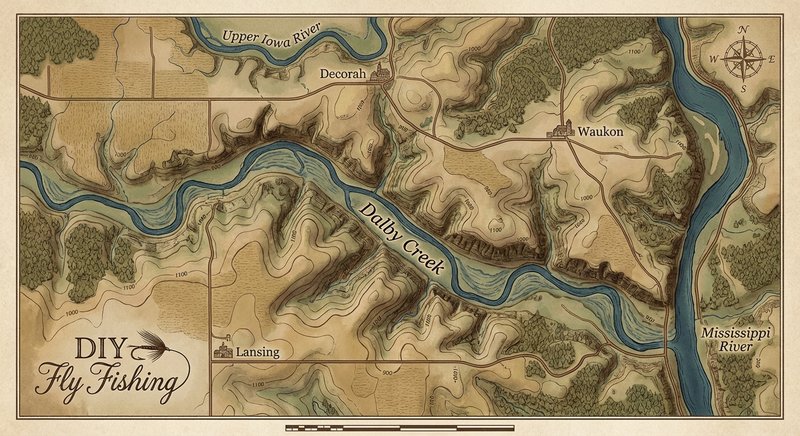
Dalby Creek
Fly fishing in Iowa · advanced · Best seasons: spring, summer
Target Species
Brook Trout
About This Water
Winneshiek County tributary with wild brook trout. Small stream adventure.
Fishing Recommendations
Welcome to the Driftless Area of Northeast Iowa. As your guide, I’m excited to talk about Dalby Creek.
Located in Allamakee County, Dalby Creek is one of Iowa’s hidden gems. While many anglers flock to the famous South Pine or French Creek, Dalby offers a more intimate, rugged experience for those seeking Iowa’s most colorful treasure: the Brook Trout.
🎣 Location Overview
Dalby Creek is a classic Driftless spring stream and a vital tributary to the Yellow River. What makes it special is its designation as one of the few streams in Iowa with a self-sustaining population of wild Brook Trout.
The water is crystal clear, cold, and highly alkaline due to the limestone geology of the region. It is a small, technical stream characterized by tight "willow-whacking" corridors, deep undercut banks, and gravel runs. It doesn’t feel like "Iowa cornfield fishing"; it feels like a mountain meadow stream tucked into a limestone valley. Anglers love it because it requires stealth, precision, and offers the reward of wild, vividly colored fish.
🐟 Target Species & Behavior
The star of the show here is the Brook Trout. While you might find an occasional stray Brown Trout near the confluence with the Yellow River, Dalby is managed primarily for Brookies.
- Behavior: These fish are spooky. Because the water is clear and the stream is narrow, they have a high "flight" response.
- Holding Patterns: Look for them in the "kitchen"—the head of the pools where oxygen is high—and under the "bedroom"—the deep undercut banks and overhanging tall grasses.
- Feeding: They are opportunistic but wary. They feed heavily on scuds (freshwater shrimp) and sowbugs year-round, but they are notorious for looking up during the summer terrestrial season.
📅 Best Times to Fish
Optimal Seasons
- Spring (April – Early June): This is the prime window. The water levels are stable, and the aquatic insect life is waking up. The vegetation hasn't completely choked the banks yet, making casting much easier.
- Summer (Late June – August): Excellent for "hopper-dropper" rigs. However, be prepared for heavy bank cover (stinging nettles and wild parsnip are common). Focus on the early mornings to avoid the midday heat.
Best Times of Day
- Early Morning: From dawn until about 10:00 AM. The low light gives the Brookies confidence to leave the undercut banks and feed in the open ripples.
- Evening: The last two hours of daylight often see frantic surface activity as midges and caddis emerge.
🪰 Recommended Flies & Techniques
Top Fly Patterns
- Nymphs:
- Pink Squirrel (Size 14-18): A Driftless staple. The flash and the pink dubbing are irresistible to Iowa Brookies.
- Scuds/Sowbugs (Size 16-20): Gray or olive. These are the primary protein source in Dalby.
- Pheasant Tail (Size 18-22): Natural and slim.
- Dry Flies:
- Elk Hair Caddis (Size 16-18): Great for skating across the surface.
- Hi-Vis Parachute Adams: Essential for seeing your fly in the shadows.
- Terrestrials: Foam beetles, ants, and small Dave’s Hoppers (Size 12-16) during July and August.
- Streamers:
- Black or Olive Woolly Bugger (Size 10-12): Best used after a light rain when the water has a slight "tea" stain.
Techniques & Presentation
- The Stealth Approach: This is more important than the fly choice. Stay low, move slowly upstream, and try to avoid casting your shadow over the water.
- Bow-and-Arrow Cast: You will encounter tight spots where a traditional backcast is impossible. Master the bow-and-arrow cast to get your fly under overhanging branches.
- Short Leashes: When nymphing, use a very small indicator or just a high-vis dry fly. The water is rarely deeper than 3-4 feet, so a long leader/indicator setup will often spook the fish.
💡 Pro Tips & Local Knowledge
- The "One Cast" Rule: On a stream this small, your first cast is your best chance. If you slap the water or snag a branch, the pool is likely "down" for 20 minutes. Move to the next bend.
- Focus on the Bends: Dalby is twisty. The outside of every bend usually features an undercut bank. Drop your fly inches from the grass on the opposite bank and let it drift right along the edge.
- Mind the Vegetation: From July onward, the banks are thick with vegetation. Wear long sleeves and pants to protect against stinging nettles, and consider a shorter rod (7' to 8' 3-weight or 4-weight) to navigate the brush.
⚠️ Important Information
- Access: Much of Dalby Creek runs through private land, but there are sections with DNR easements. Always look for the green "Angler Access" signs. Respect fences and stay within the corridor.
- Regulations:
- Iowa requires a valid fishing license and a Trout Fee.
- Check current Iowa DNR regulations for Dalby, as some sections may have specific gear restrictions (artificial lure only) or catch-and-release requirements for Brook Trout to protect the wild population.
- Catch and Release: Because these Brook Trout are a fragile, self-sustaining population, barbless hooks and quick releases are highly encouraged to ensure the fishery thrives for years to come.
Keep your rod tip up and your shadow off the water. Enjoy the quiet beauty of Dalby Creek!
Bug Hatches & Matching Flies
| Hatch | Type | Peak months | Time of day | Hook sizes | Matching flies |
|---|---|---|---|---|---|
| Blue-Winged Olive Baetis | mayfly | April, May, September, October | Midday | #18-22 | RS2 #20-22, Parachute BWO #18-20, WD-40 #20 |
| Grannom Caddis Brachycentrus | caddis | April, May | Afternoon/Evening | #14-16 | Elk Hair Caddis (Dark) #14-16, Peacock Caddis #16, LaFontaine's Deep Sparkle Pupa #14-16 |
| Sulfur / Pale Morning Dun Ephemerella invaria | mayfly | May, June | Late Afternoon/Evening | #14-18 | Sulfur Parachute #16-18, Pheasant Tail Nymph #14-18, Sulfur Spinner #16 |
| Trico Tricorythodes | mayfly | July, August, September | Morning | #20-24 | Trico Spinner #20-24, Zebra Midge #20-22 |
| Cranefly Tipulidae | midge | August, September | Afternoon | #10-14 | Killer Bug #12-14, Daddy Long Legs #10-12 |
| Terrestrials (Hopper/Ant/Beetle) Orthoptera/Formicidae | terrestrial | July, August, September | All Day | #10-18 | Dave's Hopper #10-12, Black Foam Ant #16-18, Cinnamon Ant #14-16 |
| Scuds & Sowbugs Gammarus/Asellus | midge | March, April, May, June, July, August, September, October, November | All Day | #14-18 | Ray Charles #14-18, Pink Scud #14-16, Sowbug #16-18 |
| Midges Chironomidae | midge | January, February, March, December | Midday | #18-24 | Griffith's Gnat #18-22, Zebra Midge #18-22, Mercury Midge #20-22 |