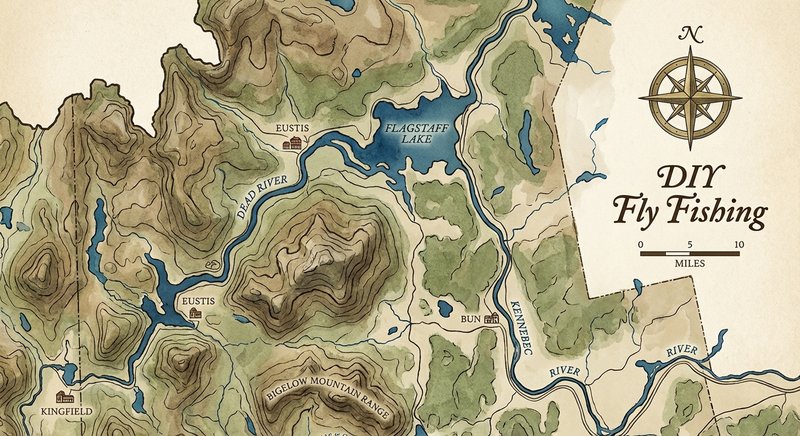
Dead River
Fly fishing in Maine · Intermediate · Best seasons: Summer, Fall
Target Species
Brook Trout, Landlocked Salmon
About This Water
Western Maine river with brook trout and landlocked salmon. Remote wilderness fishing.
Fishing Recommendations
The Dead River in Western Maine is one of the state's most storied and rugged fisheries. While the name might suggest stillness, the sections most prized by fly anglers—particularly the reach below Flagstaff Lake—are characterized by heavy pocket water, deep pools, and dramatic drops. This is a tailwater fishery, but it feels wild, remote, and powerful.
Here is your guide to mastering the Dead River.
🎣 Location Overview
The Dead River is divided into two distinct personalities. The North Branch is a meandering, classic mountain stream, but for the serious angler seeking Landlocked Salmon and large Brook Trout, the Lower Dead (from Long Falls Dam to the confluence with the Kennebec at The Forks) is the main event.
What makes this water special is the Long Falls Dam tailwater. The dam provides a consistent flow of cold, oxygenated water from the depths of Flagstaff Lake, allowing salmonids to thrive even when other Maine rivers warm up in late July. It is a "big water" experience—the river is wide, the boulders are car-sized, and the current is relentless. Anglers love it because it offers a true wilderness experience with the potential for a "trophy of a lifetime" Maine Brookie.
🐟 Target Species & Behavior
Landlocked Salmon
- Behavior: These are aggressive, acrobatic fighters. In the summer, they hold in the fast, highly oxygenated "white water" or at the heads of deep pools. In the fall, they move upriver toward the dam on their spawning run.
- Feeding: They are primarily piscivorous (fish-eaters), focusing on smelt, but they are opportunistic and will hammer large stoneflies or caddis during a hatch.
Brook Trout
- Behavior: Maine’s state fish. In the Dead River, they grow large and are exceptionally beautiful. They are more structure-oriented than salmon, often tucked behind mid-stream boulders or in the "soft" seams where fast and slow water meet.
- Feeding: They focus on aquatic insects (Mayflies, Caddis, Stoneflies) but will readily take a well-presented streamer, especially in the fall when they become territorial.
📅 Best Times to Fish
Summer (July – August)
- The Draw: While other rivers are too warm to fish safely, the Dead’s tailwater remains a sanctuary.
- Conditions: Focus on the Bypass Reach near the dam. Early morning and late evening are the only times to find fish looking at the surface. During midday, fish deep in the shadows of boulders.
Fall (September – October) — PRIME TIME
- The Draw: This is the pinnacle of the season. Salmon and Brookies move up from the lower reaches and the Kennebec confluence.
- Conditions: The fish are in their "spawning colors"—the Brookies turn a fiery orange. The fish are aggressive. This is "Streamer Season."
- Note: The season usually ends September 30th for the main river, but check current MDIFW laws for special extended seasons on certain stretches.
🪰 Recommended Flies & Techniques
Dry Flies (Summer Evenings)
- Patterns: Elk Hair Caddis (Size 12-16), Royal Wulff (Size 10-14), and Stimulators (Orange/Yellow).
- Technique: "Skating" a caddis across the surface can trigger explosive strikes from Landlocked Salmon.
Nymphing (The Bread & Butter)
- Patterns: Golden Stoneflies (Size 8-10), Pheasant Tail (Size 14-18), and the Prince Nymph.
- Technique: Use a high-stick nymphing approach or "Euro" style. The current is heavy, so use plenty of weight (split shot or tungsten beads) to get the fly into the "zone" behind boulders.
Streamers (The Fall Specialist)
- Patterns: Grey Ghost, Black Ghost, Muddler Minnow, and Woolly Buggers (Olive/Black).
- Technique: The "Maine Swing." Cast quartering downstream, let the fly swing into the soft water behind a rock, and give it short, erratic strips.
💡 Pro Tips & Local Knowledge
- Watch the Flow Schedule: The Dead River is famous for whitewater rafting releases. During a high-water release (above 3,000 CFS), fishing becomes dangerous and nearly impossible. Always check the Brookfield Power flow schedule before heading out.
- The "Bypass" Secret: There is a section of the river called the "Bypass Reach" near Long Falls Dam. Even during high releases for rafting, this section often maintains a steady, fishable flow. It is a haven for big Brook Trout.
- Heavy Tippet: Do not fish 6X here. The combination of heavy current and powerful fish means you should rarely go below 4X. If you're swinging streamers in the fall, 0X or 1X is appropriate.
- Study the "V": Look for the downstream "V" of slick water behind large rocks. Fish will sit right at the tip of that V, waiting for food to be funneled to them.
⚠️ Important Information
Access
Access is primarily via the Long Falls Dam Road out of North New Portland. It is a long, gravel logging road. Ensure you have a full tank of gas and a spare tire. This is remote territory with little to no cell service.
Regulations
- Open Season: Generally April 1st – September 30th.
- Artificial Lures Only: Much of the upper Dead is restricted to fly fishing or artificial lures.
- Catch & Release: While some harvest is allowed under specific size limits, catch and release is highly encouraged to preserve the wild genetics of these Maine Brookies.
- Permits: A valid Maine Fishing License is required. You can purchase one online via the MDIFW website.
Safety
The Dead River is powerful. A wading staff is not optional here—it is a necessity. Studded wading boots are also highly recommended due to the slick, mossy boulders. Be mindful of rising water levels if the dam gates open.
Bug Hatches & Matching Flies
| Hatch | Type | Peak months | Time of day | Hook sizes | Matching flies |
|---|---|---|---|---|---|
| Hendrickson Ephemerella subvaria | mayfly | May, June | Afternoon | #12-14 | Red Quill #12-14, Hendrickson Emerger #14, Pheasant Tail #12-14 |
| Blue-Winged Olive Baetis / Acerpenna | mayfly | May, September, October | Mid-day/Afternoon | #18-22 | RS2 #20-22, BWO Sparkle Dun #18-20, Parachute Adams #18-22 |
| Grannom Caddis Brachycentrus | caddis | May | Morning/Afternoon | #14-16 | Peacock Caddis #14-16, Holy Grail #14-16, Deep Sparkle Pupa #14-16 |
| March Brown Maccaffertium vicarium | mayfly | June | Afternoon | #10-12 | March Brown Western #10-12, Gold Ribbed Hare's Ear #10-12, March Brown Wet #12 |
| Golden Stonefly Acroneuria carolinensis | stonefly | June, July | Evening/Night | #6-10 | Kaufmann's Stone #8-10, Pat's Rubber Leg #6-10, Stonulator #8 |
| Light Cahill Stenacron interpunctatum | mayfly | June, July | Evening | #14-16 | Light Cahill Dry #14-16, Cream Usual #14-16 |
| Spotted Sedge Hydropsyche | caddis | June, July, August | Evening | #14-18 | Elk Hair Caddis (Tan) #14-18, LaFontaine's Emergent Pupa #16, Z-Wing Caddis #14-16 |
| Little Yellow Sally Isoperla | stonefly | June, July | Afternoon/Evening | #14-16 | Yellow Sally Dry #14-16, Iron Lotus #16 |
| Eastern Green Drake Ephemera guttulata | mayfly | June | Late Afternoon/Evening | #8-10 | Green Drake Cripple #8-10, Coffin Fly #8-10 |
| Terrestrials (Ants/Beetles) Formicidae / Coleoptera | terrestrial | July, August, September | All Day | #12-18 | Flying Ant #14-16, Black Foam Beetle #12-14, Chernobyl Ant #10-12 |