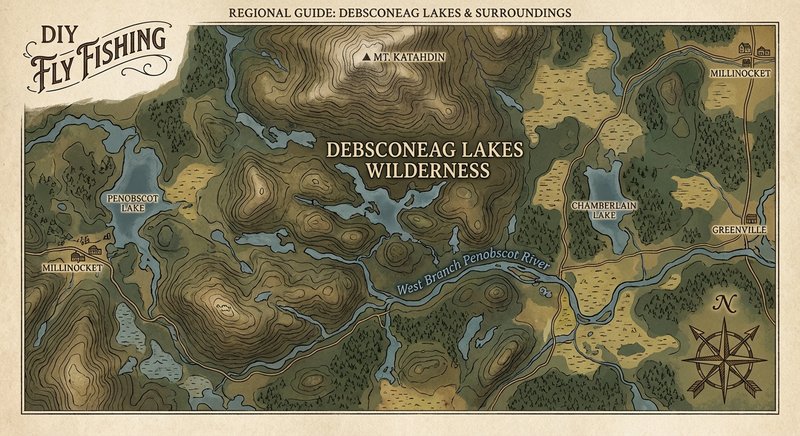
Debsconeag Lakes
Fly fishing in Maine · Advanced · Best seasons: Summer, Fall
Target Species
Brook Trout
About This Water
Remote Piscataquis County lakes with brook trout. True Maine wilderness.
Fishing Recommendations
The Debsconeag Lakes Wilderness Area is one of the crown jewels of the North Maine Woods. Managed by The Nature Conservancy and situated just south of Baxter State Park, this area represents some of the most pristine, "old-school" brook trout water left in the Eastern United States.
In the Abenaki language, Debsconeag means "carrying place," referring to the historic portage routes between the lakes. For the fly angler, this is a place of solitude, granite-rimmed shorelines, and wild, native fish that have never seen a hatchery truck.
🎣 Location Overview
The Debsconeag chain consists of eight primary lakes (First through Eighth) along with several smaller ponds like Rainbow Lake and Tumbledown Dick Pond. This is a rugged, glacial landscape characterized by massive boulders, crystal-clear water, and deep pine forests.
What makes this area special is its Wilderness Area designation. There are no paved roads, no power lines, and very few permanent structures. While First Debsconeag is accessible by vehicle, the upper lakes require a boat, a hike, or a portage. This "barrier to entry" ensures that the fishing pressure remains low and the Brook Trout grow to impressive sizes in a truly wild state.
🐟 Target Species & Behavior
Wild Brook Trout (Salvelinus fontinalis)
These are not your average stockies. The Brookies here are deep-bellied, brilliantly colored, and highly attuned to their environment.
- Summer Behavior: As surface temperatures rise, Brook Trout head for "refrigerated" water. They will hold near deep-water springs, cold-water inlets, or stay below the thermocline (often 20–30 feet down). They become opportunistic feeders, waiting for evening hatches or targeting baitfish.
- Fall Behavior: This is the magic season. As water temperatures drop in September, the trout move from the depths back to the shorelines and toward gravelly inlets/outlets to prepare for spawning. They become aggressive, territorial, and display breathtaking spawning colors (fiery orange bellies and hooked jaws).
📅 Best Times to Fish
Summer (July – August)
- The Window: Focus on the "Edges of the Day." Dawn and dusk are mandatory.
- Conditions: Look for the Hexagenia (Hex) hatch in late June and early July. This is your best chance to see the largest trout in the lake rise to the surface at twilight.
- Daytime: During the heat of the day, fishing is slow unless you are using sinking lines to reach the deep spring holes.
Fall (September)
- The Window: The entire month of September (until the season closes, usually Sept 30th on these waters—check current Maine open water laws).
- Conditions: Overcast, cool days are prime. A "Maine drizzle" often triggers a massive feeding response.
- Prime Time: Mid-morning through late afternoon as the sun warms the surface slightly.
🪰 Recommended Flies & Techniques
Dry Flies
- Hexagenia Variants (Size 6-8): Essential for late June/July evenings.
- Goddard Caddis (Size 12-14): Great for skittering across the surface to trigger explosive strikes.
- Royal Wulff & Humpy: High-visibility attractors for searching rocky shorelines.
- Terrestrials: Black Ants and Beetles (Size 14-18) are lethal in August when nothing else is hatching.
Streamers (The Maine Tradition)
- Black Ghost & Mickey Finn: Classic Maine patterns that mimic the smelt and shiners the trout crave.
- Woolly Buggers (Black or Olive): Drag these slowly along submerged timber or rock drop-offs.
- Mudler Minnow: Fished on a floating line to mimic a struggling sculpin or grasshopper.
Techniques
- The "Slow Strip": When fishing streamers from a canoe, use a slow, erratic strip with long pauses. Brook trout often hit on the pause.
- Dipping the Bush: In the fall, trout often hold tight to overhanging brush. Accurate casting is more important than distance.
- Sinking Lines: In summer, use a Type 3 or Type 5 sinking line to get streamers down to the 15-25 foot range.
💡 Pro Tips & Local Knowledge
- Focus on Third Debsconeag: While famous for its massive Lake Trout (Togue), the area near the thoroughfares and the underwater rock piles holds some of the largest Brookies in the chain.
- The "Spring Hole" Secret: In mid-summer, look for areas where small, cold streams enter the lake. Even a tiny trickle can create a "cold plume" that stacks dozens of trout in a small radius.
- Canoe Stealth: These lakes are quiet. Banging a paddle against the side of a metal canoe will spook wild trout 40 feet away. Use a wood or composite canoe if possible, or be extremely mindful of noise.
- The Rainbow Lake Hike: If you have the lungs for it, hike into Rainbow Lake. It is widely considered one of the best wild brook trout fisheries in the Eastern US.
⚠️ Important Information
- Access: Access is via the Golden Road out of Millinocket. Be prepared for dirt roads shared with massive logging trucks—they have the right of way.
- Permits: You will need a valid Maine Fishing License. Additionally, because you are entering the North Maine Woods (NMW) area, you must pay a per-person, per-night gate fee at the checkpoints (e.g., Caribou Checkpoint).
- Regulations: Many ponds in this area are ALC (Artificial Lures Only) or FFO (Fly Fishing Only). Regulations on length and bag limits are strict to protect the wild genetics. Always consult the Maine Open Water Fishing Laws (The "Green Book") before casting.
- Safety: This is true wilderness. There is no cell service. Carry a satellite communicator (InReach), a spare tire, and plenty of bug spray (the black flies are legendary through July).
Guide’s Final Word: The Debsconeags aren't about high fish counts; they are about the quality of the experience. Slow down, watch the eagles, and appreciate a fish that is a direct descendant of the trout that swam here after the glaciers receded.
Bug Hatches & Matching Flies
| Hatch | Type | Peak months | Time of day | Hook sizes | Matching flies |
|---|---|---|---|---|---|
| Hendrickson Ephemerella subvaria | mayfly | May, June | Afternoon | #12-14 | Red Quill #12-14, Hendrickson Emerger #14, Pheasant Tail #12-14 |
| Blue-Winged Olive Baetis spp. | mayfly | May, September, October | Mid-day/Overcast | #18-22 | BWO Sparkle Dun #18-20, RS2 #20, WD-40 #18-22 |
| Hex / Giant Michigan Mayfly Hexagenia limbata | mayfly | June, July | Dusk/Night | #6-10 | Hexagenia Spinner #6-8, Paradrake Hex #8, Hex Nymph #6-10 |
| Light Cahill Stenacron interpunctatum | mayfly | June, July | Evening | #12-14 | Light Cahill #12-14, Gold Ribbed Hare's Ear #14 |
| Spotted Sedge Hydropsyche | caddis | June, July, August | Evening | #14-16 | Elk Hair Caddis (Tan) #14-16, LaFontaine's Deep Sparkle Pupa #14-16 |
| Giant Orange Sedge Pycnopsyche | caddis | September, October | Evening | #8-12 | Orange Stimulator #8-10, October Caddis Pupa #10 |
| Chironomids Chironomidae | midge | May, June, September | Morning/All Day | #18-24 | Zebra Midge #18-22, Griffith's Gnat #20-24, Icebud Midge #18-20 |
| Carpenter Ants Camponotus | terrestrial | July, August | Afternoon/Windy | #10-14 | Black Foam Ant #12-14, Chernobyl Ant #10 |
| Dragonflies Anisoptera | terrestrial | July, August | Daytime | #4-8 | Dragonfly Nymph #6-8, Woolly Bugger (Olive) #4-8 |