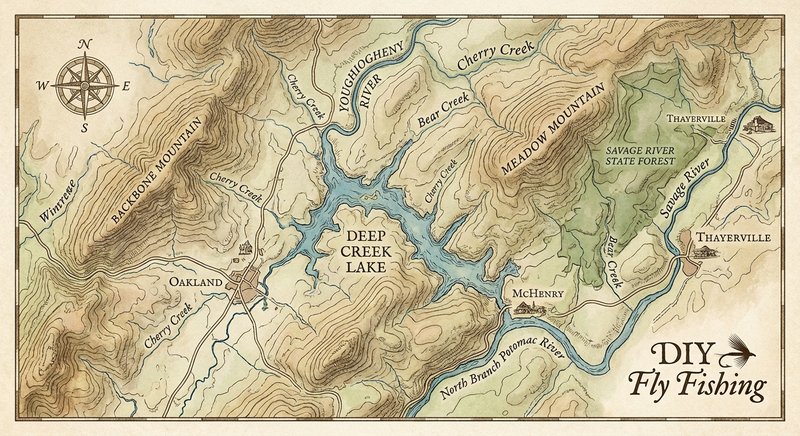
Deep Creek Lake
Fly fishing in Maryland · Intermediate · Best seasons: Spring, Summer, Fall
Target Species
Walleye, Smallmouth Bass, Yellow Perch
About This Water
Western Maryland's largest lake with diverse fishing. Walleye, bass, and trout.
Fishing Recommendations
Deep Creek Lake, nestled in the mountains of Garrett County, Maryland, is the state’s largest inland body of water. At an elevation of 2,462 feet, it offers a "high-country" fishing experience more reminiscent of Canada or New England than the Mid-Atlantic. While it is a popular resort destination, for the fly angler, it is a complex, rewarding fishery that requires a tactical approach to handle its depth and clarity.
🎣 Location Overview
Deep Creek Lake is a man-made reservoir covering nearly 3,900 acres with 65 miles of shoreline. What makes it special is the diversity of habitat: steep rocky drop-offs, expansive submerged weed beds (milfoil and curly-leaf pondweed), and thousands of private boat docks that provide artificial cover.
The water is generally clear and stays cooler than other Maryland lakes due to the altitude. While boat traffic can be heavy in the summer, the early morning fog and the "shoulder seasons" (Spring and Fall) offer a serene, world-class fly fishing environment.
🐟 Target Species & Behavior
Smallmouth Bass
The "bronze backs" are the stars here. They are incredibly hardy and lean.
- Behavior: They transition from deep winter haunts to shallow rocky shelves and docks as the water warms.
- Holdings: Look for rocky points, submerged stumps, and the "shady side" of boat docks.
- Feeding: They focus heavily on crayfish and young-of-the-year yellow perch or shiners.
Walleye
Walleye are the "ghosts" of the lake. While traditionally targeted by gear anglers with jigs, they are highly susceptible to fly fishers who understand their light sensitivity.
- Behavior: They move into the shallows (5–10 feet) during low light (dawn/dusk) and retreat to 20+ feet during the day.
- Holdings: Deep rocky ledges near the dam or gravelly flats near the mouths of tributary screams.
- Feeding: Primarily piscivorous (fish-eaters), focusing on alewives and yellow perch.
Yellow Perch
Deep Creek is famous for "jumbo" perch.
- Behavior: Schooling fish that move along weed edges.
- Holdings: Often found in 10–15 feet of water near the edge of vegetation.
- Feeding: They are opportunistic, eating small nymphs, scuds, and tiny minnows.
📅 Best Times to Fish
- Spring (Late April – June): Prime Time. This is the best window for fly anglers. Smallmouth and Walleye move into shallower water to spawn and then feed aggressively post-spawn. The fish are within reach of floating or intermediate lines.
- Summer (July – August): Focus on the "Magic Hour." You must be on the water at first light (5:30 AM) to beat the wake boats and the sun. Night fishing with surface sliders for Smallmouth is highly effective.
- Fall (September – October): The cooling water triggers a massive feeding move. As the weeds begin to die back, fish congregate around the remaining green patches and rocky points. The fall colors in Garrett County make this the most scenic time to fish.
🪰 Recommended Flies & Techniques
For Smallmouth Bass
- Top Patterns: Clouser Minnows (Chartreuse/White), Near Nuff Crawfish, and Murdich Minnows. For surface action, use BoogleBugs or foam poppers in olive or black.
- Technique: Use a 6-weight or 7-weight rod. In spring, a floating line is fine. In summer, an intermediate sinking tip is essential to get the fly down 5–10 feet along the dock pilings.
For Walleye
- Top Patterns: Large, flashy streamers. Game Changers (White/Silver), Zonkers, and Bunny Leeches (Black or Purple).
- Technique: Use a fast-sinking head (Type 5 or 6). Cast toward rocky points at dusk and use a slow, "strip-strip-pause" retrieve. The pause is often when the Walleye will inhale the fly.
For Yellow Perch
- Top Patterns: Bead-head Pheasant Tails, Hare’s Ears (size 12-14), or tiny Micro-Zonkers.
- Technique: A "dropper" rig works wonders. Hang a nymph 18 inches below a small streamer or a dry fly. Fish the edges of the weed beds slowly.
💡 Pro Tips & Local Knowledge
- The "Dock Kickback" Technique: Deep Creek has over 2,500 docks. Smallmouth sit in the shade of the platforms. If you can skip a fly (like a weighted Woolly Bugger) deep under the dock, you will find fish that others miss.
- The Dam Area: The water near the dam is the deepest and clearest. This is the stronghold for Walleye. Focus on the rocky shoreline on the eastern side of the dam breast during overcast days.
- Wind is Your Friend: A "Deep Creek Chop" (light wind) breaks the surface mirror, making the fish less spooky in the clear water. If it’s dead calm, you’ll need long leaders (9–12 feet) and delicate presentations.
- McHenry Cove: In the early spring, the northern end (McHenry) warms up first. This is where you’ll find the earliest active Smallmouth.
⚠️ Important Information
- Access:
- Deep Creek Lake State Park offers excellent boat ramps and some shoreline access (though shoreline fly fishing is tough due to trees).
- Public boat ramps are also available at the McHenry area near the Wisp Resort.
- Regulations:
- A Maryland Non-Tidal Fishing License is required.
- Check the Maryland DNR Freshwater Sportfishing Guide for current size and creel limits, as Walleye regulations are strictly enforced.
- Safety: The lake is shared with high-speed powerboats and jet skis. If you are in a kayak or small boat, stay close to the shoreline and wear high-visibility gear.
- Invasive Species: Ensure you "Clean, Drain, and Dry" your gear to prevent the spread of Hydrilla or Zebra Mussels, which are constant threats to the watershed.
Deep Creek Lake is a "thinking man’s" fishery. It rewards the fly angler who understands structure and isn't afraid to fish during the fringe hours of the day. Tight lines!
Bug Hatches & Matching Flies
| Hatch | Type | Peak months | Time of day | Hook sizes | Matching flies |
|---|---|---|---|---|---|
| Giant Michigan Mayfly (Hex) Hexagenia limbata | mayfly | June, July | Late Evening/Night | #6-10 | Hexagenia Dry #6-8, Hex Emerger #8-10, Burrowing Mayfly Nymph #6-10 |
| Midges Chironomidae | midge | March, April, October, November | Morning/Afternoon | #18-24 | Zebra Midge #18-22, Griffith's Gnat #20-24, Palomino Midge #20-22 |
| Sulphurs Ephemerella invaria/dorothea | mayfly | May, June | Late Afternoon/Evening | #14-18 | Sulphur Parachute #14-18, Pheasant Tail Nymph #14-16, Sulphur Snowshoe Emerger #16-18 |
| Blue Winged Olives (BWO) Baetis | mayfly | April, May, September, October | Midday/Afternoon | #18-22 | BWO Sparkle Dun #18-20, RS2 #20-22, Barr's BWO Nymph #18-20 |
| Tan Caddis Hydropsyche | caddis | May, June, July | Evening | #14-16 | Elk Hair Caddis (Tan) #14-16, LaFontaine's Deep Sparkle Pupa #14-16, Holy Grail Caddis #14-16 |
| Damselfly Enallagma | terrestrial | June, July, August | Midday | #10-14 | Adult Damselfly #10-12, Marabou Damsel Nymph #12-14 |
| Light Cahill Stenacron interpunctatum | mayfly | June, July | Evening | #12-14 | Light Cahill Dry #12-14, Gold Ribbed Hare's Ear #12-14 |
| Terrestrials (Ants and Beetles) Formicidae / Coleoptera | terrestrial | July, August, September | All Day | #12-18 | Black Foam Ant #14-18, Chernobyl Ant #8-12, Crowe Beetle #14-16 |