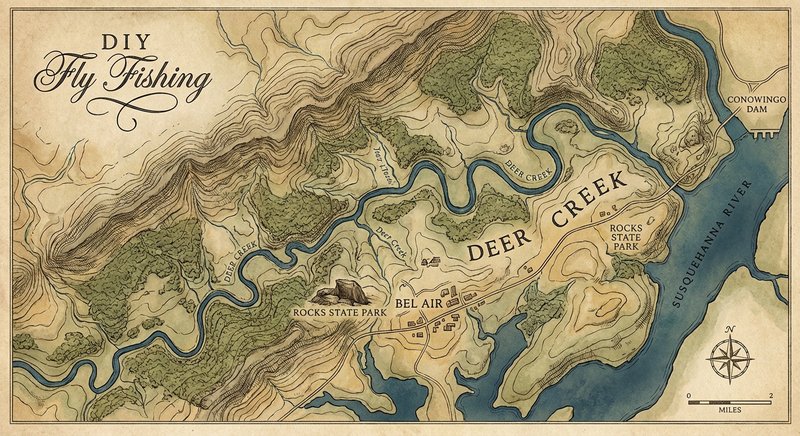
Deer Creek
Fly fishing in Maryland · Beginner · Best seasons: Spring, Fall
Target Species
Rainbow Trout, Brown Trout
About This Water
Harford County stream with stocked trout. Popular spring fishing destination.
Fishing Recommendations
Welcome to one of Maryland’s most scenic and productive trout waters. As a guide who has spent years navigating the rocky terrain of Harford County, I can tell you that Deer Creek is the crown jewel of Central Maryland fly fishing. Flowing through the dramatic landscapes of Rocks State Park, it offers a "mountain stream" feel just a short drive from Baltimore and Philadelphia.
Here is your comprehensive guide to tackling Deer Creek.
🎣 Location Overview
Deer Creek is a classic Piedmont freestone stream. What makes it special is the dramatic geology—specifically within Rocks State Park. The creek carves through deep gorges and is flanked by massive quartzite cliffs (like the King and Queen Seat).
The water is characterized by high-gradient drops, deep plunge pools, long glides, and heavy pocket water. Unlike the slow, silty runs found in much of the Mid-Atlantic, Deer Creek offers varied structure that rewards technical anglers. It feels much larger than it is, especially after a spring rain, providing ample room for backcasts in many stretches.
🐟 Target Species & Behavior
- Rainbow Trout: These are the primary targets, largely stocked by the Maryland DNR. They tend to congregate in the faster oxygenated water at the heads of pools and in the middle of heavy riffles. They are opportunistic and will often rise to bushy attractors.
- Brown Trout: You’ll find both stocked and "holdover" Browns here. The holdovers are the "PhD fish" of Deer Creek. They prefer the dark undercut banks, the depths of the "King and Queen" pool, and the shadowy areas under overhanging limbs.
- Behavior: During the spring, fish are aggressive. As the water warms or the season progresses, they become "vertical" feeders, hugging the bottom of deep pockets during the day and moving into the tails of pools to feed on hatches at dusk.
📅 Best Times to Fish
Optimal Seasons
- Spring (March – June): This is the prime window. The Maryland DNR stocks heavily during this time, and the natural insect activity is at its peak.
- Fall (October – November): The water temperatures drop back into the "sweet spot" (50–60°F). The fall foliage is stunning, and the Brown trout become more aggressive as they prepare for spawning.
Best Times of Day
- Spring: Mid-morning to late afternoon. You want the sun to warm the water slightly to trigger insect activity.
- Fall: Early morning or the "Golden Hour" before sunset.
Prime Conditions
Look for a steady barometer and water that has a "green tea" tint. If the creek is chocolate milk after a heavy rain, give it 48 hours to settle; Deer Creek drains a large agricultural area and can remain turbid longer than mountain freestones.
🪰 Recommended Flies & Techniques
Top Fly Patterns
- Nymphs:
- Pheasant Tail (Sizes 14-18): The gold standard for mimicking Mayfly nymphs.
- Hare’s Ear (Sizes 12-16): Great for the Caddis larvae prevalent here.
- Zebra Midge (Sizes 18-22): Essential for picky holdovers in low water.
- Dry Flies:
- Elk Hair Caddis (Sizes 14-16): The go-to during evening hatches.
- Adams/Parachute Adams (Sizes 14-18): Excellent general attractor.
- Sulfurs (Sizes 16-18): Vital for the late May/June evening hatches.
- Streamers:
- Woolly Bugger (Black or Olive, Sizes 8-12): Dead-drifted or swung through deep pools.
Effective Techniques
- High-Stick Nymphing: Because of the varying currents and "pocket water" around the boulders, keeping your fly line off the water is crucial to avoid drag.
- The "Dry-Dropper": A favorite here. Use a buoyant Elk Hair Caddis as your indicator with a small Pheasant Tail dropped 18-24 inches below it.
- Swinging Wet Flies: On the long glides near the picnic areas, swinging a soft-hackle Partridge and Orange can be deadly during a Caddis hatch.
💡 Pro Tips & Local Knowledge
- The "Rocks" Stretch: The water directly below the main picnic area in Rocks State Park holds fish, but it gets the most pressure. If you want better fishing, hike a half-mile upstream or downstream from the main bridge to find less-educated trout.
- Stealth Matters: Despite the rushing water, the fish are wary. Avoid wading right into the middle of a pool. Stand on the bank or the edge of the rocks and fish the water closest to you first.
- The "Hidden" Tributaries: Keep an eye on the mouths of small feeder streams entering Deer Creek after a rain; trout often congregate there for cooler, clearer, highly oxygenated water.
- Watch the Temperature: Deer Creek is a marginal trout fishery in the summer. Once water temps hit 70°F, please stop fishing for trout to ensure their survival. Switch to Smallmouth Bass, which are also excellent in this creek!
⚠️ Important Information
- Regulations: Maryland has specific "Catch and Release" and "Put and Take" areas. Most of the prime water through Rocks State Park is Catch and Release, Fly Fishing Only or Delayed Harvest. Always check the Maryland DNR Freshwater Fishing Guide for the most current boundary maps.
- Permits: A valid Maryland Non-Tidal Angler’s License and a Trout Stamp are required for all anglers 16 and older.
- Wading Safety: The rocks in Deer Creek are notoriously "greasy." Felt-soled boots or studs are highly recommended, as is a wading staff, especially when the water is high.
- Parking: Use the designated lots within Rocks State Park. Avoid parking on the shoulders of narrow roads like St. Clair Bridge Rd, as local law enforcement is strict about keeping those lanes clear for emergency vehicles.
Tight lines, and enjoy the beauty of Harford County!
Bug Hatches & Matching Flies
| Hatch | Type | Peak months | Time of day | Hook sizes | Matching flies |
|---|---|---|---|---|---|
| Sulphurs Ephemerella invaria/dorothea | mayfly | May, June | Late Afternoon/Evening | #14-18 | Sulphur Parachute #14-18, Pheasant Tail #14-16, Sulphur Spinner #16-18 |
| Blue Winged Olives Baetis | mayfly | March, April, October, November | Midday | #18-22 | RS2 #20-22, BWO Parachute #18-22, Zebra Midge #18-20 |
| Grannom Caddis Brachycentrus | caddis | April | Morning/Afternoon | #14-16 | Elk Hair Caddis (Dark) #14-16, Holy Grail #14-16, Peacock Caddis Larva #14-16 |
| March Brown Maccaffertium vicarium | mayfly | May | Afternoon | #10-14 | March Brown Parachute #12-14, Hare's Ear Nymph #10-14 |
| Tan Caddis Hydropsyche | caddis | May, June, July, August | Evening | #14-18 | LaFontaine's Deep Sparkle Pupa #14-16, Tan Elk Hair Caddis #14-18, Soft Hackle Hare's Ear #14-16 |
| Light Cahill Stenacron interpunctatum | mayfly | June, July | Evening | #12-14 | Light Cahill #12-14, Cream Variant #14 |
| Trico Tricorythodes | mayfly | July, August, September | Early Morning | #20-24 | Trico Spinner #22-24, Sunken Trico Spinner #22-24 |
| Terrestrials Formicidae / Coleoptera | terrestrial | July, August, September | All Day | #12-18 | Black Foam Ant #16-18, Crowe Beetle #14-16, Dave's Hopper #12 |