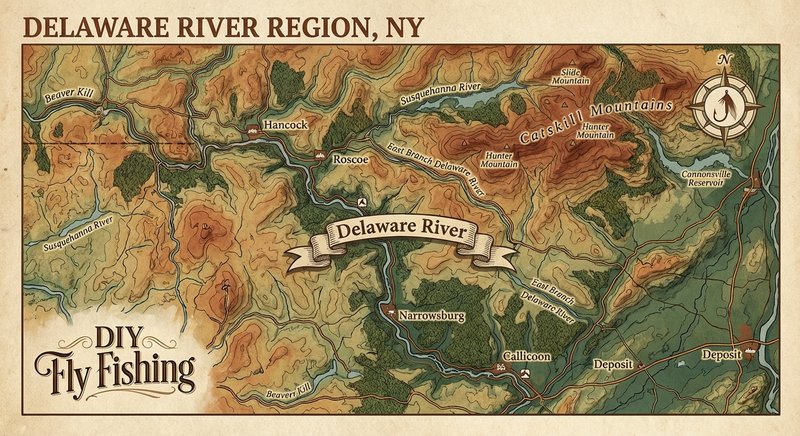
Delaware River
Fly fishing in New York · Intermediate · Best seasons: Spring, Summer, Fall
Target Species
Brown Trout, Rainbow Trout
About This Water
The West Branch and Main Stem offer world-class wild trout fishing. Famous hatches and large browns.
Fishing Recommendations
The Upper Delaware River system—comprising the West Branch, the East Branch, and the Main Stem—is widely considered the "Holy Grail" of wild trout fishing in the Eastern United States. Often referred to as the "Delaware Tailwaters," this system offers a technical, challenging, and incredibly rewarding experience that mimics the spring creeks of the West, but with a distinct Catskill soul.
🎣 Location Overview
The Delaware is not just one river; it is a complex network of tailwaters fed by the cold bottom-releases of the Cannonsville (West Branch) and Pepacton (East Branch) reservoirs.
- The West Branch: Known for its steady, cold temperatures and high fish density. It is often the most crowded but the most consistent.
- The East Branch: A more intimate, scenic, and temperamental river. It is famous for its massive, sophisticated brown trout.
- The Main Stem: Formed by the confluence at Hancock, NY. It is a big, powerful river that stays cool for miles, offering expansive flats and heavy "pushing" water.
What makes this water special is the wildness of the fish. These are not stocked trout; they are born in the river, highly pressured, and have PhDs in entomology. The river is characterized by glassy pools, long flats, and subtle currents that demand perfect presentations.
🐟 Target Species & Behavior
Wild Brown Trout
The apex predator of the system. Delaware Browns are known for their butter-yellow bellies and incredible selective feeding. They often hold in the "foam lines" or inches from the bank. When rising, they don't splash; they "sip," leaving a bubble that looks like a tiny dimple on the water.
Wild Rainbow Trout
Found more frequently in the faster riffles and the heavy water of the Main Stem and lower West Branch. These fish are exceptionally strong, often jumping multiple times once hooked. They are notoriously "hot" and will peel line into your backing faster than almost any other trout in the East.
Behavior Note: These fish are highly "surface-oriented" during hatch periods but are incredibly spooky. A shadow or a heavy footfall will shut down a pool for an hour.
📅 Best Times to Fish
Spring (April – June) — The Peak
This is the prime window. The Hendrickson hatch in late April/early May kicks off the season. By June, you hit the "Golden Period" with March Browns, Blue-Winged Olives, and the legendary Green Drake hatch.
- Best Window: 11:00 AM to 5:00 PM for hatches.
Summer (July – August) — The Technical Season
While other Eastern rivers warm up and become unfishable, the Delaware stays cold due to reservoir releases. However, the fish become "micro-focused."
- Best Window: Early morning for tricos or late evening (the "Magic Hour") for Sulphurs and Caddis.
Fall (September – October) — The Trophy Hunt
As water temps drop and crowds thin, the Isonychia and Blue-Winged Olives dominate. Brown trout become aggressive as they prepare for the spawn.
- Best Window: Overcast, drizzly days are best for BWO hatches and streamer fishing.
🪰 Recommended Flies & Techniques
Dry Fly (The Gold Standard)
90% of Delaware anglers are here for the dry fly. You must match the life stage (Dun vs. Spinner).
- Patterns: Snowshoe Rabbits Foot Emergers, Rusty Spinners (size 12-24), CDC Comparaduns, and the "Delaware Adam’s."
- The Technique: Reach casts and pile casts are mandatory. You need a 12-to-15-foot leader tapering down to 6X or 7X fluorocarbon/nylon.
Nymphing
When no bugs are on the surface, go deep.
- Patterns: Pheasant Tails (size 18-20), Zebra Midges, and Frenchies.
- The Technique: European Nymphing is effective in the riffles, but traditional indicator nymphing is better for the long, slow flats.
Streamers
For the biggest fish in the river, especially on the Main Stem.
- Patterns: Articulated Goldies, Black Buggers, or Sex Dungeon patterns.
- The Technique: "The Swing." Cast quartering downstream and swing the fly through deep holes or strip aggressively near the banks during high water.
💡 Pro Tips & Local Knowledge
- The "Hancock Pause": When you see a fish rise, do not cast immediately. Observe the rhythm of the rise. Delaware trout often feed in a "timing" loop. Wait, time it, and place your fly 3 feet above their nose just before they are due to come up again.
- Longer is Better: If you think your leader is long enough, add two more feet of tippet. The "micro-drag" caused by thick fly lines is the #1 reason fish refuse flies here.
- The "Spinner Fall": On summer evenings, don't leave when the sun goes down. The Rusty Spinner fall often happens in the "grey light," and it can lead to the most intense feeding frenzy of the day.
- Wading Safety: The Delaware has "slippery bowling ball" rocks. Felt soles (where legal) and a wading staff are non-negotiable.
⚠️ Important Information
Access
- West Branch: Excellent public access at Deposit, NY, and Stilesville.
- East Branch: Good access near Harvard and Shinhopple.
- Main Stem: Access is more limited for waders; this is a prime "drift boat" river. Public access points are found at Buckingham and Lordville.
Regulations & Permits
- Licensing: You need a New York State Fishing License. If you cross to the Pennsylvania side of the Main Stem, a PA license is also valid (reciprocal agreement), but check specific boundary rules.
- Catch & Release: While some areas allow harvest, the culture of the Upper Delaware is strictly Catch and Release to protect the wild trout populations.
- Thermal Relief: If water temperatures exceed 68°F (usually in the lower Main Stem during heatwaves), stop fishing. It is lethal for the trout.
Gear Recommendations
- Rod: 9ft 4wt or 5wt with a medium-fast action for delicate presentations.
- Tippet: 5X, 6X, and 7X are standard. If you aren't using 6X, you probably won't catch many fish on the West Branch.
Bug Hatches & Matching Flies
| Hatch | Type | Peak months | Time of day | Hook sizes | Matching flies |
|---|---|---|---|---|---|
| Hendrickson Ephemerella subvaria | mayfly | April, May | Afternoon | #12-14 | Red Quill #12-14, Hendrickson Comparadun #12-14, Pheasant Tail #12-14 |
| Blue-Winged Olive (BWO) Baetis / Drunella | mayfly | April, May, September, October | Mid-day/Afternoon | #18-22 | RS2 #18-22, BWO Sparkle Dun #18-22, CDC Baetis #20-22 |
| Sulfur Ephemerella invaria / dorothea | mayfly | May, June, July | Late Afternoon/Evening | #14-18 | Sulfur Snowshoe Emerger #14-18, Sulfur Parachute #14-18, Sulfur Spinner #14-18 |
| March Brown Maccaffertium vicarium | mayfly | May, June | Mid-day/Afternoon | #10-12 | March Brown Parachute #10-12, Gold Ribbed Hare's Ear #10-12, March Brown Wet Fly #12 |
| Green Drake Ephemera guttulata | mayfly | June | Evening/Dusk | #8-10 | Green Drake Cripple #8-10, Coffin Fly #8-10, Green Drake Nymph #8-10 |
| Grannom Caddis Brachycentrus | caddis | April, May | All Day | #14-16 | Peacock Caddis #14-16, Holy Grail #14-16, LaFontaine's Deep Sparkle Pupa #14-16 |
| Isonychia (Slate Drake) Isonychia bicolor | mayfly | June, July, August, September | Afternoon/Evening | #10-12 | Iso Parachute #10-12, Isonychia Nymph #10-12, Zug Bug #10-12 |
| Trico Tricorythodes | mayfly | July, August, September | Morning | #20-24 | Trico Spinner #22-24, Trico Parachute #20-22, Zebra Midge #20-22 |
| Apple Caddis Brachycentrus appalachia | caddis | August, September | Evening | #16-18 | Elk Hair Caddis (Green) #16-18, Iris Caddis #16-18, Pupa (Bright Green) #16-18 |