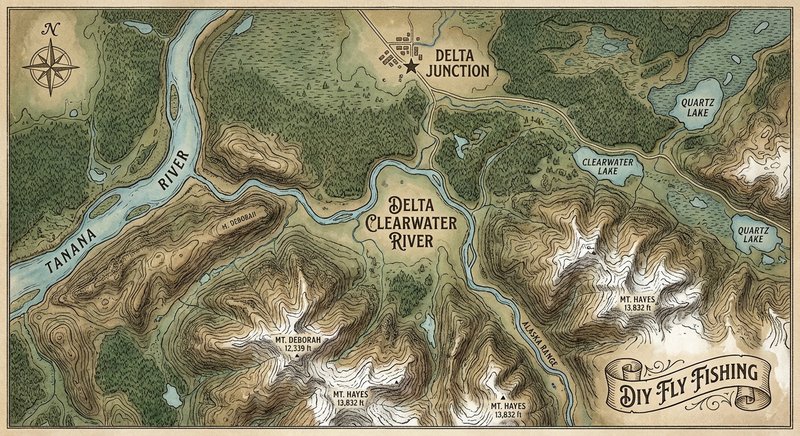
Delta Clearwater River
Fly fishing in Alaska · Beginner · Best seasons: Summer, Fall, Winter
Target Species
Arctic Grayling, Rainbow Trout
About This Water
Spring-fed stream near Delta Junction with Arctic grayling. Year-round fishery.
Fishing Recommendations
The Delta Clearwater River (DCR) is a crown jewel of Interior Alaska fly fishing. Located near Delta Junction, about 100 miles southeast of Fairbanks, it is a spring-fed system that stays crystal clear year-round. Unlike the glacier-fed rivers that dominate the region, the DCR offers technical, "Lower 48 style" spring creek fishing in a rugged Alaskan setting.
🎣 Location Overview
The Delta Clearwater is famous for being one of the most productive Arctic Grayling fisheries in the world. Because it is spring-fed, the water temperature remains relatively stable (around 38-42°F), and the clarity is world-class. You can often sight-fish to large grayling in 10 feet of water.
The river is relatively short (about 20 miles long), characterized by thick aquatic vegetation, a gentle current, and a gravel bottom. Anglers love it because it offers a rare opportunity for delicate dry-fly presentations in a state otherwise known for heavy streamers and egg patterns.
🐟 Target Species & Behavior
Arctic Grayling
The star of the show. The DCR holds a massive population of "trophy" grayling (18"+).
- Behavior: They are opportunistic but can become surprisingly selective during a heavy hatch. They hold in the "seams" between weed beds and in the slower water near the banks.
- Feeding: They rise readily to surface insects but spend the winter and early spring hugging the bottom for nymphs.
Rainbow Trout
While not as numerous as the grayling, the DCR holds a population of resident rainbows, often found in the lower reaches or tucked deep under overhanging brush.
- Behavior: They are much more elusive than the grayling. They often hold in the faster chutes or deep holes where the river bends.
- Feeding: They focus on sculpins, sticklebacks, and—during the fall—salmon eggs and flesh.
📅 Best Times to Fish
Summer (June – August)
- Prime Window: Late June through July.
- Conditions: Long daylight hours (20+ hours) and peak insect activity. This is the best time for dry fly fishing.
- Time of Day: On the DCR, "banker's hours" are fine. The water is cold, so fish become more active as the sun hits the water and triggers hatches (10 AM – 6 PM).
Fall (September – October)
- Prime Window: September.
- Conditions: This is when the Coho (Silver) Salmon enter the river to spawn. Grayling and Trout gorger themselves on salmon eggs.
- Note: The weather turns quickly; expect frost and potential snow.
Winter (November – March)
- Prime Window: Late February and March.
- Conditions: Because it is spring-fed, parts of the river remain ice-free even in -30°F.
- Note: This is "hardcore" fishing. You will be clearing ice from guides every three casts. Focus on deep slow pools where fish congregate to conserve energy.
🪰 Recommended Flies & Techniques
Dry Flies (Summer Priority)
- Patterns: Elk Hair Caddis (#12-16), Parachute Adams (#14-18), Black Gnats, and Griffith’s Gnat.
- Presentation: A dead drift is essential. Grayling have "up-turned" eyes and will rise from the bottom to hit a fly, but they will abort if they see drag. Use a 9ft 5x or 6x leader.
Nymphs (All Seasons)
- Patterns: Gold-Ribbed Hare’s Ear (#14-16), Pheasant Tail, and Zebra Midges.
- Technique: Sight-nymphing is possible here. Use a small, sensitive indicator.
The "Egg & Flesh" Game (Fall)
- Patterns: 6mm or 8mm Glo-Bugs or beads (color: "dead egg" or "light orange") and Bunny Flesh flies.
- Technique: Dead drift these behind spawning salmon. If you see a pod of Silvers, the grayling and trout are sitting 5–10 feet downstream waiting for "drift."
Streamers (Trout Focus)
- Patterns: White or Olive Sculpzilla, Woolly Buggers.
- Technique: Strip slowly along the edges of weed beds or deep woody debris.
💡 Pro Tips & Local Knowledge
- The "Slow Rise" Mystery: Grayling often rise slowly and "sip" the fly. If you set the hook too fast (the "trout set"), you’ll pull it right out of their mouths. Count "one-one-thousand" before lifting the rod.
- Boat vs. Wade: While you can wade near the Clearwater State Recreation Site, the best fishing is accessed by boat (jet boat or canoe/kayak). Paddling upstream from the boat launch is difficult; most people arrange a drop-off upstream or use a motor to get to the "upper" sections.
- Polarized Lenses are Non-Negotiable: Because the water is so clear, you are missing 50% of the experience if you can't see through the surface. Copper or amber lenses are best for the varied light of the Interior.
- The "Big" Water: The largest grayling often hold in the deepest, slowest water near the "Mile 8" mark. Don't just fish the ripples.
⚠️ Important Information
Access
- The primary access point is the Clearwater State Recreation Site at the end of Remington Road. There is a boat launch, camping, and some limited bank access.
- Public access is limited to the river corridor; much of the surrounding land is private or state-owned.
Regulations
- Catch and Release: As of current regulations, the Delta Clearwater is primarily Catch and Release for Arctic Grayling to protect the trophy status of the fishery.
- Gear: Use of bait is generally prohibited to reduce mortality. Always check the ADF&G (Alaska Department of Fish and Game) emergency orders before heading out.
- License: You need a standard Alaska sport fishing license.
Special Considerations
- Bears: This is Alaska. Grizzly and Black bears frequent the river, especially in the fall when the salmon are running. Carry bear spray and be "bear aware."
- Bug Protection: In June and July, the mosquitoes and "no-see-ums" can be brutal. Bring a head net and high-DEET repellent.
Bug Hatches & Matching Flies
| Hatch | Type | Peak months | Time of day | Hook sizes | Matching flies |
|---|---|---|---|---|---|
| Midges Chironomidae | midge | March, April, September, October | All Day | #18-24 | Zebra Midge #18-22, Griffith's Gnat #20-22, Smoke Jumper #20-22 |
| Blue Winged Olive Baetis spp. | mayfly | May, September | Mid-day/Afternoon | #18-22 | RS2 #20-22, Parachute Adams #18-22, Pheasant Tail Nymph #18-20 |
| Grannom Caddis Brachycentrus | caddis | June, July | Late Afternoon/Evening | #14-16 | Peacock Caddis #14-16, Green Weenie #14-16, Elk Hair Caddis #14-16 |
| March Brown Rhithrogena morrisoni | mayfly | May, June | Afternoon | #12-14 | March Brown Western #12-14, Gold Ribbed Hare's Ear #12-14, Soft Hackle March Brown #14 |
| Little Brown Stonefly Nemouridae | stonefly | April, May | Mid-day | #14-16 | Copper John #14-16, Stimulator #14-16, Little Brown Stone Nymph #14-16 |
| Alaska Mosquito Aedes spp. | terrestrial | June, July | All Day | #12-16 | Mosquito #12-16, Black Gnat #14-16 |
| Cinnamon Sedge Limnephilidae | caddis | August, September | Evening | #12-16 | Cinnamon Caddis #12-14, LaFontaine's Deep Sparkle Pupa #14-16 |
| Black Carpenter Ant Camponotus spp. | terrestrial | July, August | Afternoon | #12-16 | Chernobyl Ant #12-14, Black Foam Ant #14-16 |