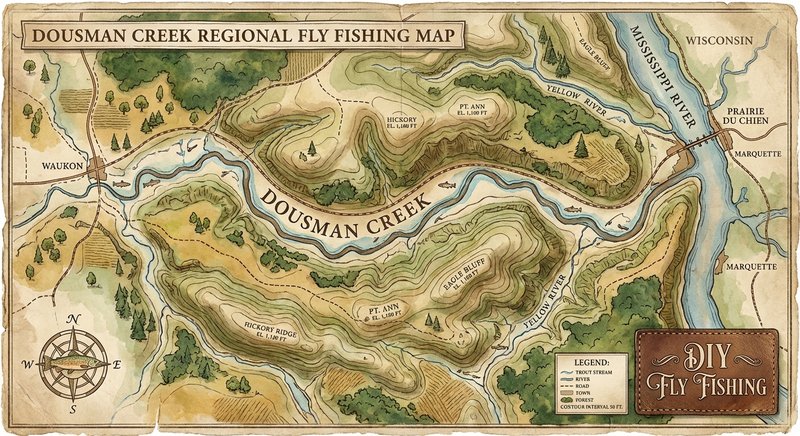
Dousman Creek
Fly fishing in Iowa · advanced · Best seasons: spring, summer, fall
Target Species
Brook Trout
About This Water
Allamakee County stream with wild brook trout. Remote headwaters fishing.
Fishing Recommendations
Welcome to the Driftless Area of Northeast Iowa. As a guide in this region, I can tell you that Dousman Creek is one of our true hidden gems. Located in Allamakee County, it is one of the few streams in the state that supports a self-sustaining, naturally reproducing population of wild Brook Trout.
Here is your comprehensive guide to fly fishing Dousman Creek.
🎣 Location Overview
Dousman Creek is a cold-water tributary to the Yellow River. What makes it special is its "wild" character. Unlike many Iowa streams that rely heavily on stocking, Dousman is a nursery for native genetics.
The water is classic Driftless: limestone spring-fed, crystal clear, and highly productive in terms of biomass (bugs). The creek is relatively small and intimate, characterized by tight bends, deep undercut banks, and overhanging "tag alders" and willow brush. This isn't a place for hero casts; it’s a place for stealth, precision, and appreciation for small-stream tactics.
🐟 Target Species & Behavior
- Wild Brook Trout: These are the stars of the show. They are stunningly beautiful but notoriously "spooky." They average 6–10 inches, but a 12-incher is a trophy here.
- Brown Trout: You will occasionally find wild Browns, especially near the confluence with the Yellow River.
Behavior: These fish are opportunistic but wary. Because the water is so clear, they can see you long before you see them. They hold in the "cushion" in front of rocks, deep in the shadows of undercut banks, and at the head of plunge pools. During a hatch, they will move into the tail-outs of pools to sip insects.
📅 Best Times to Fish
Spring (April – May)
This is "hatch season." As the water warms, the bugs get active. Look for Blue Winged Olives (BWOs) on cloudy days and Hendricksons in late April.
- Prime Window: 10:00 AM – 3:00 PM.
Summer (June – August)
The vegetation gets thick, and the fishing gets "buggy." This is the best time for terrestrial fishing. The water stays cold due to the spring influence, making it a safe haven when other rivers get too warm.
- Prime Window: Early morning or the "magic hour" before sunset.
Fall (September – October)
The Brookies begin to dawn their spectacular spawning colors (deep oranges and vibrant halos). They become more aggressive as they prepare for the spawn.
- Prime Window: Midday. Note: Be mindful of redds (spawning beds) in late October/November and avoid stepping on them.
🪰 Recommended Flies & Techniques
Top Fly Patterns
- Nymphs:
- Scuds (Size 14-18): In grey or olive. This is the #1 food source in Iowa spring creeks.
- Pheasant Tail (Size 16-20): Classic for a reason.
- Zebra Midge (Size 18-22): Essential for winter and early spring.
- Dry Flies:
- Parachute Adams (Size 16-20): The ultimate searcher pattern.
- Elk Hair Caddis (Size 14-18): Great for the "skating" caddis action in summer evenings.
- Hi-Vis Foam Ant or Beetle: Crucial for summer.
- Streamers:
- Black or Olive Pine Squirrel Leech (Size 10-12): Small and jiggy.
Techniques
- The Bow-and-Arrow Cast: You will use this more than a traditional overhead cast. The brush is thick; learn to load the rod by holding the fly and "shooting" it into tight pockets.
- High-Sticking: Due to the varying currents, keep as much line off the water as possible to avoid drag.
- Dry-Dropper: A buoyant dry fly (like a Stimulator) with a small weighted scud 18 inches below it is the most effective way to cover Dousman Creek.
💡 Pro Tips & Local Knowledge
- The Stealth Approach: If you walk up to a pool and can see the fish, they have already seen you and won't eat. Wear drab colors (camo, olive, or tan), stay low, and move slowly upstream.
- Short Rods are King: Leave your 9-foot 5-weight at home. A 7' to 7'6" 2-weight or 3-weight is the perfect tool for Dousman.
- Target the "Micro-Eddies": Brookies love to sit in tiny pockets of calm water right next to fast chutes. Even a pocket the size of a dinner plate can hold a nice fish.
- Focus on the Lower Sections: The water near the Yellow River State Forest access offers great habitat and public ease, but don't be afraid to hike—the further you get from the bridge, the better the fishing gets.
⚠️ Important Information
Access
- Dousman Creek has several sections of public access through the Yellow River State Forest and Iowa DNR easements.
- Always look for the green "Trout Stream" signs.
- Respect Private Property: If a section isn't marked as public easement, you must ask permission. In Iowa, the landowner owns the stream bed; you cannot legally "wade through" private property without permission.
Regulations
- License: You need a valid Iowa Fishing License AND a Trout Fee.
- Gear: Dousman is generally open to all lures, but check the latest DNR "Trout Fishing Guide" for any emergency rule changes.
- Sustainability: Because these Brook Trout are wild and fragile, Catch and Release is highly encouraged. Use barbless hooks and keep the fish in the water while unhooking.
Safety
- Wild Parsnip: Be careful walking through tall grass in summer. Wild Parsnip causes severe skin burns when combined with sunlight. Wear long pants.
- Ticks: The Driftless is heavy tick country. Use a repellent containing DEET or Permethrin.
Enjoy the solitude of Dousman Creek. It’s one of the few places where you can still find the "Old Iowa" wilderness. Tight lines!
Bug Hatches & Matching Flies
| Hatch | Type | Peak months | Time of day | Hook sizes | Matching flies |
|---|---|---|---|---|---|
| Blue-Winged Olive Baetis tricaudatus | mayfly | March, April, September, October | Afternoon | #18-22 | RS2 #18-22, BWO Sparkle Dun #18-22, Pheasant Tail Nymph #18-20 |
| Grannom Caddis Brachycentrus occidentalis | caddis | April, May | Afternoon/Evening | #14-16 | Elk Hair Caddis (Olive) #14-16, Peacock Caddis #14-16, LaFontaine's Deep Sparkle Pupa #14-16 |
| Sulphur Ephemerella invaria | mayfly | May, June | Evening | #14-18 | Sulphur Parachute #14-18, Sulphur Emerger #16-18, Gold Ribbed Hare's Ear #14-16 |
| Trico Tricorythodes | mayfly | July, August, September | Morning | #20-24 | Trico Spinner (Poly Wing) #20-24, Griffith's Gnat #20-22 |
| Spotted Sedge Hydropsyche | caddis | June, July, August | Evening | #14-18 | Tan Elk Hair Caddis #14-18, Green Caddis Larva #14-16 |
| Midges Chironomidae | midge | January, February, March, December | Morning/Afternoon | #18-24 | Zebra Midge #18-22, Palomino Midge #20-22, Mercury Midge #20-24 |
| Terrestrials Orthoptera/Formicidae | terrestrial | July, August, September | Afternoon | #10-16 | Dave's Hopper #10-12, Black Foam Beetle #14-16, Cinnamon Ant #16-18 |
| Cinnamon Sedge Pycnopsyche | caddis | September, October | Evening | #12-14 | Stimulator (Orange/Tan) #12-14, Orange Caddis Pupa #12-14 |