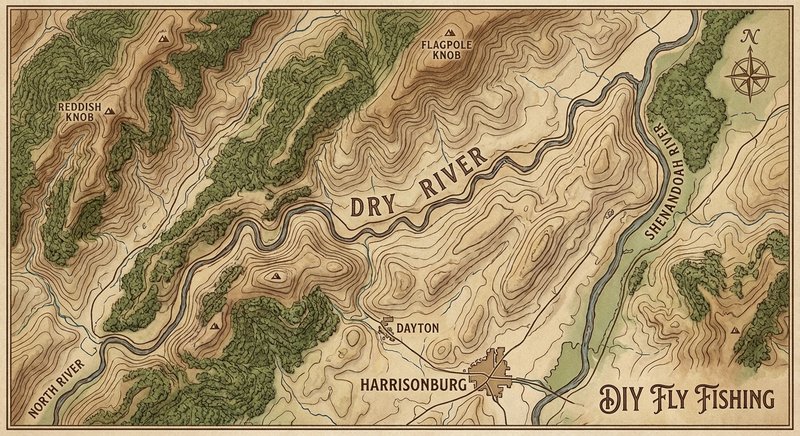
Dry River
Fly fishing in Virginia · Intermediate · Best seasons: Spring, Summer, Fall
Target Species
Brook Trout, Brown Trout
About This Water
Rockingham County stream with wild trout. George Washington National Forest.
Fishing Recommendations
As an expert guide with years spent navigating the technical waters of the Shenandoah Valley, it is a pleasure to break down the Dry River. Located just west of Harrisonburg, Virginia, the Dry River is a quintessential Appalachian freestone stream that offers a "tale of two rivers" experience—ranging from rugged, high-gradient native Brook Trout water to a productive Delayed Harvest section.
🎣 Location Overview
The Dry River flows out of the George Washington National Forest, carved into the eastern slopes of the Allegheny Mountains. Despite its name, the river usually has plenty of flow in its upper reaches, though its porous limestone and gravel bed can cause the water to go subsurface in certain stretches during dry spells—hence the name.
What makes this water special is its diversity. The upper reaches and tributaries (like Skidmore Fork) are pristine, hemlock-shaded sanctuaries for native Brook Trout. The lower section, particularly near the town of Rawley Springs, is a designated Delayed Harvest (DH) area. Anglers love it for the accessibility, the dramatic mountain backdrop, and the technical challenge of fishing crystal-clear water.
🐟 Target Species & Behavior
Native Brook Trout
Found primarily above the Rawley Springs area and into the headwaters. These are "Jewels of the Blue Ridge."
- Behavior: Highly opportunistic but extremely wary. They hold in the "cushion" in front of rocks or in the deep plunge pools.
- Feeding: They rely heavily on surface insects and terrestrials. In high-gradient sections, they have a split second to decide to eat before the current sweeps the meal away.
Brown Trout (and Stocked Rainbows)
Primary residents of the Delayed Harvest section.
- Behavior: Browns are notorious for hugging undercut banks and deep ledge holes. In the Dry River, they tend to be more active during low-light transitions.
- Feeding: They focus on midge and mayfly larvae (nymphs) throughout the day, but will aggressively chase streamers during high water or overcast conditions.
📅 Best Times to Fish
Spring (March – May)
- The Prime Window: This is the peak. Water levels are usually stable, and the aquatic insect hatches are prolific.
- Hatches: Look for Quill Gordons in March, followed by March Browns and the famous Hendrickson hatch in April.
Summer (June – August)
- Upper River: This is the time to head into the high-altitude headwaters. While the valley floor gets hot, the mountain canopy keeps the headwaters cool enough for Brookies.
- Time of Day: Early morning (dawn to 10:00 AM) is essential.
Fall (September – November)
- The Awakening: As water temperatures drop, trout become aggressive again.
- October: This is a magical month. The Brook Trout are in their vibrant spawning colors (please avoid stepping on "redds" or gravel nests). The DH section re-opens under catch-and-release regulations on October 1st.
🪰 Recommended Flies & Techniques
Dry Flies
- Adams (Size 14-18): The gold standard for imitating almost any grey mayfly.
- Elk Hair Caddis (Size 14-16): Best for the choppy pocket water; it floats high and is easy to see.
- Royal Wulff: An attractor pattern that Brook Trout simply cannot resist.
- Terrestrials (Summer): Foam Ants, Beetles, and Dave’s Hoppers.
Nymphs
- Pheasant Tail (Size 16-20): Imitates the small mayfly nymphs found under almost every rock here.
- Prince Nymph (Size 14-16): A great "heavy" nymph for the deeper DH runs.
- Zebra Midge: Essential for technical winter or late-fall fishing.
Streamers
- Woolly Bugger (Olive or Black): Swing these through the deep pools in the DH section to entice larger Brown Trout.
Technique Tip: The "Dry-Dropper"
Given the pocket-water nature of the Dry River, a Dry-Dropper rig is my go-to. Use a buoyant Stimulator as your "indicator" and hang a small Pheasant Tail nymph about 18–24 inches below it. This covers both levels of the water column simultaneously.
💡 Pro Tips & Local Knowledge
- The "Subsurface" Mystery: If you are driving along Route 33 and the river looks bone dry, keep driving upstream. Because of the geology, the river often disappears into the gravel bed and re-emerges a mile or two upstream as a cold, flowing stream.
- Stealth is Mandatory: The water is exceptionally clear. If you can see the fish, they have likely already seen you. Wear earthy tones (greens/browns), keep a low profile, and avoid splashing.
- Skidmore Fork: If the main stem of the Dry River is crowded, hike up into the Skidmore Fork above Switzer Lake. You’ll find some of the purest native Brookie water in the state.
- The "Rawley Springs" Hole: There are several large, deep pools near the Rawley Springs bridge. These hold the largest holdover fish but require long, fine leaders (6X or 7X) to fool them.
⚠️ Important Information
- Access: Much of the upper river is within the George Washington National Forest and is open to the public. The Delayed Harvest section is well-marked with signs along Route 33.
- Regulations:
- Delayed Harvest (Oct 1 – May 31): Catch and release only. Only artificial lures with single hooks may be used. No bait allowed.
- June 1 – Sept 30: The DH section reverts to general trout regulations (harvest is allowed).
- Permits: You will need a valid Virginia Fishing License AND a National Forest Permit. If fishing during the trout season, a Virginia Trout Stream license is also required.
- Safety: The rocks in the Dry River are notoriously "greased lightning" slick. Felt-soled boots or studded rubber soles are highly recommended. Cell service is non-existent once you pass Rawley Springs heading west.
Guide's Final Word: The Dry River rewards the patient angler who appreciates the beauty of a wild fish over the size of a trophy. Tight lines!
Bug Hatches & Matching Flies
| Hatch | Type | Peak months | Time of day | Hook sizes | Matching flies |
|---|---|---|---|---|---|
| Quill Gordon Epeorus pleuralis | mayfly | March, April | Midday | #12-14 | Quill Gordon Dry #12-14, Gordon Quill Nymph #12-14 |
| Blue Quill Paraleptophlebia adoptiva | mayfly | April | Midday | #16-18 | Blue Quill #16-18, Pheasant Tail Nymph #16-20 |
| Hendrickson Ephemerella subvaria | mayfly | April, May | Afternoon | #12-14 | Hendrickson Pink Lady #12-14, Red Quill #12-14, Hendrickson Emerger #14 |
| Sulphur Ephemerella invaria / dorothea | mayfly | May, June | Late Afternoon/Evening | #14-18 | Sulphur Parachute #14-18, CDC Sulphur Emerger #16-18 |
| Yellow Sally Isoperla spp. | stonefly | May, June, July | Afternoon/Evening | #14-16 | Yellow Sally Dry #14-16, Little Yellow Stone Nymph #14-16 |
| Cinnamon Caddis Hydropsyche spp. | caddis | May, June, September | Evening | #14-18 | Elk Hair Caddis (Tan) #14-18, Pupa (Cinnamon) #14-16 |
| Blue Winged Olive Baetis spp. | mayfly | March, October, November | Midday | #18-22 | BWO Sparkle Dun #18-22, RS2 (Olive) #20-22 |
| Terrestrials (Ants/Beetles) Formicidae / Coleoptera | terrestrial | July, August, September | All Day | #12-18 | Black Foam Ant #16-18, Crowe Beetle #14-16 |