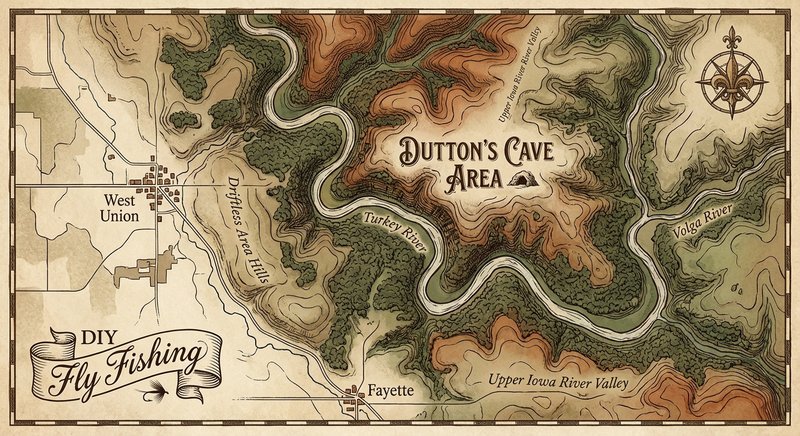
Dutton's Cave Area
Fly fishing in Iowa · beginner · Best seasons: spring, fall
Target Species
Rainbow Trout
About This Water
Fayette County fishing near cave system. Stocked trout in unique setting.
Fishing Recommendations
As an expert guide familiar with the hidden gems of the Driftless Area, it is a pleasure to break down the Dutton’s Cave Area near West Union, Iowa. While many anglers flock to the larger rivers in Northeast Iowa, Dutton’s Cave offers a technical, intimate, and highly rewarding spring creek experience that epitomizes Iowa trout fishing.
🎣 Location Overview
Dutton’s Cave County Park is a 100-acre limestone treasure located in Fayette County. The fishing here centers on a small, spring-fed tributary that eventually feeds into the Turkey River watershed.
What makes this area special is its classic Driftless topography. The water emerges from subterranean limestone passages, ensuring it stays cold (around 48-55°F) year-round. The stream is characterized by tight quarters, overhanging limestone bluffs, and crystal-clear "gin" water. Anglers love it because it feels like a secret garden; it requires stealth, precision casting, and a "stalking" mentality rather than a "wading" one.
🐟 Target Species & Behavior
Primary Species: Rainbow Trout. Note: While the Iowa DNR primarily stocks Rainbows here, you may occasionally encounter wild Brown Trout that have migrated up from larger systems.
- Behavior: Because the water is shallow and clear, these fish are extremely "spooky." They are highly attuned to overhead shadows and vibrations on the bank.
- Holding Patterns: Look for fish tucked tightly against the limestone undercut banks, behind large "lookout" boulders, or in the bubble line of the small plunges near the cave entrance.
- Feeding: Their diet is heavy on crustaceans (scuds and sowbugs) due to the limestone-rich water. During hatches, they become very focused on the film.
📅 Best Times to Fish
Optimal Seasons
- Spring (April – early June): This is the prime window. The aquatic insect life is waking up, and the water levels are usually perfect before the summer "veg-up" (heavy weed growth).
- Fall (September – October): The cooling air temperatures trigger a secondary feeding frenzy as fish prepare for winter. The fall colors against the limestone bluffs are spectacular.
Best Times of Day
- Low Light Windows: Early morning (dawn to 9:00 AM) and late evening (two hours before sunset) are critical. In such clear, small water, trout feel exposed in bright midday sun and will often tuck under banks where they won't take a fly.
- Overcast Days: A cloudy, drizzly day in May is perhaps the best possible scenario for Dutton's Cave.
🪰 Recommended Flies & Techniques
Top Fly Patterns
- The Pink Squirrel (Size 14-18): A Driftless Area staple. The flash and the pink bead are irresistible to stocked and holdover Rainbows.
- Ray Charles or Scud (Grey/Olive, Size 16-20): These mimic the primary protein source in these spring-fed waters.
- Elk Hair Caddis (Tan, Size 16-18): Best for the evening "smutting" rises in late spring.
- Hi-Vis Griffith’s Gnat (Size 18-22): Essential for the midge hatches that occur even on colder days.
- Black Beetle or Foam Ant (Size 14-16): Deadly in the fall near overhanging brush.
Techniques & Presentation
- The Stealth Approach: Do not wade if you can avoid it. Cast from the bank, staying low (sometimes on your knees). If you must enter the water, move like a heron—slowly and without ripples.
- Light Tackle: A 7’6” or 8’ rod in a 3-weight or 4-weight is ideal. You need a rod that can load quickly with very little line out.
- 6X or 7X Tippet: The water clarity demands thin, fluorocarbon tippets for nymphing and supple nylon for dries.
- Bow-and-Arrow Cast: This is "tight quarters" fishing. You will often find yourself under a canopy of trees where a traditional backcast is impossible. Master the bow-and-arrow cast to get your fly into the "kitchen" under the brush.
💡 Pro Tips & Local Knowledge
- The Cave Pool: The pool directly below the cave outflow is the most popular spot. If someone is already there, don't crowd them. Instead, hike downstream. The fish often move down into the deeper runs where they receive significantly less pressure.
- Wait Them Out: If you spook a fish (you’ll see a "V" wake heading for the weeds), sit still on the bank for 10–15 minutes. In these small systems, fish will often return to their feeding lie relatively quickly if the predator (you) disappears.
- The "Iowa Twitch": When fishing a scud or nymph under an indicator, give the rod tip a tiny, one-inch wiggle. This "life-like" pulse often triggers a strike from a Rainbow that has been staring at your fly for three drifts.
⚠️ Important Information
- Access: Dutton’s Cave County Park is managed by Fayette County Conservation. Access is public, but please respect the park boundaries and stay on the trails where possible to prevent bank erosion.
- Regulations: You must have a valid Iowa Fishing License and a Trout Fee (Trout Stamp).
- Limit/Size: Check the current Iowa DNR Trout Regulations at the park entrance. While some areas are catch-and-release, many allow a daily limit of 5 trout. However, most fly anglers here practice Catch and Release to preserve the quality of the fishery.
- Terrain: The trails down to the water can be steep and slippery, especially after rain. Wear wading boots with good traction (felt or sticky rubber with studs).
Dutton’s Cave is a microcosm of why Iowa trout fishing is so addictive. It’s not about the size of the water; it’s about the strategy required to fool a fish in a stream no wider than a sidewalk. Tight lines!
Bug Hatches & Matching Flies
| Hatch | Type | Peak months | Time of day | Hook sizes | Matching flies |
|---|---|---|---|---|---|
| Blue-Winged Olive Baetis tricaudatus | mayfly | March, April, October, November | Midday | #18-22 | RS2 #18-22, Parachute Adams #18-22, Pheasant Tail #18-20 |
| Grannom Caddis Brachycentrus occidentalis | caddis | April, May | Afternoon | #14-16 | Elk Hair Caddis #14-16, Peacock Caddis #14-16, Deep Sparkle Pupa #14-16 |
| Sulphur Ephemerella invaria | mayfly | May, June | Evening | #14-18 | Sulphur Parachute #14-18, Hare's Ear Nymph #14-16, Sulphur Emerger #16-18 |
| Trico Tricorythodes | mayfly | July, August, September | Morning | #20-24 | Trico Spinner #20-24, Drowned Trico #22-24 |
| Spotted Sedge Hydropsyche | caddis | June, July, August | Evening | #14-18 | Tan Elk Hair Caddis #16-18, LaFontaine's Emergent Pupa #14-18 |
| Midges Chironomidae | midge | January, February, March, December | Midday | #18-24 | Zebra Midge #18-22, Griffith's Gnat #18-22 |
| Terrestrials Formicidae/Gryllidae | terrestrial | July, August, September | Afternoon | #10-18 | Fat Albert #10-14, Black Foam Ant #16-18, Dave's Hopper #12-14 |
| Scud Gammarus | crustacean | March, April, May, June | All Day | #14-18 | Ray Charles #14-18, Pink Scud #12-16 |