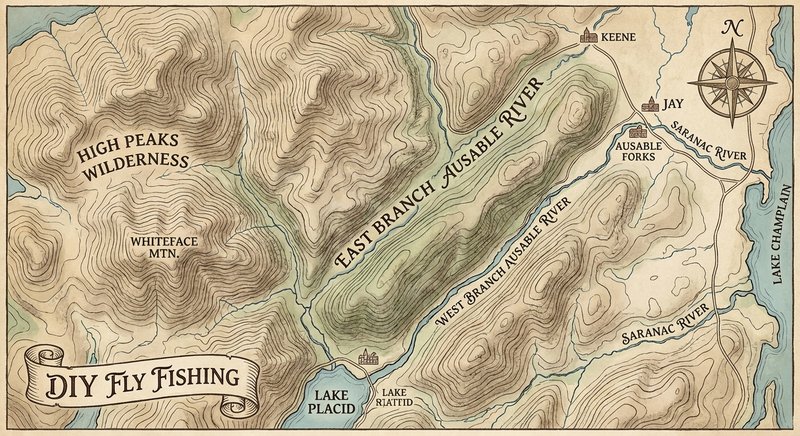
East Branch Ausable River
Fly fishing in New York · Intermediate · Best seasons: Spring, Summer, Fall
Target Species
Brook Trout, Brown Trout
About This Water
Adirondack freestone joining the West Branch. Wild brook and brown trout.
Fishing Recommendations
The East Branch of the Ausable River is one of the Adirondacks’ most cherished trout streams. While it often plays second fiddle to its more famous cousin, the West Branch, the East Branch offers a more intimate, classic freestone experience with stunning views of the High Peaks.
As your guide, here is everything you need to know to find success on these historic waters.
🎣 Location Overview
Flowing through the heart of the High Peaks region—specifically through the towns of Keene Valley and Keene—the East Branch is a quintessential mountain freestone river. It is characterized by its crystal-clear water, rugged boulder gardens, and a "riffle-pool-run" structure that challenges and rewards the technical angler.
What makes the East Branch special is its intimacy. It is generally narrower and shallower than the West Branch, making it much more approachable for wading. It feels "wilder" and less crowded. While the West Branch is a powerhouse of productivity, the East Branch is a river of stealth and beauty, requiring a delicate touch and a keen eye for reading water.
🐟 Target Species & Behavior
The East Branch is home to both Brown Trout and Brook Trout.
- Brown Trout: These are the primary residents of the lower and middle stretches (around Keene). They are savvy and tend to hold in deep undercut banks, behind large boulders (pillows), and in the tail-outs of pools during low light. In the spring, they are aggressive; in the summer, they become highly selective and wary of heavy leaders.
- Brook Trout: You will find native and wild Brookies primarily in the upper reaches (above Keene Valley) and near the mouths of cold-water tributaries. They are opportunistic but shy. Look for them in the "pocket water"—small soft spots behind rocks—and in the shaded, turbulent headwaters.
Behavior Note: Because this is a freestone river, the fish are highly attuned to water temperature and flow. They will move significantly throughout the season to find oxygenated, cool water.
📅 Best Times to Fish
The East Branch is highly dependent on snowmelt and rainfall.
- Spring (Late April – June): This is the "Goldilocks" period. The water levels stabilize after the spring runoff, and the major hatches begin. Late May to mid-June is arguably the best window for dry fly fishing.
- Summer (July – August): This can be a "hike and strike" season. The East Branch runs warmer than the West Branch. Pro Tip: Bring a thermometer. If the water is over 68°F, stop fishing to protect the trout. Focus on the early morning (5 AM – 9 AM) or the final hour of light, and target areas near cold-water springs.
- Fall (September – October): A spectacular time to be on the water. Brown trout become aggressive as they prepare to spawn. The colors of the Adirondack foliage are matched only by the vibrant spawning colors of the brook trout.
🪰 Recommended Flies & Techniques
Top Fly Patterns
You cannot fish the Ausable without paying homage to local legend Fran Betters.
- Dry Flies:
- Ausable Wulff: The gold standard. It’s buoyant, easy to see, and mimics many things. (Sizes 10-14).
- Haystack: Another Fran Betters classic; perfect for the broken water of the East Branch.
- Adirondack Series: Hendrickson, March Brown, and Light Cahills (seasonal).
- Terrestrials: Black Ants and Foam Beetles (crucial in August).
- Nymphs:
- Pheasant Tail & Hare’s Ear: (Sizes 14-18) Work these through the deep runs.
- Pat’s Rubber Legs: In stonefly colors (black/brown) for higher water.
- Streamers:
- Woolly Bugger: Olive or Black.
- Muddler Minnow: Fished on a swing to imitate sculpins.
Effective Techniques
- High-Sticking / Tight-Line Nymphing: Because the river is full of conflicting currents and boulders, keeping your fly line off the water is essential to avoid drag.
- The "Dry-Dropper": A favorite for the East Branch. Use a buoyant Ausable Wulff as your indicator and hang a small Pheasant Tail nymph 18-24 inches below it.
- Pocket Water Fishing: Don't just fish the big pools. Cast into the small "pockets" of calm water behind rocks. The fish have to make a split-second decision there, often leading to aggressive takes.
💡 Pro Tips & Local Knowledge
- The "Keene Valley Stealth": The water is often exceptionally clear. Long leaders (9-12 feet) and 5x or 6x fluorocarbon tippets are often necessary during the summer months to avoid spooking fish.
- Focus on the Confluences: Where cold mountain streams enter the East Branch, you will find "thermal refuges." Fish congregate here during the heat of July.
- The "Fran Betters" Flick: Learn to make short, accurate casts. You rarely need to cast more than 30 feet on the East Branch. Accuracy and a drag-free drift trump distance every time.
- Wading Safety: The rocks in the Ausable are notoriously "greasy." Studded boots and a wading staff are highly recommended, even in shallower sections.
⚠️ Important Information
- Access: Much of the East Branch is lined by NYSDEC Public Fishing Rights (PFR). Look for the yellow "Public Fishing Stream" signs. Large stretches of accessible water exist along Route 73 and Route 9N.
- Regulations: New York State recently updated trout regulations.
- Most of the East Branch falls under the "Statewide" rule (5 fish, any size, only 2 over 12"), but be sure to check the specific reach you are fishing, as certain sections may have "Catch and Release Only" or tackle restrictions.
- Permits: A valid New York State Freshwater Fishing License is required for everyone 16 and older.
- Clean, Drain, Dry: Help prevent the spread of invasive species like Didymo (rock snot), which has been a concern in Adirondack waters.
Guide’s Final Thought: The East Branch Ausable isn't just about the fish; it's about the cathedral-like atmosphere of the High Peaks. Slow down, observe the water, and enjoy the quietest gem in the Adirondacks. Tight lines!
Bug Hatches & Matching Flies
| Hatch | Type | Peak months | Time of day | Hook sizes | Matching flies |
|---|---|---|---|---|---|
| Hendrickson Ephemerella subvaria | mayfly | April, May | Afternoon | #12-14 | Red Quill #12-14, Hendrickson Emerger #12-14, Pheasant Tail Nymph #12-14 |
| Quill Gordon Epeorus pluralis | mayfly | April, May | Midday | #12-14 | Quill Gordon Dry #12-14, Quill Gordon Nymph #12-14 |
| March Brown Maccaffertium vicarium | mayfly | May, June | Afternoon | #10-12 | March Brown American #10-12, Hare's Ear Nymph #10-12, March Brown Wet Fly #10-12 |
| Slate Drake Isonychia bicolor | mayfly | June, September | Afternoon/Evening | #10-12 | Iso Parachute #10-12, Isonychia Nymph #10-12, Zug Bug #10-12 |
| Light Cahill Stenonema/Stenacron | mayfly | June, July | Evening | #12-16 | Light Cahill Dry #12-16, Cream Usual #14-16 |
| Grannom Caddis Brachycentrus | caddis | April, May | Morning/Afternoon | #14-16 | Grannom Apple-Green Pupa #14-16, Elk Hair Caddis (Olive) #14-16 |
| Blue-Winged Olive Baetis species | mayfly | May, September, October | Midday | #18-22 | BWO Parachute #18-22, RS2 #20-22, Baetis Nymph #18-22 |
| Giant Golden Stonefly Pteronarcys dorsata | stonefly | May, June | Evening/Night | #4-8 | Ausable Ugly #6-10, Golden Stone Nymph #8-12, Stimulator #8-12 |
| Ants and Beetles Formicidae / Coleoptera | terrestrial | July, August | All Day | #12-18 | Black Foam Ant #14-18, Cinnamon Ant #14-16, Crowe Beetle #12-16 |