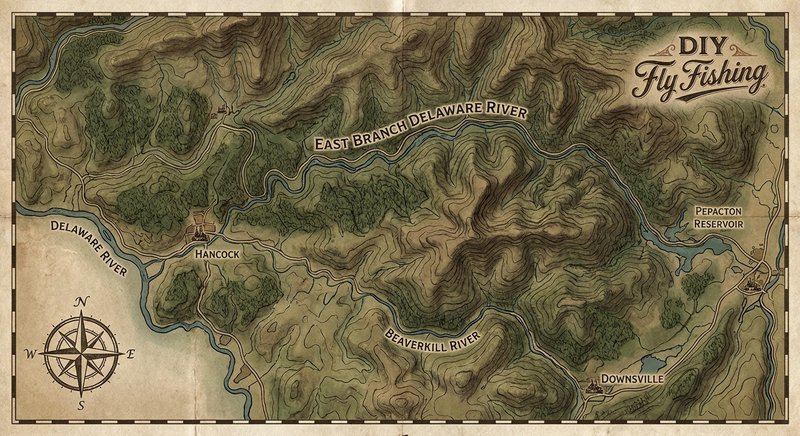
East Branch Delaware River
Fly fishing in New York · Intermediate · Best seasons: Spring, Summer, Fall
Target Species
Rainbow Trout, Brown Trout
About This Water
Excellent tailwater fishing below Pepacton Reservoir. Wild rainbow and brown trout.
Fishing Recommendations
As an expert guide in the Catskills, I can tell you that the East Branch of the Delaware River is often called "The Garden of Eden" for fly anglers. While its sibling, the West Branch, gets more press for its density of fish, the East Branch is where the "intellectuals" of fly fishing go. It is a technical, beautiful, and often rewarding tailwater that demands your "A-game."
Here is your comprehensive guide to mastering the East Branch.
🎣 Location Overview
The East Branch is a river of two personalities, divided by the Pepacton Reservoir. The section most anglers focus on is the Lower East Branch, which flows from the Downsville Dam to the confluence with the West Branch in Hancock to form the Main Stem.
What makes it special is its clarity and temperament. It is generally shallower, clearer, and runs warmer than the West Branch. It features long, glassy pools (flats) that act like mirrors, making the fish extremely wary. It is the birthplace of American dry fly fishing traditions and remains one of the most challenging—and rewarding—wild trout fisheries in the United States.
🐟 Target Species & Behavior
- Brown Trout: The East Branch is legendary for its wild, "PhD" Brown Trout. These fish are notorious for "sipping"—rising so softly to a fly that they barely leave a bubble. They often hold in very thin water (inches deep) near the banks or at the tail-outs of long pools.
- Rainbow Trout: While more common in the lower reaches (below the confluence with the Beaverkill at East Branch, NY), the rainbows here are incredibly strong and acrobatic. They tend to hold in faster oxygenated water, riffles, and the heads of pools.
Behavior Note: These fish are highly selective. They will often "inspect" your fly, drifting downstream with it for several feet before deciding to eat or refuse.
📅 Best Times to Fish
- Spring (Late April – June): This is the "Main Event." The Hendrickson hatch in late April starts the season, followed by the legendary March Browns and Sulphurs in May and June.
- Summer (July – August): The Upper East Branch (near Downsville) stays cool due to bottom-release dam flows. Look for Trico hatches in the early morning and Sulphurs in the late evening. This is also prime Terrestrial season (ants and beetles).
- Fall (September – October): My personal favorite. The crowds thin out, and the Isonychia and Blue-Winged Olives (BWO) hatches are prolific. Brown trout become more aggressive as they prepare for the spawn.
- The "Magic Hour": On the East Branch, the 90 minutes before dark are often more productive than the rest of the day combined.
🪰 Recommended Flies & Techniques
Top Fly Patterns
- Dry Flies:
- Hendrickson/Red Quill (Size 12-14)
- Sulphur Parachutes and Comparaduns (Size 16-20)
- Rusty Spinner (Size 14-22) — Absolute Must-Have for evening falls.
- Blue-Winged Olive (Size 18-22)
- Cdc Ants and Beetles (Size 16-18)
- Nymphs:
- Pheasant Tail (Size 16-20)
- Frenchies or Perdigons for Euro-nymphing the riffles.
- Streamers:
- Black or Olive Wooly Buggers or Small Sculpin patterns. Work these in the lower river during high water or low light.
Presentation Tips
- Long Leaders: Use 12-foot to 15-foot leaders tapering down to 6X or even 7X fluorocarbon/nylon.
- The Reach Cast: You must master the reach cast to present the fly before the fly line. If the fish sees your line first in this clear water, the game is over.
- Down-and-Across: For picky fish in the flats, casting downstream and across and "dropping" the fly into their feeding lane is often more effective than an upstream cast.
💡 Pro Tips & Local Knowledge
- The "Micro-Drag" is Your Enemy: Because the East Branch has many micro-currents, your fly might look like it’s drifting perfectly to you, but it’s actually dragging slightly. Use a "slack line" cast (like a puddle cast) to ensure a dead drift.
- Focus on the "Flats": Many anglers skip the slow, mirror-like pools because they are hard to fish. That is where the biggest browns live. Look for the "rise ring" that looks like a tiny dimple.
- Be a Heron: Wading on the East Branch should be done with extreme stealth. Move slowly. If you splash, you’ve likely spooked every fish within 30 feet.
- Check the Temperature: If the water at the lower end (near Hancock) hits 70°F, stop fishing to protect the trout. Head upstream toward the Downsville dam where the water is significantly colder.
⚠️ Important Information
Access & Permits
- NYC DEP Access Permit: Much of the land surrounding the East Branch is owned by New York City as part of the reservoir system. You must carry a free NYC DEP Access Permit. You can get this online instantly.
- NYS Fishing License: A standard New York State freshwater fishing license is required.
Regulations
- The East Branch has several "Catch and Release Only" and "Artificial Lures Only" sections. Always check the current NYS DEC Trout Stream Regulations Map before you head out.
- The "No-Kill" section from the Shinhopple Bridge downstream is highly productive but strictly enforced.
Safety
- Flows: The East Branch is a tailwater. Check the USGS gauges (Downsville and Harvard). A sudden release from the dam can raise water levels quickly.
- Wading: The rocks can be incredibly "greasy." Felt soles (where legal) or studs are highly recommended.
The East Branch is a river that rewards patience over power. Spend 15 minutes just watching the water before you make your first cast, and you'll find the East Branch to be one of the most rewarding experiences in fly fishing.
Bug Hatches & Matching Flies
| Hatch | Type | Peak months | Time of day | Hook sizes | Matching flies |
|---|---|---|---|---|---|
| Blue-Winged Olive Baetis / Acerpenna | mayfly | April, May, September, October | Midday | #18-22 | RS2 #18-22, BWO Parachute #18-22, CDC Baetis Emerger #20-22 |
| Hendrickson Ephemerella subvaria | mayfly | April, May | Afternoon | #12-14 | Hendrickson Dark #12-14, Red Quill Spinner #12-14, Pheasant Tail #12-14 |
| Apple Caddis / Grannom Brachycentrus | caddis | April, May | Morning/Afternoon | #14-16 | LaFontaine Sparkle Pupa #14-16, Elk Hair Caddis (Green body) #14-16, Peacock Caddis #14-16 |
| March Brown Maccaffertium vicarium | mayfly | May, June | Afternoon | #10-12 | March Brown American #10-12, Gold Ribbed Hare's Ear #10-12, March Brown Wet #12 |
| Sulphur Ephemerella invaria / dorothea | mayfly | June, July | Evening | #14-18 | Sulphur Parachute #16-18, Sulphur Snowshoe Emerger #14-18, Sulphur Spinner #14-18 |
| Green Drake Ephemera guttulata | mayfly | May, June | Evening | #8-10 | Green Drake Paradrake #8-10, Coffin Fly (Spinner) #8-10, Green Drake Nymph #8-10 |
| Slate Drake Isonychia bicolor | mayfly | June, July, August, September | Late Afternoon | #10-12 | Iso Parachute #10-12, Isonychia Nymph #10-12, Zug Bug #10-12 |
| Trico Tricorythodes | mayfly | July, August, September | Early Morning | #22-26 | Trico Spinner #22-26, Trico Drowned Spinner #24, Black Zebra Midge #22-24 |