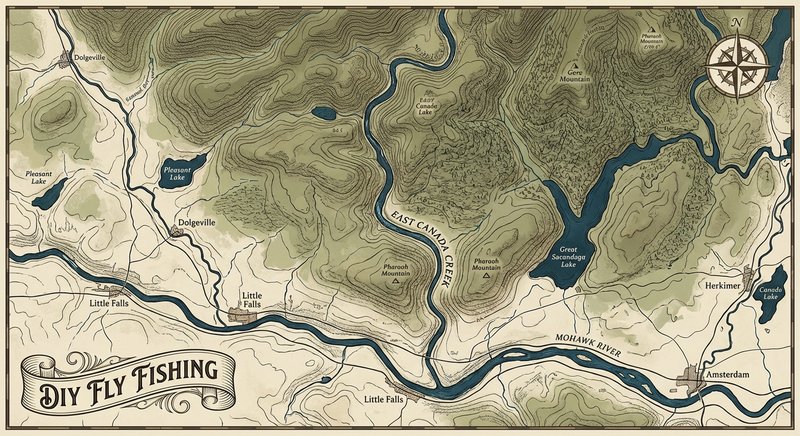
East Canada Creek
Fly fishing in New York · Intermediate · Best seasons: Spring, Summer, Fall
Target Species
Brown Trout, Brook Trout
About This Water
Herkimer County stream with wild brown trout. Less pressured alternative to West Canada.
Fishing Recommendations
As a guide who has spent years traversing the limestone and freestone waters of the Northeast, I can tell you that East Canada Creek is one of New York’s most underrated gems. While its neighbor to the west (the West Canada) gets more press, the "East" offers a more intimate, rugged experience that bridges the gap between Adirondack mountain fishing and Mohawk Valley fertile waters.
🎣 Location Overview
East Canada Creek is a major tributary to the Mohawk River, originating in the southern Adirondack Mountains and flowing south through Hamilton, Fulton, and Herkimer counties. It is a diverse fishery that transforms as it descends:
- The Upper Section: Above the village of Dolgeville, the creek feels like a classic Adirondack stream—boulder-strewn, cold, and surrounded by forest.
- The Middle Section: In the Dolgeville area, the creek drops through a dramatic, steep-walled gorge.
- The Lower Section: Below the dams, the water becomes larger and more fertile as it approaches its confluence with the Mohawk River near St. Johnsville.
What makes it special is its resilience. Thanks to its headwaters in the Adirondack wilderness and several hydroelectric dams that provide bottom-release cooling in certain stretches, it stays fishable when other regional streams get too warm in mid-summer.
🐟 Target Species & Behavior
Brown Trout
The primary draw. You’ll find a mix of savvy holdover browns and wild fish.
- Behavior: In the lower sections, they are opportunistic but wary. They tuck tight into the undercut banks and under the shadows of the massive limestone and shale slabs.
- Feeding: They are highly piscivorous (fish-eaters) once they hit 14 inches. They focus on sculpins and dace but will rise consistently for heavy caddis hatches.
Brook Trout
Found primarily in the headwaters above Stratford and in the small feeder tributaries.
- Behavior: These are "mountain" fish. They are smaller, vibrantly colored, and far less selective than the browns.
- Feeding: They hold in the "pillows" in front of rocks and the tail-outs of small pools. They feed aggressively on terrestrial insects and small nymphs.
📅 Best Times to Fish
Spring (April – June)
This is "Prime Time." Once the spring runoff subsides (usually late April), the Hendrickson hatch kicks off the season.
- Window: Mid-day (1:00 PM – 4:00 PM) is best for dry fly activity.
- Conditions: Look for "tannin" colored water that is clearing.
Summer (July – August)
Unlike many NY streams, the East Canada can stay cool due to its mountain origin and dam releases.
- Window: First light and the last hour of "magic hour" before dark.
- Conditions: Focus on the faster pocket water and highly oxygenated riffles.
Fall (September – October)
The most beautiful time to be on the water. The Brown Trout become aggressive as they prepare for the spawn.
- Window: All day, especially on overcast days.
- Conditions: This is streamer season. Big, meat-and-potato flies are the ticket.
🪰 Recommended Flies & Techniques
Nymphing (The Bread & Butter)
Most fish here are caught sub-surface.
- Patterns: Frenchie (#14-16), Pheasant Tail (#12-18), and the Walts Worm.
- Technique: "High-sticking" or Euro-nymphing through the deep pocket water in the Dolgeville gorge is incredibly effective.
Dry Flies (The Excitement)
- Patterns: Elk Hair Caddis (Tan/Olive #14-16), Parachute Adams (#14-18), and the Stimulator (#10-12) for the faster water.
- Technique: Target the "seams" where slow and fast water meet. Use a reach cast to avoid drag caused by the complex currents around boulders.
Streamers (For the Trophies)
- Patterns: Wooly Buggers (Black or Olive #6-10), Black Nose Dace, and Sculpin patterns.
- Technique: Swing them through deep runs or "strip-and-pause" through the slower pools near the Mohawk confluence.
💡 Pro Tips & Local Knowledge
- The "Gorge" Secret: The area just below the Dolgeville dam is spectacular but can be physically demanding. The rocks are notoriously slick—aluminum bars or tungsten studs on your wading boots are non-negotiable here.
- Follow the Cold: If the lower river hits 70°F, drive north. Every mile you drive toward Stratford, the water temperature drops significantly.
- The Mohawk Migration: In late fall, some very large "lake-run" style browns may move from the Mohawk River into the lower reaches of East Canada Creek. Fish the deep holes in the bottom two miles with heavy streamers.
- Stealth Matters: Because the water is often crystal clear in the upper sections, wear natural colors (greens/browns) and avoid lining the fish.
⚠️ Important Information
Access
- Public Fishing Rights (PFR): New York State has purchased many PFR easements along the creek. Look for the yellow "Public Fishing Stream" signs.
- Key Access Points: Route 29 bridge, Route 170, and the various bridge crossings between Dolgeville and the Mohawk River.
Regulations
- License: A valid New York State Fishing License is required.
- Specifics: Generally, East Canada Creek follows the standard statewide trout regulations (5 fish per day, any size), but always check the current NYSDEC Freshwater Fishing Guide as special "Catch and Release" sections or seasonal closures can change.
Safety
- Dam Releases: This is a dam-controlled river. Be aware of sudden rises in water levels. If you see the water becoming muddy or notice sticks/debris floating by, exit the river immediately.
- Wildlife: You are in bear country in the upper reaches. Keep a clean camp and be aware of your surroundings.
Guide’s Final Word: East Canada Creek is a "fisherman's creek." It’s not always easy, and the wading can be tough, but for the angler who loves technical pocket water and the chance at a wild-looking Adirondack brown, there is nowhere better in Central New York.
Bug Hatches & Matching Flies
| Hatch | Type | Peak months | Time of day | Hook sizes | Matching flies |
|---|---|---|---|---|---|
| Hendrickson Ephemerella subvaria | mayfly | April, May | Afternoon | #12-14 | Red Quill #12-14, Hendrickson Emerger #14, Pheasant Tail #12-14 |
| Sulphur Ephemerella invaria/dorothea | mayfly | May, June | Evening | #14-18 | Sulphur Parachute #14-18, Sulphur Cripple #16, Hare's Ear #14-16 |
| Blue Winged Olive Baetis / Drunella | mayfly | April, May, September, October | Late Morning/Afternoon | #18-22 | BWO Sparkle Dun #18-22, RS2 #20-22, Barr's BWO Emerger #18-20 |
| Grannom Caddis Brachycentrus | caddis | April, May | Morning/Afternoon | #14-16 | Elk Hair Caddis (Dark) #14-16, Deep Sparkle Pupa #14-16, Peacock Caddis #14 |
| Slate Drake Isonychia bicolor | mayfly | June, September | Afternoon/Evening | #10-14 | Isonychia Parachute #12-14, Zug Bug #10-12, Iso Nymph #10-12 |
| Light Cahill Stenonema ithaca | mayfly | June, July | Evening | #12-16 | Light Cahill #12-16, Cream Usual #14-16, Gold Ribbed Hare's Ear #14 |
| Golden Stonefly Acroneuria | stonefly | June, July | Evening/Night | #6-10 | Kaufmann's Stimulator #8-12, Pats Rubber Legs #6-10, Golden Stone Nymph #8-10 |
| Trico Tricorythodes | mayfly | July, August, September | Morning | #22-26 | Trico Spinner #22-26, Griffith's Gnat #22-24, Trico Nymph #22-24 |