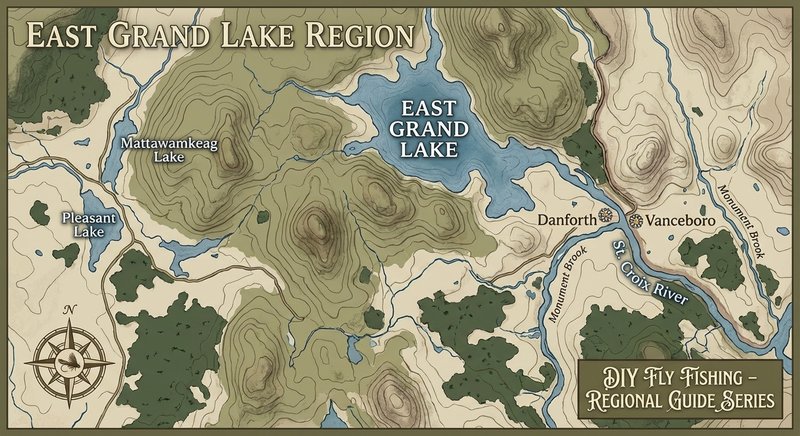
East Grand Lake
Fly fishing in Maine · Intermediate · Best seasons: Spring, Summer, Fall
Target Species
Landlocked Salmon, Smallmouth Bass
About This Water
Border lake with landlocked salmon and smallmouth bass. Grand Lake Stream headwaters.
Fishing Recommendations
Welcome to the "North Country." As a guide who has spent years poling and rowing the glacial waters of the Maine-New Brunswick border, I can tell you that East Grand Lake is one of the crown jewels of the Chiputneticook Chain.
Spanning over 16,000 acres with depths reaching 128 feet, East Grand is a cold-water powerhouse. It is famous for its crystal-clear water, rugged granite shoreline, and its status as a premier international fishery (shared with Canada).
🎣 Location Overview
East Grand Lake is a massive, deep-water glacial lake that serves as the headwaters for the St. Croix River. What makes it special is its stability. Because it is so deep and well-oxygenated, it maintains a world-class landlocked salmon fishery even when other Maine lakes warm up too much in the summer.
The shoreline is a mix of jagged boulders, sandy coves, and submerged ledge transitions. For the fly angler, it offers two distinct worlds: the deep-water "blue water" hunt for salmon and the rocky-shoreline "structure game" for some of the biggest smallmouth bass in the Northeast.
🐟 Target Species & Behavior
Landlocked Salmon (Salmo salar sebago)
- Behavior: These are "landlocked" Atlantic Salmon. They are acrobatic, aggressive, and highly migratory within the lake.
- Holding Zones: In the spring, they are found in the top 10 feet of the water column near the mouths of inlets and along rocky points. As the water warms, they retreat to the thermocline (30–50 feet down).
- Forage: Their world revolves around Smelt. If you find the smelt, you find the salmon.
Smallmouth Bass
- Behavior: Known for their size and fight, East Grand smallies are prolific.
- Holding Zones: Look for "the drops." They love the transition where a 5-foot flat drops off into 15 or 20 feet of water. Boulder piles and submerged timber are magnets.
- Forage: Crawfish, dragonflies, and various minnows (shiners and dace).
📅 Best Times to Fish
- Spring (Ice-out to Mid-June): The Prime Window. This is when the Salmon are near the surface. "Ice-out" (usually late April/early May) triggers a smelt run, and the salmon follow them into the shallows. This is the best time for fly rodders to hit them with streamers.
- Summer (July - August): The best time for Smallmouth Bass. They are active in the shallows during low light and move to the ledges during the day. Salmon fishing requires sinking lines or downriggers during this period.
- Fall (September - October): The "Second Spring." As water temperatures drop, salmon move back toward the surface and congregate near the mouth of the Thoroughfare and other spawning tributaries. The bass feed heavily before winter.
🪰 Recommended Flies & Techniques
For Landlocked Salmon
- Technique: Trolling streamers is the traditional Maine method, but "casting to the splash" or stripping streamers near rocky points is exhilarating. Use a Type 3 or Type 5 sinking tip.
- Top Patterns:
- Gray Ghost: The quintessential Maine smelt imitation.
- Black Ghost: High contrast for overcast days.
- Joe’s Smelt: An underrated local favorite.
- Governor Aiken: Great for when they are keyed in on brighter colors.
For Smallmouth Bass
- Technique: Poppers on the surface at dawn/dusk; weighted streamers or "craw" patterns bounced along the rocks during the day.
- Top Patterns:
- BoogleBug Poppers: (Yellow or Green) Indestructible and loud.
- Clouser Minnow: (Chartreuse/White) The gold standard.
- Murdich Minnow: Great for mimicking injured baitfish in the waves.
- Hellgrammite patterns: Heavy nymphs fished on a long leader.
💡 Pro Tips & Local Knowledge
- The "Thoroughfare": The channel connecting East Grand to North Lake (The Thoroughfare) is a legendary spot. In the spring and fall, salmon stack up here. Focus on the moving water sections.
- Wind is your Friend: A "Maine Chop" (6–12 inch waves) breaks up the surface and makes salmon less spooky. If the lake is glass-calm, your chances of a salmon strike on a fly drop significantly.
- The Smelt Connection: Keep a pair of binoculars in the boat. If you see gulls diving in the middle of the lake, they are over a school of smelt pushed to the surface by salmon. Get there fast and cast into the chaos.
- Vary the Strip: When fishing streamers, don't just steady-retrieve. Use a "pulse" or a "strip-strip-pause." The pause is usually when the salmon will hammer the fly.
⚠️ Important Information
- Access: Public boat launches are available in Danforth and Brookton. There are also excellent sporting camps (like First Settlers Lodge or Greenland Cove) that offer docks and local intel.
- International Border: The lake is split between Maine (USA) and New Brunswick (Canada). The border is marked by buoys, but it is invisible on the water. Carry a GPS. If you cross the line and fish, you must have a Canadian license and be aware of their "Customs" reporting requirements (the CANPASS system).
- Regulations: Maine's "Open Water" fishing season typically runs April 1st to September 30th, though some "catch and release" seasons may apply in October. Always check the Maine MDIFW Law Book for the "S-Codes" specific to East Grand (e.g., minimum length for salmon is often 14-16 inches).
- Safety: This is a big lake. It can kick up 3-4 foot swells in minutes. Always check the wind forecast before heading to the middle of the lake.
Guide’s Final Word: If you want the true Maine experience, get out at 5:00 AM, fish a Gray Ghost on a sinking line, and keep your eyes on the shoreline for moose. Tight lines!
Bug Hatches & Matching Flies
| Hatch | Type | Peak months | Time of day | Hook sizes | Matching flies |
|---|---|---|---|---|---|
| Hexagenia (Giant Mayfly) Hexagenia limbata | mayfly | June, July | Late Evening/Dusk | #6-10 | Hexagenia Dry #6-8, Hex Nymph #8-10, Floating Nymph #8 |
| Green Drake Ephemera guttulata | mayfly | June | Afternoon/Evening | #8-12 | Green Drake Wulff #10-12, Green Drake Paradrake #10, Hairwing Green Drake #10 |
| Brown Drake Ephemera simulans | mayfly | June | Evening | #10-12 | Brown Drake Cripple #10-12, Adams #10-12 |
| Grannom Caddis Brachycentrus | caddis | May | Morning/Afternoon | #14-16 | Elk Hair Caddis (Dark) #14-16, Pupa Larva #14-16 |
| Carpenter Ant Camponotus | terrestrial | May, June | All Day | #10-14 | Black Foam Ant #10-14, Chernobyl Ant #10-12 |
| White Miller Ephoron leukon | mayfly | August | Evening/Night | #12-14 | White Wulff #12-14, Snowshoe Emerger #14 |
| Blue Winged Olive Baetis | mayfly | May, September, October | Afternoon | #18-22 | BWO Sparkle Dun #18-20, Pheasant Tail #18-22 |
| Spotted Sedge Hydropsyche | caddis | July, August | Evening | #14-18 | Tan Elk Hair Caddis #14-16, LaFontaine's Deep Pupa #14-16 |
| Alderfly Sialis hastata | caddis | June, July | Morning/Afternoon | #10-14 | Alder Fly #12, Black Wooly Bugger (Small) #10-12 |