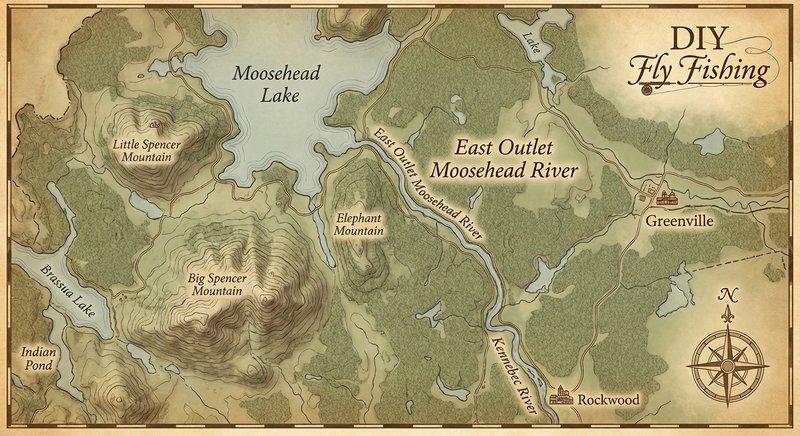
East Outlet Moosehead
Fly fishing in Maine · Intermediate · Best seasons: Spring, Summer, Fall
Target Species
Landlocked Salmon, Brook Trout
About This Water
Moosehead Lake outlet with landlocked salmon and brook trout. Excellent fly water.
Fishing Recommendations
Welcome to the East Outlet of the Kennebec River, arguably the most iconic fly fishing destination in the state of Maine. As a tailwater flowing out of the massive Moosehead Lake, the East Outlet offers consistent cold water, breathtaking scenery, and some of the hardest-fighting Landlocked Salmon in the Northeast.
🎣 Location Overview
The East Outlet (EO) is a 3.5-mile stretch of water that connects Moosehead Lake to Indian Pond. It is a quintessential Maine river: rugged, boulder-strewn, and surrounded by dense forest.
What makes it special is its tailwater status. Because the water is drawn from the depths of Moosehead Lake, it stays cool even in the heat of August, providing a sanctuary for cold-water salmonids. The river is characterized by heavy pocket water, long pools, and classic "slick" tail-outs. It is a powerful river; even at lower flows, it commands respect. Anglers love it because it offers a "big water" experience where you have a legitimate chance at a 20-inch wild Brook Trout or a leaping Landlocked Salmon on any given cast.
🐟 Target Species & Behavior
Landlocked Salmon
The "Landlock" is the king of the East Outlet. Unlike their sea-run cousins, these fish spend their lives in the lake/river system.
- Behavior: They are notorious acrobats. When hooked, expect multiple jumps.
- Holding Water: They love oxygenated water. Look for them in the "bubbles"—the seams where fast water meets slow water, and at the very head of pools.
- Feeding: They are highly piscivorous (fish-eaters), primarily chasing smelt, but they will rise readily to caddis and stoneflies.
Brook Trout
Maine is the last stronghold for wild Brook Trout in the Eastern US.
- Behavior: More opportunistic and slightly more cautious than the salmon.
- Holding Water: They prefer the "soft" spots. Look behind large boulders (cushion water), under overhanging banks, and in the slower eddies near the shoreline.
- Feeding: They focus heavily on aquatic insects (nymphs and dries) but will rarely turn down a well-presented streamer.
📅 Best Times to Fish
Spring (Mid-May to June)
The Prime Time. As the ice leaves Moosehead Lake, the smelt begin their run. The salmon follow them into the river to gorge.
- Conditions: High water is common. Streamer fishing is the name of the game.
Summer (July to August)
The Hatch Season. While other rivers get too warm, the EO remains fishable.
- Conditions: Evening caddis hatches are spectacular. This is the best time for dry fly enthusiasts. Fish early morning or the last two hours of daylight.
Fall (September to October 31)
The Spawning Run. Salmon and trout move from Indian Pond up into the river to spawn.
- Conditions: Fish become aggressive and territorial. The colors on the Brook Trout are breathtaking. Note: Be mindful of spawning redds in late October.
🪰 Recommended Flies & Techniques
Streamers (Best for Spring/Fall)
- Patterns: Gray Ghost, Black Ghost, Mickey Finn, Herb Johnson’s Smelt, and Sparkle Minnows.
- Technique: The "Maine Swing." Cast 45 degrees downstream, mend to sink the fly, and let it swing through the current. Add small strips at the end of the swing.
Nymphing (Consistent Year-Round)
- Patterns: Golden Stoneflies (size 8-12), Pheasant Tails (14-18), Prince Nymphs, and Zebra Midges.
- Technique: High-stick nymphing through pocket water or using a strike indicator in the deeper pools. Use plenty of split shot; you need to get down to the bottom in this heavy current.
Dry Flies (Summer Evenings)
- Patterns: Elk Hair Caddis (Tan/Olive, 14-16), Stimulators (Orange/Yellow), and Blue Winged Olives (18-22).
- Technique: Focus on the tail-outs of pools. A dead-drift is standard, but for salmon, a "skittered" caddis (twitching the fly on the surface) can trigger violent strikes.
💡 Pro Tips & Local Knowledge
- The "Beach" and the "Dam": The most popular wading spot is right at the dam. While productive, don't be afraid to hike down the tracks. The "Beach" area about a mile down offers excellent wading and holds massive fish.
- Watch the Flow: Check the USGS gauge for "Kennebec River at East Outlet."
- 500–1,000 cfs: Perfect wading.
- 1,500–2,500 cfs: Difficult wading, prime for drift boats.
- 3,000+ cfs: Dangerous for wading; stay on the banks.
- The Soft Hackle Secret: If the fish are rising but won't take a dry, swing a Partridge and Orange or a Soft Hackle Pheasant Tail just under the surface. It is often the "secret weapon" on the EO.
- Studded Boots: The rocks in the EO are famously "greased" with algae and are very round. Studded felt boots and a wading staff are not optional—they are safety equipment here.
⚠️ Important Information
- Access: Access is via Route 15/6. There is a large parking lot at the dam (West Cove side). You can also access the lower river via the "Yellow Gate" on the Burnham Pond Road, which requires a hike or a mountain bike.
- Regulations: The East Outlet is FFO (Fly Fishing Only).
- Permits: A valid Maine Freshwater Fishing License is required. These can be purchased online or at local shops in Greenville (like Northwoods Outfitters).
- Safety: This is moose and bear country. While they generally avoid crowds, be aware of your surroundings, especially if hiking the lower trails alone.
- Catch and Release: While regulations allow for some harvest, most guides and locals practice 100% catch and release here to preserve the world-class trophy quality of the fishery.
Guide's Final Word: The East Outlet is a river of dreams. Respect the power of the water, keep your flies deep in the morning and on the surface in the evening, and hold on tight when a Salmon heads for the downstream rapids!
Bug Hatches & Matching Flies
| Hatch | Type | Peak months | Time of day | Hook sizes | Matching flies |
|---|---|---|---|---|---|
| Hendrickson Ephemerella subvaria | mayfly | May, June | Afternoon | #12-14 | Red Quill #12-14, Hendrickson Nymph #12-14, Hendrickson Emerger #14 |
| Grannom Caddis Brachycentrus | caddis | May | All Day | #14-16 | Elk Hair Caddis (Olive/Black) #14-16, Peeking Caddis #14, Deep Sparkle Pupa #16 |
| Blue Winged Olive Baetis | mayfly | May, September, October | Afternoon | #18-22 | Parachute BWO #18-22, RS2 #20, Pheasant Tail Nymph #18-20 |
| Sulfur Ephemerella invaria | mayfly | June, July | Evening | #14-18 | Sulfur Sparkle Dun #16-18, Pale Evening Dun #14-16, Sulfur Nymph #16 |
| Slate Drake Isonychia bicolor | mayfly | July, August, September | Afternoon/Evening | #10-12 | Iso Parachute #10-12, Prince Nymph #10-12, Zug Bug #10-12 |
| Green Drake Ephemera guttulata | mayfly | June | Evening | #8-10 | Coffin Fly #8-10, Green Drake Hairwing #8-10, Green Drake Nymph #8-10 |
| October Caddis Dicosmoecus | caddis | September, October | All Day/Evening | #8-12 | Orange Stimulator #8-12, October Caddis Pupa #10, Morrish October Caddis Adult #10 |
| Black Fly Simulium | midge | May, June | All Day | #18-24 | Zebra Midge (Black) #18-22, Black Gnat #20-22, Griffith's Gnat #18-22 |
| Golden Stonefly Acronuria | stonefly | June, July | Morning/Evening | #6-10 | Golden Stone Nymph #6-10, Kaufmann's Stone #8, Rogue River Stone #8 |