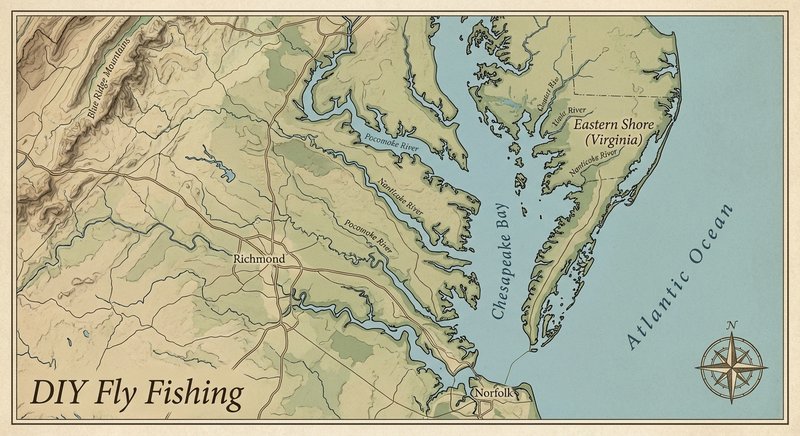
Eastern Shore (Virginia)
Fly fishing in Virginia · Intermediate · Best seasons: Spring, Summer, Fall
Target Species
Red Drum, Speckled Trout, Flounder
About This Water
Barrier island coast with red drum, speckled trout, and flounder. World-class saltwater fishing.
Fishing Recommendations
The Eastern Shore of Virginia (ESVA) is one of the last truly wild frontiers on the Atlantic seaboard. This 70-mile long peninsula separates the Chesapeake Bay from the Atlantic Ocean, offering a dual-threat environment of sprawling salt marshes, labyrinthine tidal creeks, and pristine barrier islands. For the fly angler, it is a sight-fishing paradise that rivals the marshes of Louisiana or the flats of the Bahamas, but with a distinctly Mid-Atlantic grit.
🎣 Location Overview
The Eastern Shore is defined by two distinct sides:
- The Seaside (Atlantic): A massive complex of salt marshes and uninhibited barrier islands (the longest chain of undeveloped barrier islands in the US). It is characterized by expansive mudflats, oyster bars, and deep tidal guts.
- The Bayside (Chesapeake): Known for its sandy bottoms, lush eelgrass beds, and "potholes." The water here is often clearer, making it the premier destination for sight-casting to Speckled Trout and Red Drum.
What makes this area special is the isolation. You can spend a day on the flats without seeing another skiff. The fishery is highly dependent on tides, which can swing up to 4-5 feet, completely transforming the landscape every six hours.
🐟 Target Species & Behavior
Red Drum (Redfish)
- Behavior: In the spring and fall, "Bull" Reds (30–50+ inches) roam the surf and deeper inlets. However, the stars for fly anglers are the "Slot" Reds (18–27 inches).
- Holding Spots: On high tides, they push deep into the marsh grass to hunt crabs (look for "tailing" fish). On low tides, they retreat to the edges of oyster bars and depressions in the mud.
- Feeding: Primarily blue crabs, mud crabs, and mud minnows.
Speckled Trout (Spotted Seatrout)
- Behavior: Highly predatory and aggressive. They love "structure" but on the Eastern Shore, that structure is often an eelgrass bed or a drop-off near a marsh point.
- Holding Spots: They sit in "potholes" (sandy depressions in grass beds) waiting to ambush shrimp and silversides.
- Feeding: Shrimp, menhaden (pogy), and mullet.
Flounder
- Behavior: Often considered a "bycatch" on fly, but a worthy target. They are camouflage experts.
- Holding Spots: They sit on the edges of channels where the current brings food to them. On the flats, look for "flounder beds" (depressions left in the sand) to know if they are in the area.
- Feeding: Heavy emphasis on small finfish and shrimp.
📅 Best Times to Fish
- Spring (May – June): This is the time for Bull Reds in the surf and the arrival of the first big Speckled Trout. Flounder fishing is at its peak in the seaside inlets.
- Summer (July – August): Best for Sight-Fishing. The water is warm, and Redfish are active in the grass. Focus on the early morning or late evening to avoid the heat (and the bugs).
- Fall (September – November): The "Golden Era." As the water cools, fish bulk up for winter. This is the best time for trophy Speckled Trout (the "Gator" Trout) and massive schools of Redfish.
The Tides:
- Tailing Fish: Focus on the last two hours of the flood tide and the first hour of the ebb.
- The "Low": Focus on the low-tide drains where water exits the marsh; fish will stack up here to eat anything being flushed out.
🪰 Recommended Flies & Techniques
Top Fly Patterns
- Clouser Minnow: The undisputed king. Chartreuse/White or Tan/White. Size 1/0 to 2.
- Kinky Muddler: Excellent for Speckled Trout; it moves a lot of water and mimics a struggling baitfish.
- KW Crab / Merkin: Essential for tailing Redfish. Use weedguards, as you will be throwing into thick grass.
- Gurgler: For heart-stopping topwater strikes from Reds and Trout in the early morning.
- EP Shrimp: Translucent patterns work best in the clear Bayside water.
Presentation & Technique
- The "Strip Strike": Never "trout set" (lift the rod). When you feel a hit, pull the line hard with your stripping hand to set the hook in the fish’s tough mouth.
- The Lead: When sight-fishing, do not land the fly on the fish's head. Cast 2–3 feet in front of their path and wait for them to approach before giving the fly short, twitchy strips.
- Weighted Flies: Always carry flies with varying eye weights (bead chain vs. lead eyes) to account for different water depths and current speeds.
💡 Pro Tips & Local Knowledge
- The Stealth Factor: The flats on the Eastern Shore are shallow. If you are in a boat, use a push-pole; if wading, move at a snail's pace. The vibration of a closing hatch or a heavy footstep will spook fish 50 feet away.
- Watch the Birds: "Working birds" (terns and gulls) are your best friends. They indicate schools of baitfish being pushed to the surface by predators.
- The "Greens": In late spring and summer, the Greenhead Flies and mosquitoes can be brutal. Wear long sleeves, long pants (buffs are a must), and use high-DEET repellent. If the wind dies, the bugs arrive.
- Oyster Safety: The Shore is covered in razor-sharp oysters. If wading, you must wear heavy-duty wading boots with puncture-resistant soles. Do not wade in old sneakers.
⚠️ Important Information
Access Information
- Cape Charles: Great Bayside access with public piers and ramps.
- Oyster & Willis Wharf: Premier Seaside access points for launching skiffs or kayaks.
- Chincoteague: Northern end of the shore; excellent for flounder and back-bay reds.
Regulations & Permits
- A Virginia Saltwater Fishing License is required.
- Be aware of "Sanctuary" zones within the Virginia Coast Reserve (The Nature Conservancy). Some islands allow hiking/fishing on the beach but prohibit entering the interior marshes.
- Check the VMRC (Virginia Marine Resources Commission) website for current size and bag limits, as Speckled Trout and Red Drum regulations can change seasonally.
Special Considerations
- Navigation: The Eastern Shore is a maze. If you are new to the area, use a GPS with high-quality satellite imagery. It is very easy to get "beached" on a falling tide and have to wait six hours for the water to return.
Bug Hatches & Matching Flies
| Hatch | Type | Peak months | Time of day | Hook sizes | Matching flies |
|---|---|---|---|---|---|
| Chironomids (Midges) Family Chironomidae | midge | March, April, October, November | All Day | #18-24 | Zebra Midge #18-22, Griffith's Gnat #20-22 |
| Blue-Winged Olive Baetidae | mayfly | March, April, September, October | Afternoon | #18-22 | RS2 #20-22, Parachute Adams #18-20 |
| Blue Damselfly Enallagma cyathigerum | terrestrial | June, July, August | Late Morning/Afternoon | #10-14 | Braided Butt Damsel #12-14, Marabou Damsel Nymph #10-12 |
| Green Darner (Dragonfly) Anax junius | terrestrial | July, August, September | Afternoon | #6-10 | Adult Dragonfly #6-8, Dragonfly Nymph #8-10 |
| Black Carpenter Ant Camponotus pennsylvanicus | terrestrial | June, July | Afternoon | #12-16 | Chernobyl Ant #12-14, Black Foam Ant #14-16 |
| Caenis (Angler's Curse) Caenis spp. | mayfly | June, July, August | Dawn/Dusk | #22-26 | Caenis Spinner #24-26, Trico Spinner #22-24 |
| Grasshopper Melanoplus spp. | terrestrial | August, September | Afternoon | #8-12 | Dave's Hopper #10-12, Joe's Hopper #8-12 |
| Japanese Beetle Popillia japonica | terrestrial | June, July | All Day | #12-14 | Foam Beetle #12-14, Coffee's Sparkle Beetle #14 |