Eighteen Mile Creek
Fly fishing in New York · Intermediate · Best seasons: Fall, Winter, Spring
Target Species
Steelhead, Chinook Salmon, Brown Trout
About This Water
Lake Ontario tributary with steelhead and salmon. Popular western NY fishery.
Fishing Recommendations
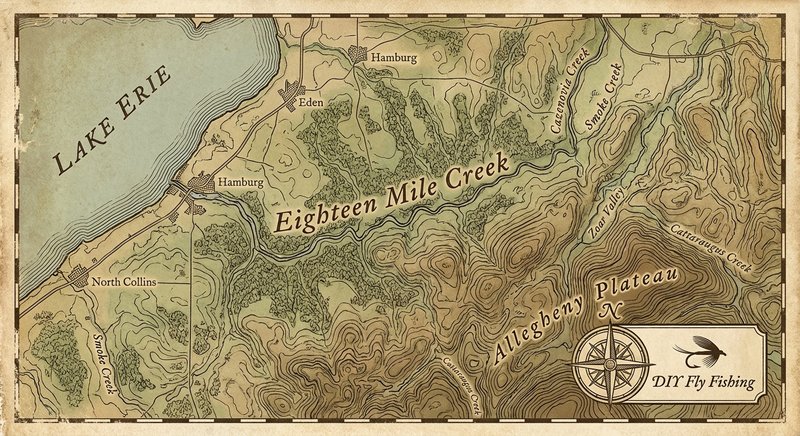
Welcome to the "Steelhead Alley" region of Western New York. As your guide, I’m focusing on the Eighteen Mile Creek that flows into Lake Ontario at Olcott, NY. (Note: There is another Eighteen Mile Creek that flows into Lake Erie, but the Lake Ontario tributary is world-renowned for its runs of Chinook Salmon and massive Brown Trout).
Eighteen Mile Creek is a "destination" tributary, famous for holding massive amounts of fish in a relatively short, accessible stretch of water.
🎣 Location Overview
Eighteen Mile Creek is unique because its fishable area for migratory salmonids is largely concentrated between the harbor at Olcott and the Burt Dam, located about two miles upstream. Because the dam is a total barrier to fish passage, the fish stack up in incredible densities in the pools below the dam.
The water is characterized by shale bedrock, deep slow-moving pools, and some classic riffle-run sections. It is a "low gradient" stream compared to some mountain creeks, often featuring murky or "tannin" stained water. What makes it special is the sheer volume of fish; during peak runs, the biomass in the creek is staggering, offering some of the best opportunities in the Great Lakes region to hook into a "fish of a lifetime."
🐟 Target Species & Behavior
- Chinook (King) Salmon: The heavyweights. They enter the creek in September and October on a terminal spawning mission. They are aggressive early in the run and will hold in the deeper holes or "the wall" right below the dam.
- Brown Trout: Eighteen Mile is famous for its "football" shaped lake-run Browns. They follow the salmon to gorge on eggs. They tend to sit just behind spawning salmon or in the slower "seams" of the current.
- Steelhead: The acrobats of the creek. They arrive in late autumn and stay through the winter. They prefer the more oxygenated water in the riffles and the heads of pools. Unlike salmon, they are actively feeding on nymphs and stray eggs throughout the winter.
📅 Best Times to Fish
- Fall (September – November):
- Late Sept/Oct: Peak Chinook Salmon run.
- Late Oct/Nov: Peak Lake-run Brown Trout and the first push of Steelhead.
- Winter (December – February):
- This is the "hardcore" season. If the creek isn't frozen, the Steelhead fishing can be world-class. Focus on the warmest part of the day (10 AM – 2 PM).
- Spring (March – April):
- Steelhead begin their spawning rituals. You will also find "dropbacks" (fish heading back to the lake) that are incredibly hungry and aggressive.
🪰 Recommended Flies & Techniques
Top Fly Patterns
- Egg Patterns: The absolute staple.
- Glo-Bugs, Sucker Spawn, and Estaz Eggs in orange, chartreuse, and "oregon cheese" colors.
- Nymphs:
- Stoneflies: Large black or golden stones (Size 6-10).
- Hare’s Ear or Pheasant Tail: Size 12-16 for picky Steelhead in clear water.
- Streamers:
- Wooly Buggers: Black, olive, or white.
- Zonkers: To mimic emerald shiners (the primary forage in Lake Ontario).
Techniques
- Indicator Nymphing: The most effective method here. Use a long leader (9–12 ft) and enough split shot to get the fly to the "zone" (within 6 inches of the bottom). The current is often slower than it looks, so use a sensitive float.
- Swinging Streamers: Effective in the lower stretches of the creek for fresh-run fish. Use a sink tip line and swing large intruders or baitfish patterns.
- Centerpinning (The Local Secret): While this is a fly fishing guide, many fly anglers adopt "long rod" techniques here to achieve a perfectly drag-free drift, which is crucial in the deeper pools.
💡 Pro Tips & Local Knowledge
- The "Burt Dam" Shuffle: The area below the dam (Fisherman’s Park) can get crowded. To find success, don't just stand at the dam. Walk downstream and look for "secondary" holding water—small depressions in the shale or log jams that others walk past.
- Low and Slow: In the winter, fish metabolism slows down. Your fly needs to literally bump them on the nose. Use the smallest amount of weight possible to keep the fly moving naturally.
- The "Egg Drop": If you see Salmon spawning on a redd (the light-colored gravel), do not fish for the salmon. Instead, fish directly behind them. The Brown Trout and Steelhead are sitting there waiting for eggs to drift down.
- Stealth and Fluorocarbon: Despite the high fish numbers, these fish see a lot of lures. Use 8lb or even 6lb fluorocarbon tippet. It’s invisible and abrasion-resistant against the shale.
⚠️ Important Information
- Access: The primary access point is Burt Dam Fisherman’s Park (Newfane, NY). There is a fee for parking during the peak salmon season, but it provides well-maintained trails and stairs down to the water.
- Regulations:
- A New York State fishing license with a Great Lakes Privilege is required.
- Pay close attention to "snagging" regulations. The fish must take the fly in the mouth.
- Check the NYDEC website for specific creel limits and tackle restrictions, as they can change seasonally.
- Safety: The shale bottom of Eighteen Mile Creek is notoriously slippery. Studded wading boots are a must, and a wading staff is highly recommended, especially when the water is high or murky.
- Etiquette: This is a popular spot. If someone is hooked up, pull your line in and give them room to land the fish. A little kindness goes a long way on a crowded "combat fishing" day.
Tight lines, and enjoy the power of a Great Lakes King or the chrome flash of a Lake Ontario Steelhead!
Bug Hatches & Matching Flies
| Hatch | Type | Peak months | Time of day | Hook sizes | Matching flies |
|---|---|---|---|---|---|
| Blue Winged Olive Baetis | mayfly | April, May, September, October | Afternoon | #18-22 | RS2 #18-22, Parachute Adams #18-22, Pheasant Tail Nymph #18-20 |
| Hendrickson Ephemerella subvaria | mayfly | April, May | Afternoon | #12-14 | Red Quill #12-14, Hendrickson Emerger #12-14, Gold Ribbed Hare's Ear #12-14 |
| Grannom Caddis Brachycentrus | caddis | April, May | Morning/Afternoon | #14-16 | Elk Hair Caddis (Olive) #14-16, Pupa-X #14-16, Peacock Caddis Larva #14-16 |
| March Brown Maccaffertium vicarium | mayfly | May, June | Afternoon/Evening | #10-12 | March Brown Dry #10-12, Gold Ribbed Hare's Ear #10-12 |
| Sulphur Ephemerella invaria | mayfly | May, June | Evening | #14-18 | Sulphur Parachute #14-18, Sulphur Snowshoe Emerger #16-18 |
| Light Cahill Stenacron interpunctatum | mayfly | June, July | Evening | #12-16 | Light Cahill #12-16, Cahill Nymph #14-16 |
| Common Midge Chironomidae | midge | March, April, October, November | Morning/Afternoon | #20-26 | Zebra Midge #18-22, Griffith's Gnat #20-24 |
| Terrestrials Formicidae/Coleoptera | terrestrial | July, August, September | Afternoon | #12-18 | Black Foam Ant #14-18, Chernobyl Ant #12-14, Beetle-Juice #14-16 |