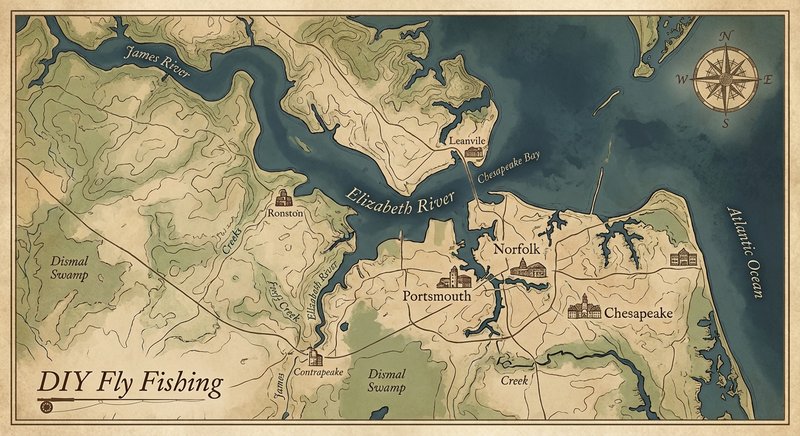
Elizabeth River
Fly fishing in Virginia · Beginner · Best seasons: Spring, Summer, Fall
Target Species
Striped Bass, Speckled Trout, Red Drum
About This Water
Hampton Roads tidal river with diverse fishing. Urban fishing near Norfolk.
Fishing Recommendations
Welcome to the "Industrial Estuary." As a guide, I can tell you that the Elizabeth River is one of the most misunderstood and rewarding fly fishing destinations in the Mid-Atlantic. Flowing through the heart of Chesapeake, Norfolk, and Portsmouth, Virginia, this is an urban fishery defined by shipyards, naval vessels, and heavy industry—but beneath the surface lies a world-class salt-marsh ecosystem.
Here is your comprehensive guide to fly fishing the Elizabeth River.
🎣 Location Overview
The Elizabeth River is a tidal estuary forming a major harbor for the U.S. Navy and commercial shipping. It consists of four main branches: the Main Stem, Eastern, Southern, and Western Branches.
What makes it special is the "Urban Heat Island" effect. The industrial infrastructure and deep-water channels keep the water temperatures slightly higher than the open Chesapeake Bay. This makes the Elizabeth a critical wintering ground for Speckled Trout and a year-round haunt for resident Striped Bass. Anglers love it for its "dock light" fishery—the density of private and commercial piers creates a nighttime fly fishing paradise that is second to none on the East Coast.
🐟 Target Species & Behavior
Speckled Trout (Spotted Seatrout)
The Elizabeth is famous for "Gator Trout" (trophy fish over 24 inches).
- Behavior: They are ambush predators. They hang on the edges of current seams, oyster bars, and under lighted docks at night.
- Feeding: They focus heavily on grass shrimp and juvenile finfish like silversides and mullet.
Striped Bass (Local: Rockfish)
- Behavior: Resident "schoolie" stripers (12–22 inches) are present year-round. Larger migratory fish move in during the late fall. They love heavy structure: bridge pilings, dry docks, and submerged rock piles.
- Feeding: Aggressive feeders on menhaden (bunker), mullet, and blue crabs.
Red Drum (Redfish)
- Behavior: Primarily "Puppy Drum" (juveniles). You’ll find them cruising shallow mudflats in the Western Branch or tight against the marsh grass on a high tide.
- Feeding: Bottom-oriented. They look for crabs and shrimp.
📅 Best Times to Fish
- Optimal Seasons:
- Fall (September–November): The absolute peak. The "shrimp run" occurs, and all three species are feeding heavily to bulk up for winter.
- Spring (April–June): As water warms, fish move out of the deep Southern Branch holes and onto the flats.
- Best Time of Day:
- Low Light/Night: The Elizabeth is a premier night-fishing destination. The "Night Shift" under dock lights is often more productive than midday.
- Tidal Flow: You must have moving water. The two hours before and after a tide change are the "Golden Hours." An outgoing tide flushing out of the marshes is generally preferred.
🪰 Recommended Flies & Techniques
Top Fly Patterns
- Clouser Minnow: The king of the Elizabeth. Chartreuse/White or Pink/White for Stripers and Trout. Use size 2 to 1/0.
- Kinky Muddler / Gamechanger: Excellent for mimicking the local menhaden.
- Vudu-style Shrimp Patterns: Anything with rubber legs and a bit of flash. Tan or clear/pink are local favorites.
- Gurglers: Essential for summer mornings or evening topwater action.
- EP Silverside: Great for clear water days in the Western Branch.
Techniques
- The "Shadow Line" Cast: When fishing dock lights at night, do not cast into the center of the light. Cast into the darkness and strip your fly across the "shadow line" where the light meets the dark. This is where the big Trout lurk.
- Sinking Lines: Because of the deep shipping channels (40+ feet) and bridge pilings, an Intermediate or Type 3 Sinking Line is mandatory to get the fly down to the strike zone in the current.
- The "Elizabeth Twitch": A fast, erratic strip followed by a long pause. Most Trout strikes happen on the pause.
💡 Pro Tips & Local Knowledge
- The Southern Branch: Historically known for the "Hot Ditch" (warm water discharge). While the discharge has changed over the years, this branch remains the warmest and holds fish the deepest into the winter.
- The "Great Bridge" Lock: The area near the locks is a bottleneck for bait. It’s a prime spot for Red Drum and Stripers.
- Kayak is King: While big boats work the main channels, a kayak allows you to stealthily fish the shallow docks of the Western Branch and the "Money Point" area where larger boats can't reach.
- Industrial Advantage: Don't be afraid of the "ugly" spots. Some of the best fishing is around rusted bulkhead walls and old dolphin pilings near the shipyards.
⚠️ Important Information
Access
- Boat Ramps: Elizabeth River Park (Chesapeake) and Carolanne Farm Park (Virginia Beach/Eastern Branch) are excellent launch points.
- Wading: Very limited due to the muddy "plop" bottom and private industrial land. This is primarily a boat or kayak fishery.
Regulations & Permits
- License: A Virginia Saltwater Fishing License is required.
- Striped Bass Regs: Virginia's Striped Bass regulations change frequently (often including a summer closure). Always check the VMRC website before heading out.
- Consumption: While water quality has improved, check local health department advisories regarding fish consumption, as the river has a history of industrial PCB contamination. Many fly anglers here practice 100% Catch and Release.
Special Considerations
- Safety: You are sharing water with Aircraft Carriers and Tugboats. Give them a wide berth. Their wakes are massive and can swamp a small skiff or kayak in seconds.
- Night Safety: If fishing the lights at night, ensure your 360-degree white light is functional and bright. The harbor is busy 24/7.
Bug Hatches & Matching Flies
| Hatch | Type | Peak months | Time of day | Hook sizes | Matching flies |
|---|---|---|---|---|---|
| Chironomid Midges Chironomidae | midge | March, April, October, November | All Day | #18-24 | Zebra Midge #18-22, Griffith's Gnat #20-24 |
| Grass Shrimp Palaemonetes pugio | terrestrial | May, June, July, August, September | Evening/Night | #4-8 | Veverka's Mantis Shrimp #6-8, Glass Minnow #4-8 |
| Saltmarsh Ants Formicidae | terrestrial | July, August | Afternoon | #16-20 | Black Foam Ant #16-18, Chernobyl Ant #12-14 |
| Marine Polychaetes (Bloodworms) Glycera dibranchiata | midge | March, April | Evening | #2-6 | Cowen's Albie Prostitute #4-6, San Juan Worm (Saltwater variant) #2-6 |
| Green Marsh Dragonflies Anax junius | terrestrial | August, September | Afternoon | #6-10 | Dragonfly Popper #6-8, Deer Hair Frog #4-8 |
| Blue Crab (Megalopa Stage) Callinectes sapidus | terrestrial | August, September, October | Night | #2-6 | Kung Fu Crab #4-8, Strong Arm Crab #2-6 |
| Saltmarsh Beetles Coleoptera | terrestrial | June, July | Afternoon | #12-16 | Foam Beetle #14-16, Coffee's Sparkle Beetle #12-14 |
| Backswimmers Notonectidae | terrestrial | May, June | All Day | #14-18 | Backswimmer Nymph #14-16, Water Boatman #16-18 |