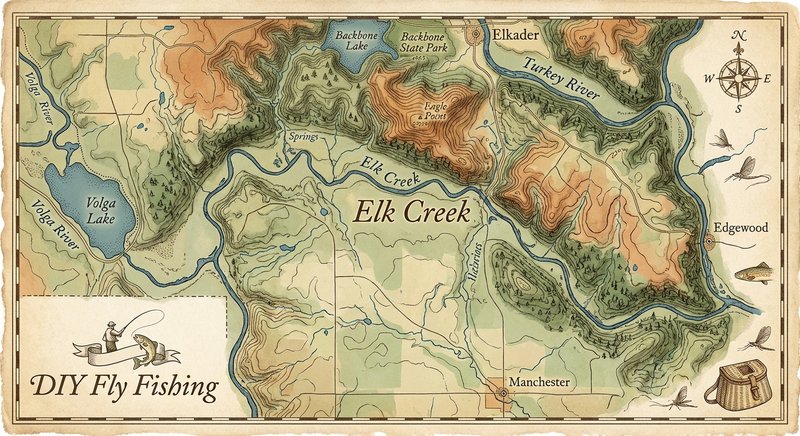
Elk Creek
Fly fishing in Iowa · intermediate · Best seasons: spring, summer, fall
Target Species
Brown Trout
About This Water
Clayton County stream with wild trout. Public access through wildlife area.
Fishing Recommendations
Welcome to the Driftless Area of Northeast Iowa. As your guide, I’m excited to walk you through Elk Creek, located in Delaware County. While many anglers flock to the famous streams of Montana or Colorado, those in the know recognize Elk Creek as one of the crown jewels of Iowa’s coldwater fisheries. It is a quintessential limestone spring stream that offers some of the best wild brown trout fishing in the Midwest.
🎣 Location Overview
Elk Creek is a stunning example of a Driftless Area stream. It flows through a mix of rugged limestone bluffs, timbered valleys, and lush pastures. What makes it special is its high rate of natural reproduction. Unlike many Midwestern streams that rely solely on stocking, Elk Creek boasts a robust population of wild, stream-reared Brown Trout.
The water is typically crystal clear and cold, thanks to the numerous springs that feed it. The stream architecture is diverse, featuring deep limestone-carved pools, fast-moving riffles, and classic "cut-bank" bends. It is a technical stream—it’s narrow enough that a sloppy backcast will find a willow tree, but productive enough to reward a stealthy angler with a trophy-sized Brown.
🐟 Target Species & Behavior
The primary draw here is the Brown Trout (Salmo trutta).
- Behavior: These fish are notoriously "spooky." Because the water is clear and the stream is relatively small, they have high situational awareness. They are highly structure-oriented.
- Holding Patterns: Look for them tucked tight against undercut banks, behind large submerged boulders, or at the "tail-out" of deep pools during low-light conditions.
- Feeding: They are opportunistic but can become highly selective during a hatch. While juveniles feed heavily on aquatic insects, the larger "resident" Browns (16"+) are piscivorous (fish-eaters) and will also hunt crayfish and even small terrestrial mammals.
📅 Best Times to Fish
Seasons
- Spring (April – June): This is prime time. Water levels are usually good, and the first major hatches occur. The fish are hungry after winter and less pressured.
- Summer (July – August): Excellent for terrestrial fishing (hoppers/ants). However, watch the water temps—if the water exceeds 68°F, give the fish a break to prevent mortality.
- Fall (September – October): My personal favorite. The Browns are in their pre-spawn aggression phase and display vibrant colors. The "streamer bite" is at its peak.
Time of Day & Conditions
- Early Morning/Dusk: Essential for the biggest Browns. They are light-sensitive and do their heaviest hunting in the shadows.
- Cloudy/Overcast Days: This is "streamer weather." On a gray, drizzly day, the big fish lose their wariness and move into the open to feed.
🪰 Recommended Flies & Techniques
Top Fly Patterns
- Nymphs: Pheasant Tail (#16-20), Zebra Midge (#18-22), Gold-Ribbed Hare’s Ear (#14-18), and Scuds (Grey or Olive, #16-18). Scuds are a staple diet in Iowa spring streams.
- Dry Flies: Adams (Parachute or traditional, #16-20), Blue Winged Olive (BWO) (#18-22), and Elk Hair Caddis (#14-18).
- Terrestrials: Fat Albert (#10-14), Dave’s Hopper (#10-12), and Black Foam Ants (#16-18).
- Streamers: Woolly Buggers (Olive or Black, #8-12), Pine Squirrel Leeches, and small Sculpin patterns.
Techniques
- The "Hopper-Dropper": Very effective in summer. Use a buoyant grasshopper pattern as your indicator and hang a small scud or pheasant tail 18-24 inches below it.
- Euro-Nymphing: Because Elk Creek has many deep "pockets" and runs, a tight-line nymphing setup allows you to get flies down quickly without the drag of a plastic indicator.
- Stealth Approach: This is a technique in itself. Stay low, wear drab colors (camo or earth tones), and avoid wading whenever possible. If you must wade, move like a heron.
💡 Pro Tips & Local Knowledge
- Focus on the Bends: The outside bends of Elk Creek often feature deep undercuts. Don't just cast into the middle; try to "tuck" your fly right against the grass hanging over the bank.
- The "Scud Side-Step": If the fish aren't rising, go small and olive. The limestone chemistry of the Driftless creates a massive biomass of freshwater shrimp (scuds). A weighted scud drifted through a riffle is often the "secret weapon."
- Mind the Silt: Some sections have silty bottoms. Avoid walking through them as you’ll send a plume of mud downstream that alerts every fish for a hundred yards that an intruder is present.
- The "Greeley" Stretch: The area near the town of Greeley offers excellent public access points via the Elk Creek Wildlife Management Area.
⚠️ Important Information
- Access: Much of Elk Creek runs through private land, but there are significant stretches of Public Fishing Access managed by the Iowa DNR. Look for the green and white "Public Fishing" signs. Always respect fences and property lines.
- Regulations: Iowa trout regulations can vary by stream. As of current rules, Elk Creek is generally open year-round for trout, but you must have a valid Iowa Fishing License and a paid Trout Fee.
- Gear Recommendation: A 3-weight or 4-weight rod (8’ to 8’6”) is ideal. A 9-foot rod can be cumbersome in the tighter, brushier sections. Use a 5x or 6x fluorocarbon tippet for its invisibility and abrasion resistance.
- Catch & Release: While some sections allow harvest, I strongly encourage catch and release for wild Brown Trout to maintain the quality of this fragile and beautiful fishery.
Guide’s Final Word: Elk Creek isn't about high numbers or easy catches; it's about the reward of a perfectly placed cast in a beautiful, quiet valley. Take your time, watch the water, and respect the fish. Tight lines!
Bug Hatches & Matching Flies
| Hatch | Type | Peak months | Time of day | Hook sizes | Matching flies |
|---|---|---|---|---|---|
| Blue-winged Olive Baetis tricaudatus | mayfly | April, May, September, October | Late Morning/Afternoon | #18-22 | RS2 #18-22, Parachute Adams #18-22, Pheasant Tail #18-20 |
| Sulphur Ephemerella invaria | mayfly | May, June | Evening | #14-18 | Sparkle Dun #14-16, Sulphur Parachute #16-18, Hare's Ear Nymph #14-16 |
| Trico Tricorythodes | mayfly | July, August, September | Early Morning | #20-24 | Trico Spinner #20-24, Drowned Trico #22, Griffith's Gnat #20-22 |
| Little Brown Caddis Glossosoma | caddis | April, May | All Day | #16-18 | Elk Hair Caddis #16-18, LaFontaine Sparkle Pupa #16-18, Zebra Midge #18 |
| Light Cahill Stenacron canadense | mayfly | June, July | Evening | #12-14 | Light Cahill Dry #12-14, Gold Ribbed Hare's Ear #12-14 |
| Midges Chironomidae | midge | January, February, March, December | Afternoon | #18-26 | Zebra Midge #18-22, Griffith's Gnat #18-24, Mercury Midge #20-22 |
| Terrestrials (Hopper/Ant) Formicidae/Orthoptera | terrestrial | July, August, September | Mid-day/Afternoon | #10-16 | Cinnamon Ant #14-18, Dave's Hopper #10-12, Black Foam Beetle #14-16 |
| Cranefly Tipulidae | terrestrial | August, September | Afternoon/Evening | #10-14 | Daddy Long Legs #10-12, Killer Bug #12-14 |