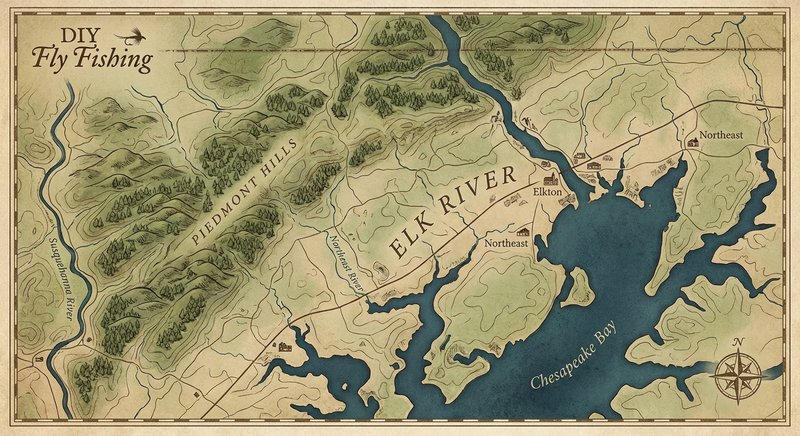
Elk River
Fly fishing in Maryland · Intermediate · Best seasons: Spring, Summer, Fall
Target Species
Striped Bass, Largemouth Bass, White Perch
About This Water
Cecil County river with diverse fishing. Striped bass and largemouth bass.
Fishing Recommendations
The Elk River, located at the northernmost reaches of the Chesapeake Bay, is a premier "sweetwater-meets-salt" destination. As a guide, I consider this transition zone one of the most dynamic fly fishing environments in the Mid-Atlantic.
🎣 Location Overview
The Elk River is a tidal waterway that serves as a critical gateway between the Chesapeake & Delaware (C&D) Canal and the Susquehanna Flats. What makes it special is its brackish diversity. Depending on the rainfall and tide, you might catch a 5-pound largemouth and a 30-inch striped bass on back-to-back casts.
The water characteristics range from wide, shallow flats and muddy marshes to deep, high-current channels near the C&D Canal. The shoreline is a mix of private docks, rocky riprap, and dense shoreline timber. It is a "working river," meaning you'll share the main channel with large cargo ships, but the feeder creeks and shorelines remain a fly fisher's playground.
🐟 Target Species & Behavior
- Striped Bass (Rockfish): These are the kings of the Elk. They use the river as a corridor. They are highly structure-oriented here, holding against bridge pilings, rocky points, and submerged ledges. They feed heavily on "peanut" menhaden (bunker), silversides, and river herring.
- Largemouth Bass: Found primarily in the upper reaches and the quieter, fresher "guts" (small tidal creeks). They behave like classic tidal bass—positioning themselves on the down-current side of structure (docks/fallen trees) to ambush prey washed past by the tide.
- White Perch: The unsung heroes of the Elk. They school in massive numbers. They are aggressive, hard-fighting for their size, and will take small streamers and nymphs readily. Look for them around shaded dock pilings and oyster bars.
📅 Best Times to Fish
- Spring (April – June): This is prime time for migratory Striped Bass moving off the spawning grounds in the nearby Susquehanna and North East Rivers. White perch also "run" up the creeks to spawn in April.
- Summer (July – August): Focus on the "Low Light Window." Topwater action for both Striped Bass and Largemouth is electric from 5:00 AM to 8:00 AM. As the water warms, fish move to deeper channel edges.
- Fall (September – November): The "Fall Blitz." As temperatures drop, baitfish migrate out of the creeks. Stripers and Bass gorge themselves to prepare for winter. This is the best time for sheer numbers and aggressive takes.
- The Tidal Factor: Never fish slack water. The Elk is tide-driven. The best fishing usually occurs during the middle two hours of an outgoing tide when bait is flushed out of the marshes and concentrated.
🪰 Recommended Flies & Techniques
Striped Bass
- Patterns: Chartreuse/White Clouser Minnows (size 1/0 - 2/0), Left’s Deceivers, and Bob's Banger (foam popper).
- Technique: Use an Intermediate Sinking Line to get the fly down 3–5 feet along riprap banks. Use a "strip-strip-pause" retrieve to mimic a wounded baitfish.
Largemouth Bass
- Patterns: Dahlberg Divers, Gamechangers, and large murky-water patterns like a Black/Blue Woolly Bugger or a Crawfish imitation.
- Technique: Fish the "pockets" in the lily pads or under overhanging trees. Topwater frog patterns are deadly in the backwater "guts" during an incoming tide.
White Perch
- Patterns: Size 6–10 bead-head nymphs (Hare’s Ear or Prince Nymph) or small "Perch Pounder" streamers in pink/white or chartreuse.
- Technique: Use a 4-weight or 5-weight rod. Cast toward dock pilings and let the fly sink; a slow, rhythmic jigging motion usually triggers a strike.
💡 Pro Tips & Local Knowledge
- The Turkey Point Effect: The mouth of the Elk River at Turkey Point is a legendary ambush spot. Where the Elk meets the Bay, there are massive underwater flats. Fish the drop-offs where the water goes from 3 feet to 15 feet.
- Fish the "Shadow Lines": If fishing at night or very early morning near docks with lights, cast your fly into the darkness and strip it into the light. Stripers sit in the shadows waiting for bait to cross the light beam.
- Color Palette: The Elk can be "tannic" or stained. Use darker silhouettes (Black/Purple) in low visibility and fluorescent colors (Chartreuse) in murky water. On rare clear days, switch to "Match the Hatch" silver/white.
- Watch the Ships: Large cargo ships entering the C&D Canal create massive wakes and temporary "surges" in water level. This can actually stir up bait and trigger a short, intense feeding frenzy.
⚠️ Important Information
- Access:
- Elk Neck State Park: Offers excellent boat ramps and some shore access near the lighthouse.
- Rogue's Harbor: The most popular public boat launch for hitting the lower river.
- Regulations: Maryland DNR requires a Chesapeake Bay & Coastal Sport Fishing License. Be aware of seasonal "No Targeted Fishing" periods for Striped Bass (usually in April) to protect spawning fish. Always check the current MD DNR Tidal Scoping before heading out.
- Safety: The Elk is wide and can get very choppy with a South wind. If you are in a kayak, stay close to the shoreline and be extremely wary of large vessel traffic in the C&D approach.
Bug Hatches & Matching Flies
| Hatch | Type | Peak months | Time of day | Hook sizes | Matching flies |
|---|---|---|---|---|---|
| Blue Winged Olive Baetis spp. | mayfly | March, April, October, November | Mid-day/Afternoon | #18-22 | RS2 #20-22, Parachute BWO #18-20, Pheasant Tail #18-22 |
| Quill Gordon Epeorus pleuralis | mayfly | March, April | Afternoon | #12-14 | Quill Gordon #12-14, Hare's Ear Nymph #12-14 |
| Hendrickson Ephemerella subvaria | mayfly | April, May | Afternoon | #12-14 | Red Quill #12-14, Hendrickson Emerger #14, Pheasant Tail #12-14 |
| Tan Caddis Hydropsyche spp. | caddis | May, June | Evening | #14-16 | Elk Hair Caddis #14-16, LaFontaine's Deep Sparkle Pupa #14-16, Holy Grail #14-16 |
| Sulphur Ephemerella invaria/dorothea | mayfly | May, June | Evening | #14-18 | Sulphur Parachute #16-18, Sulphur Spinner #14-18, Cdc Sulphur Emerger #16 |
| Light Cahill Stenacron interpunctatum | mayfly | June, July | Evening | #12-14 | Light Cahill #12-14, Gold Ribbed Hare's Ear #14 |
| Trico Tricorythodes spp. | mayfly | July, August, September | Morning | #22-26 | Trico Spinner #22-26, Griffith's Gnat #20-24 |
| Terrestrials Formicidae / Coleoptera | terrestrial | July, August, September | All day | #12-20 | Black Foam Ant #16-20, Chernobyl Ant #12-14, Crowe Beetle #14-16 |
| Midges Chironomidae | midge | December, January, February, March | Late Morning | #20-26 | Zebra Midge #20-24, Griffith's Gnat #20-22, Mercury Midge #22 |