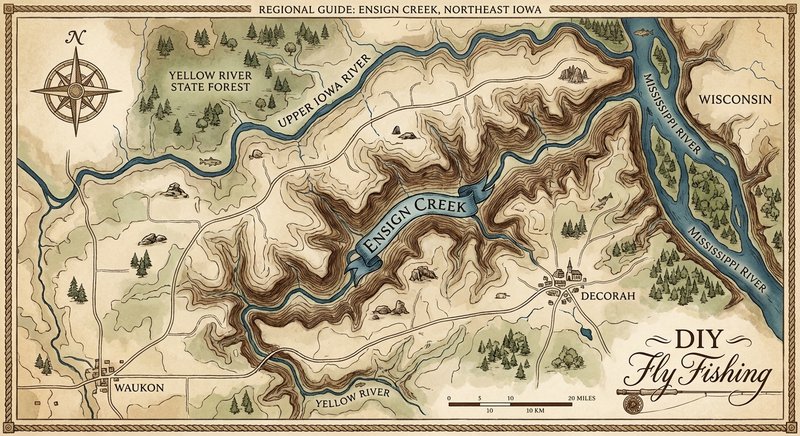
Ensign Creek
Fly fishing in Iowa · advanced · Best seasons: spring, summer, fall
Target Species
Brook Trout
About This Water
Howard County spring creek with wild brook trout. Small stream adventure fishing.
Fishing Recommendations
Ensign Creek, located within the Ensign Hollow Wildlife Management Area (WMA) in Dubuque County, is one of the true "crown jewels" of the Iowa Driftless Area. While Iowa is often associated with cornfields, this specific pocket of the state features rugged limestone bluffs and cold, spring-fed streams that feel more like the mountains of Appalachia than the Midwest.
Here is your comprehensive guide to fly fishing Ensign Creek.
🎣 Location Overview
Ensign Creek is a small, intimate, and highly productive cold-water stream. What makes it special is its status as one of the few streams in Iowa that supports a naturally reproducing population of wild Brook Trout.
The water is classic "Driftless": crystal clear, limestone-filtered, and highly alkaline, which leads to massive insect populations. The stream is narrow—often only 4 to 10 feet wide—and is characterized by tight bends, deep undercut banks, and overhanging vegetation. Anglers love it because it offers a "pure" fly fishing experience where stealth and technical casting are rewarded over distance.
🐟 Target Species & Behavior
The primary draw here is the Wild Brook Trout. These are not the lethargic hatchery fish found in other regions; they are vibrant, spooky, and incredibly aggressive when they feel safe.
- Holding Patterns: Look for them in the "dark water"—underneath overhanging grasses, tucked tight against limestone ledges, or in the deep "buckets" at the tail-end of riffles.
- Feeding Behavior: Brookies in Ensign Creek are opportunistic. Because the stream is small, they can’t afford to let a meal pass by. However, they have a "one strike and you're out" policy regarding shadows and heavy wading. If they see you, the fishing in that hole is done for the hour.
- Diet: Their diet consists heavily of Scuds (freshwater shrimp) and Sowbugs, which thrive in the limestone-rich water. They also key in on midge larvae, caddis, and terrestrial insects during the warmer months.
📅 Best Times to Fish
- Spring (April – May): This is the prime window for aquatic insect hatches. As the water warms into the 50s, the fish become very active. This is also when the Blue-Winged Olives (BWO) and Grannom Caddis appear.
- Summer (June – August): This is Terrestrial Season. While the air is hot, the spring-fed nature of Ensign Creek keeps the water cold (usually under 60°F). This is the best time for "dry-dropper" rigs using ants, beetles, and hoppers.
- Fall (September – October): The Brook Trout begin to sport their spectacular spawning colors (deep oranges and reds). They become more aggressive as they prepare for the spawn. Note: Be mindful of redds (spawning beds) in late October and avoid stepping on gravelly tail-outs.
- Prime Windows: Low-light conditions are best. Early morning (first light) and the "magic hour" before sunset are the most productive times. Cloud-covered, drizzly days are arguably the best fishing days on Ensign Creek.
🪰 Recommended Flies & Techniques
Top Fly Patterns
- The Pink Squirrel (Size 14-18): A Driftless Area staple. The flash and the pink bead are irresistible to Iowa trout.
- Scuds/Sowbugs (Size 16-20): Gray, olive, or tan. These are the "bread and butter" of the creek year-round.
- Elk Hair Caddis (Size 14-18): The go-to dry fly for evening rises.
- Hi-Viz Foam Beetle or Ant (Size 16-18): Crucial for summer fishing under overhanging trees.
- Black Ghost or Small Wooly Bugger (Size 10-12): Use these in the deeper pools if the water is slightly stained after a rain.
Effective Techniques
- The Bow-and-Arrow Cast: Because the banks are brushy, you will often lack the room for a traditional backcast. Mastering the bow-and-arrow cast is essential to reach fish tucked under trees.
- Nymphing without a Float: Use a "tight-line" or Euro-style approach on a small scale, or use a very small, sensitive yarn indicator. Traditional plastic indicators often land too heavily and spook the fish in this shallow water.
- Dry-Dropper: A buoyant dry fly with a small Scud weighted with a single tiny shot or a tungsten bead hanging 12-18 inches below.
💡 Pro Tips & Local Knowledge
- Stealth is Everything: Dress in drab colors (olive, tan, camo). Do not stand on high banks where your silhouette is cast over the water. Crawl on your knees if you have to.
- Work Upstream: Always fish moving upstream. Brook trout face into the current; if you approach from behind, you are less likely to be seen.
- The "One Cast" Rule: On a stream this small, your first cast is your best chance. Accuracy is more important than distance. Practice hitting a teacup in your backyard before heading out.
- Equipment: Leave the 9-foot 5-weight at home. The ideal rod for Ensign Creek is a 7-foot to 7.5-foot 2-weight or 3-weight. A shorter rod allows for better maneuverability in the "jungle" of the WMA.
⚠️ Important Information
- Access: Access is via the Ensign Hollow Wildlife Management Area. There is a parking area off of Ensign Hollow Rd. Expect a bit of a hike through timber and meadows to reach the best water.
- Regulations: Iowa fishing regulations apply. You must have a valid Iowa Fishing License and have paid the Trout Fee.
- Catch & Release: While some Iowa streams allow harvesting, most serious Brook Trout anglers on Ensign Creek practice 100% Catch and Release. These wild heritage fish are a fragile resource. Use barbless hooks to ensure a quick and safe release.
- Wading: The stream bottom can be a mix of "sticky" silt and slippery limestone. Felt soles or studs are recommended, but move slowly to avoid sending vibrations through the water.
- Respect the Resource: Stay on established paths where possible to avoid bank erosion, and always pack out what you pack in.
Bug Hatches & Matching Flies
| Hatch | Type | Peak months | Time of day | Hook sizes | Matching flies |
|---|---|---|---|---|---|
| Blue Winged Olive Baetis tricaudatus | mayfly | April, October | Late Morning/Afternoon | #18-22 | RS2 #20-22, Parachute BWO #18-20, Pheasant Tail #18-20 |
| Grannom Caddis Brachycentrus | caddis | April, May | Afternoon | #12-16 | Elk Hair Caddis (Dark) #14-16, LaFontaine's Deep Sparkle Pupa #14-16, Peacock Caddis #16 |
| Midges Chironomidae | midge | January, February, March, December | All Day | #20-26 | Zebra Midge #20-24, Griffith's Gnat #20-22, Top Secret Midge #22-24 |
| Scud Gammarus lacus | crustacean | March, April, September, October | All Day | #14-18 | Ray Charles #14-18, Pink Squirrel #14-16, Orange Scud #16-18 |
| Pale Morning Dun Ephemerella invaria | mayfly | June, July | Late Morning | #14-18 | PMD Sparkle Dun #16-18, Pale Morning Dun Parachute #14-16, Hare's Ear Nymph #14-16 |
| Trico Tricorythodes | mayfly | July, August, September | Early Morning | #22-26 | Trico Spinner #22-24, Sunken Trico Spinner #22-26, CDC Trico #22-24 |
| Terrestrials Formicidae / Orthoptera | terrestrial | July, August, September | Afternoon | #10-18 | Dave's Hopper #10-12, Black Foam Ant #16-18, Crowe Beetle #14-16 |
| Cinnamon Caddis Hydropsyche | caddis | June, July, August | Evening | #14-18 | Tan Elk Hair Caddis #14-16, Caddis Pupa (Tan) #16-18, X-Caddis #16 |