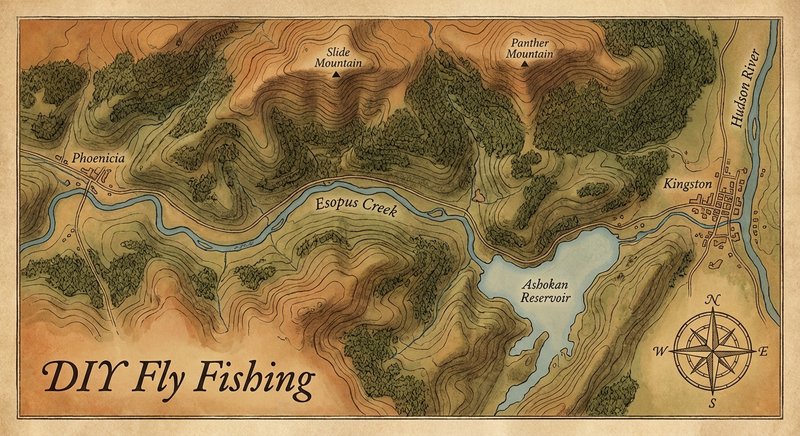
Esopus Creek
Fly fishing in New York · Intermediate · Best seasons: Spring, Summer, Fall
Target Species
Rainbow Trout, Brown Trout
About This Water
A Catskills tailwater below the Schoharie Reservoir. Excellent rainbow trout fishing.
Fishing Recommendations
Welcome to the Esopus Creek, a legendary stretch of water nestled in the heart of the Catskill Mountains. As a guide, I consider the Esopus one of the most unique "freestone" rivers in the East because of its hybrid nature—part mountain stream, part tailwater—thanks to the Shandaken Tunnel (The Portal).
Here is your comprehensive guide to fly fishing the "Sopus."
🎣 Location Overview
The Esopus Creek is often called the "Cradle of American Fly Fishing." Located in Ulster County, NY, it flows through the rugged Catskill Park before emptying into the Ashokan Reservoir.
What makes it special is the Shandaken Tunnel (The Portal) in Allaben. This tunnel brings cold, often turbid water from the Schoharie Reservoir into the Esopus. This injection of cold water keeps the creek fishable even in the dog days of summer when other Catskill rivers like the Beaverkill or Willowemoc become too warm.
The river is characterized by heavy pocket water, classic riffles, and deep, ledge-lined pools. It is notoriously difficult to wade; the rocks are often described as "greased bowling balls."
🐟 Target Species & Behavior
- Wild Rainbow Trout: The Esopus is famous for its prolific population of wild rainbows. These are descendants of fish brought from the West Coast in the 1800s. They are scrappy, jump frequently, and hold in the fastest "bubbly" water.
- Brown Trout: You will find both wild and stocked browns. Large, "lake-run" browns move up from the Ashokan Reservoir into the creek to spawn in the fall.
- Behavior:
- Rainbows love the heads of pools and the "pockets" behind large boulders where oxygen levels are high.
- Browns are more secretive, hugging the undercut banks and the dark bottoms of deep ledge pools, becoming more active during low-light conditions or after a rain.
📅 Best Times to Fish
- Spring (April - May): This is the time for the classic Catskill hatches. Early season can be high and cold, but once the Hendrickson hatch starts (late April), the dry fly fishing is world-class.
- Summer (June - August): While other rivers heat up, the Esopus stays cool due to the Portal. This is Isonychia (Iso) season. The "Iso" is the most important bug on the Esopus; these large, purple-bodied mayflies hatch throughout the summer.
- Fall (September - October): This is the time for trophy hunters. As water temperatures drop, large Brown Trout move up from the Ashokan Reservoir. The Blue Winged Olive (BWO) hatches are consistent on drizzly afternoons.
- Prime Window: Early morning for tricos in mid-summer, or "The Magic Hour"—the last 60 minutes of daylight when the spinner falls happen.
🪰 Recommended Flies & Techniques
Top Fly Patterns
- Dry Flies:
- Isonychia (Size 10-12): Parachute or Comparadun style. This is a must-have.
- Catskill Classics: Light Cahill, Quill Gordon, and Hendrickson.
- Elk Hair Caddis (Size 14-18): Tan or Olive.
- Terrestrials: Ant and Beetle patterns for mid-summer banks.
- Nymphs:
- Pheasant Tail (Size 14-18): Works year-round.
- Girdle Bug / Pat’s Rubber Legs: Excellent for the large stoneflies present in the rocky substrate.
- Prince Nymph: The flash works well in the slightly turbid "Portal" water.
- Streamers:
- Wooly Buggers (Black or Olive): Effective when the water is high or off-color.
- Muddler Minnow: Mimics the sculpins that hide in the rocks.
Techniques
- High-Sticking/Euro Nymphing: Because the Esopus is so rocky with complex currents, traditional indicator nymphing can be tough. Using a tight-line approach allows you to get flies down into the deep pockets without the drag of a float.
- Pocket Water Dry-Dropper: A buoyant dry fly (like a Stimulator or heavy Elk Hair Caddis) with a weighted nymph 18-24 inches below it is the most effective way to cover the miles of "boulder gardens."
- The "Esopus Swing": Swinging wet flies or small streamers through the riffles is a traditional and highly effective method here.
💡 Pro Tips & Local Knowledge
- Watch the Portal: Check the USGS gauge at Allaben. If the "Portal" is wide open, the water will be cold but can be very "milky" or turbid. A little turbidity is good—it hides you from the fish—but chocolate milk is a no-go.
- Wading Safety: I cannot stress this enough: wear studded boots. A wading staff is not optional on the Esopus; it is a necessity. The rocks are exceptionally slippery and unstable.
- The "Rubber Hatch": In the summer, the stretch from Phoenicia downstream is very popular for tubing. If you want peace, fish above the Portal in Allaben or get on the water before 10:00 AM.
- Spot Highlight: Focus on the stretches around Phoenicia and Mt. Tremper. Look for where the "seams" of fast and slow water meet.
⚠️ Important Information
- Access: Much of the Esopus is accessible via Route 28. Look for the "NYC DEC Public Fishing Stream" signs and designated pull-offs.
- Regulations: Regulations can vary by section. Many areas are "Catch and Release Only" or have specific size/creel limits. Always consult the current NYSDEC Freshwater Fishing Regulations.
- License: A valid New York State Fishing License is required for everyone 16 and older.
- Invasive Species: To prevent the spread of Didymo (Rock Snot), please clean and dry your waders and gear thoroughly after fishing the Esopus.
The Esopus is a "working man’s" river—it’s rugged, it’s loud, and it requires physical effort to fish. But when you hook into a wild, jumping rainbow in the shadow of Panther Mountain, you’ll understand why anglers have been coming here for 150 years. Tight lines!
Bug Hatches & Matching Flies
| Hatch | Type | Peak months | Time of day | Hook sizes | Matching flies |
|---|---|---|---|---|---|
| Blue Winged Olive Baetis / Pseudocloeon | mayfly | April, May, September, October | Afternoon | #18-22 | RS2 #18-22, BWO Sparkle Dun #18-22, Pheasant Tail Nymph #18-20 |
| Hendrickson Ephemerella subvaria | mayfly | April, May | Afternoon | #12-14 | Red Quill #12-14, Hendrickson Emerger #12-14, Hare's Ear Nymph #12-14 |
| March Brown Maccaffertium vicarium | mayfly | May, June | Afternoon | #10-12 | March Brown American #10-12, Gold Ribbed Hare's Ear #10-12, March Brown Wet Fly #12 |
| Grannom Caddis Brachycentrus | caddis | April, May | Morning/Afternoon | #14-16 | Peacock Caddis #14-16, Deep Sparkle Pupa #14-16, Elk Hair Caddis (Olive) #14-16 |
| Sulphur Ephemerella invaria / dorothea | mayfly | May, June, July | Evening | #14-18 | Sulphur Parachute #14-18, Pheasant Tail #14-18, Sulphur Spinner #14-18 |
| Isonychia (Slate Drake) Isonychia bicolor | mayfly | June, July, August, September | Late Afternoon/Evening | #10-12 | Iso Parachute #10-12, Zug Bug #10-12, Prince Nymph #10-14 |
| Light Cahill Stenocron / Stenonema | mayfly | June, July | Evening | #12-14 | Light Cahill #12-14, Cahill Wet Fly #12-14 |
| Trico Tricorythodes | mayfly | July, August, September | Morning | #22-26 | Trico Spinner #22-26, Griffith's Gnat #22-24 |
| Golden Stonefly Acroneuria | stonefly | June, July | Evening/Night | #6-10 | Kaufmann's Stone #6-10, Stimulator (Yellow) #8-12 |