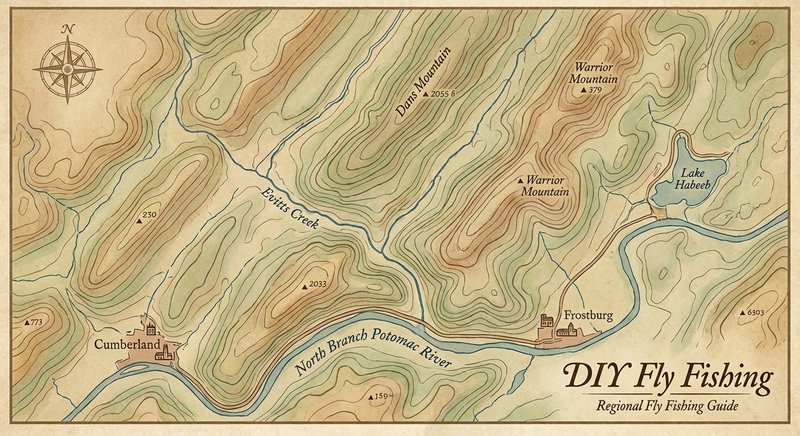
Evitts Creek
Fly fishing in Maryland · Beginner · Best seasons: Spring, Fall
Target Species
Rainbow Trout, Brown Trout
About This Water
Allegany County stream with stocked trout. Accessible fishing near Cumberland.
Fishing Recommendations
As an expert guide who has spent significant time in the Mid-Atlantic, I can tell you that Evitts Creek is one of the hidden gems of Western Maryland. While many anglers rush past Cumberland to reach the world-famous Savage or Casselman rivers, Evitts Creek offers a more intimate, technical, and rewarding experience for those who appreciate small-to-medium stream dynamics.
Here is the comprehensive guide to fishing Evitts Creek.
🎣 Location Overview
Evitts Creek is a limestone-influenced freestone stream located in Allegany County, just outside of Cumberland. It originates in Pennsylvania and flows south into the Potomac River.
What makes it special is its limestone character. Because it is fed by limestone springs, the water is rich in nutrients, leading to exceptional insect life and better thermal stability than a pure freestone stream. The section most prized by fly anglers is the Delayed Harvest Trout Management Area (DHTMA), which runs from the Mason-Dixon line downstream through Rocky Gap State Park property.
The water characteristics vary from tight, rhododendron-choked pockets to long, glassy glides and deep limestone pools. It feels like a "classic" Eastern trout stream—intimate, beautiful, and demanding of a stealthy approach.
🐟 Target Species & Behavior
The Maryland Department of Natural Resources (DNR) heavily stocks this creek, but its limestone influence allows for decent holdover potential.
- Rainbow Trout: These are the primary targets. In the faster riffles and "heads" of pools, you’ll find the active feeders. They are generally less shy than the browns and will move a significant distance to grab a well-presented nymph or attractor dry.
- Brown Trout: The "Local Legends." While fewer in number than rainbows, the browns in Evitts Creek are notorious for tucking under undercut banks and deep root balls. They become highly selective during hatches and are best targeted during low-light conditions.
- Behavior: Because this is a high-pressure area during the stocking season, the fish quickly become "educated." They hold in the bubble lines and right against the banks. If you see a fish, it has likely already seen you.
📅 Best Times to Fish
Optimal Seasons
- Spring (March – June): This is the "Golden Era" on Evitts. The water levels are prime, and the insect activity is at its peak.
- Fall (October – December): As temperatures cool, the trout become active again. The fall colors in the Allegany mountains are spectacular, and the crowds are significantly thinner than in the spring.
Best Times of Day
- Early Morning: Best for nymphing before the sun hits the water.
- Evening: The "Magic Hour" on Evitts often sees a flurry of dry fly activity, especially during May and June.
Prime Conditions
Look for "stained" water—about 24 hours after a light rain. The slight turbidity hides your leader and gives the trout the confidence to move out of the deep holes to feed.
🪰 Recommended Flies & Techniques
Top Fly Patterns
- Nymphs:
- Pheasant Tail (Sizes 14-18): A staple for mimicking the Mayfly nymphs abundant here.
- Zebra Midge (Sizes 18-22): Essential for those picky limestone holdovers.
- Walts Worm: Highly effective in the deeper runs.
- Dry Flies:
- Elk Hair Caddis (Sizes 14-16): The go-to for the heavy Tan Caddis hatches.
- Adams Parachute (Sizes 16-20): Perfect for the technical glides.
- Sulpher/Pale Morning Dun (Sizes 16-18): Vital for late spring evenings.
- Streamers:
- Woolly Bugger (Olive or Black, Sizes 8-12): Best fished through deep holes or during higher water.
Effective Techniques
- Tight-Line (Euro) Nymphing: Because the creek has many complex current seams, a tight-line rig allows you to get your flies deep without the "drag" created by a traditional bobber/indicator.
- The "Dry-Dropper": In the shallow riffles, use a buoyant Elk Hair Caddis with a small unweighted Pheasant Tail dropped 18 inches below it.
- Stealth Casting: Use a 7.5ft to 8.5ft 4-weight rod. Long, delicate casts and 5X or 6X fluorocarbon tippet are mandatory when the water is clear.
💡 Pro Tips & Local Knowledge
- The "Sneak Attack": Stay out of the water whenever possible. The fish in Evitts Creek are notoriously spooky. Approach a pool from downstream, stay low (kneel if you have to), and make your first cast your best cast.
- Fish the "In-Between" Water: Most anglers walk right past the shallow, 12-inch deep riffles to get to the big blue pools. In the spring, the biggest rainbows often sit in that thin, oxygenated water.
- Focus on the State Line: The area right near the Mason-Dixon line tends to stay slightly cooler and holds fish longer into the early summer.
- The "Caddis Blizzard": If you are there in May, be prepared for heavy caddis activity. If they aren't rising to the dry, try "skittering" your fly across the surface to mimic the egg-laying motion.
⚠️ Important Information
Access
Access is excellent through Rocky Gap State Park and along Evitts Creek Drive. There are several designated parking pull-offs. Be respectful of private property boundaries, which are generally well-marked.
Regulations & Permits
- License: You must have a Maryland Non-Tidal Fishing License and a Trout Stamp.
- Delayed Harvest (DHTMA): Check the current DNR regulations. Typically, from October 1 through May 31, it is Catch and Release Only, and you are restricted to artificial lures and flies only. This is what keeps the fishing quality high.
Special Considerations
- Cell Service: It can be spotty in the valley; download your maps beforehand.
- Wading: The rocks can be incredibly slick due to the limestone-induced algae. Felt soles (where legal) or studs are highly recommended.
Evitts Creek is a "chess match" stream. It rewards patience, fine tippets, and a good eye for reading water. Tight lines!
Bug Hatches & Matching Flies
| Hatch | Type | Peak months | Time of day | Hook sizes | Matching flies |
|---|---|---|---|---|---|
| Blue-Winged Olive Baetis / Pseudocloeon | mayfly | March, April, September, October | Mid-day/Afternoon | #18-22 | RS2 #20-22, BWO Sparkle Dun #18-20, Pheasant Tail #18-22 |
| Hendrickson Ephemerella subvaria | mayfly | April | Afternoon | #12-14 | Red Quill #12-14, Hendrickson Emerger #12-14, Hare's Ear Nymph #12-14 |
| Sulphur Ephemerella dorothea | mayfly | May, June | Evening | #14-18 | Sulphur Parachute #14-18, CDC Sulphur Emerger #16-18, Sulphur Cripple #14-16 |
| Tan Caddis Hydropsyche | caddis | May, June, July | Late Afternoon/Evening | #14-18 | Elk Hair Caddis #14-16, Holy Grail Caddis #14-18, Pupa (LaFontaine style) #14-16 |
| Slate Drake Isonychia bicolor | mayfly | June, September | Late Afternoon | #10-14 | Iso Parachute #12-14, Prince Nymph #10-14, Zug Bug #12-14 |
| Grannom Caddis Brachycentrus | caddis | April | Morning/Afternoon | #14-16 | Peacock Caddis #14-16, Green Weenie #14-16, Zebra Midge (Green) #16-18 |
| Midges Chironomidae | midge | January, February, March, December | Mid-day | #20-26 | Griffith's Gnat #20-24, Zebra Midge #18-24, Top Secret Midge #20-24 |
| Terrestrials Formicidae / Coleoptera | terrestrial | July, August, September | All Day | #12-18 | Cinnamon Ant #16-18, Black Foam Beetle #14-16, Dave's Hopper #12-14 |