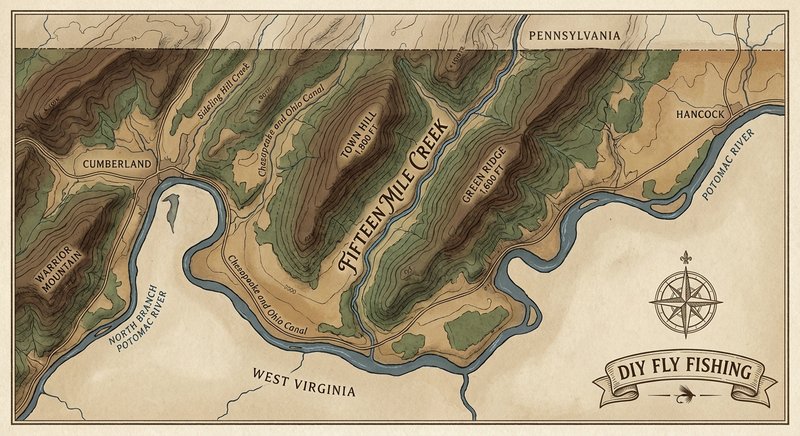
Fifteen Mile Creek
Fly fishing in Maryland · Beginner · Best seasons: Spring, Summer, Fall
Target Species
Brown Trout, Rainbow Trout
About This Water
Western Maryland trout stream. Good stocked and wild trout fishing.
Fishing Recommendations
Welcome to the heart of the Appalachian Mountains. As your guide, I’m excited to walk you through one of Maryland’s most scenic and rewarding technical trout streams: Fifteen Mile Creek.
Located within the sprawling 49,000-acre Green Ridge State Forest in Allegany County, this creek offers a quintessential mountain fishing experience. It is rugged, remote, and rewards the angler who is willing to hike and hunt for their fish.
🎣 Location Overview
Fifteen Mile Creek is a classic freestone stream that carves its way through steep ridges and shale outcroppings. What makes this water special is its isolation; unlike the more famous Gunpowder or Savage rivers, Fifteen Mile Creek offers a sense of solitude that is hard to find on the East Coast.
The water is characterized by a "pool-and-drop" morphology. You’ll find long, glassy flats separated by short, bubbly riffles and deep plunge pools carved into the shale. Because it flows through a state forest, the banks are heavily timbered, providing excellent shade but requiring precise casting to avoid the "tree trout."
🐟 Target Species & Behavior
The creek is primarily managed as a Stocked Trout Stream, with significant numbers of Rainbow and Brown Trout introduced by the Maryland DNR.
- Rainbow Trout: These are often found in the faster water at the heads of pools or in the "pocket water" behind large boulders. They are opportunistic and will often slash at dry flies or aggressive nymphs.
- Brown Trout: The Browns here tend to seek cover. Look for them tucked under overhanging banks, beneath downed timber, or at the very tail-ends of deep pools during low light.
- Behavior: In the spring, fish are active and spread out. As the water warms in late spring and summer, they congregate in the deepest pools and near "seeps" where colder groundwater enters the creek.
📅 Best Times to Fish
Optimal Seasons
- Spring (March – May): This is the prime window. The Maryland DNR stocks heavily during this time, and the aquatic insect hatches (Early Stones, Quill Gordons, Hendricksons) are at their peak.
- Fall (October – November): As temperatures drop, the fish become active again. The fall colors in Green Ridge State Forest are world-class, and the Brown Trout begin their pre-spawn movements.
- Summer (June – August): This is "local knowledge" time. The creek can get low and warm. Focus on the early mornings or late evenings using terrestrial patterns (ants/beetles).
Best Times of Day
- Early Morning: Best for nymphing before the sun hits the water.
- Last Light: The "Evening Rise" on Fifteen Mile Creek can be spectacular, especially in May and June.
🪰 Recommended Flies & Techniques
Top Fly Patterns
- Nymphs:
- Pheasant Tail (Size 14-18): Mimics the abundant Mayfly nymphs.
- Hare’s Ear (Size 12-16): A great general attractor.
- Zebra Midge (Size 18-22): Essential for the slow, deep pools.
- Dry Flies:
- Elk Hair Caddis (Size 14-16): The gold standard for this creek.
- Adams (Parachute) (Size 14-18): Perfect for the flat water sections.
- Chernobyl Ant (Size 10-12): A summer favorite for "smash" takes.
- Streamers:
- Woolly Bugger (Black or Olive, Size 8-10): Swing these through deep holes for holdover Browns.
Techniques & Presentation
- Tight-Line Nymphing: In the riffles, use a high-stick approach to keep your line off the complex currents.
- The "Dry-Dropper": Because the water is often shallow, a buoyant dry fly (like a Stimulator) with a small nymph tied 18 inches below it is the most effective way to cover water.
- Stealth is Key: The water is often crystal clear. Approach pools from downstream, stay low, and wear earthy colors to blend into the forest.
💡 Pro Tips & Local Knowledge
- The "Deep Gap" Spot: Focus on the stretch near the Deep Gap Trailhead. This area is further from the main road and receives less pressure than the spots near the campgrounds.
- Watch the Gauge: This creek reacts quickly to rain. If the Potomac River (into which it flows) is flooding, Fifteen Mile Creek will be a chocolate mess. Conversely, in a drought, it can become too warm to fish safely for trout. Check the USGS gauges for nearby "Sideling Hill Creek" to estimate levels.
- The Shale Slide: Fish the water right against the shale cliffs. The current often scours out deep trenches against the rock faces that hold the largest fish.
- Terrestrials: In late summer, don't overlook the "Inchworm" drop. The overhanging oaks drop caterpillars into the water, and a green foam fly can result in explosive strikes.
⚠️ Important Information
Access & Parking
- The best access is via Fifteen Mile Creek Road and Green Ridge Road. There are numerous pull-offs and designated campsites.
- The Fifteen Mile Creek Campground offers easy access for families, but serious anglers should hike a mile upstream or downstream from the main bridge to find unpressured fish.
Regulations & Permits
- License: A Maryland Non-Tidal Fishing License AND a Trout Stamp are required for everyone 16 and older.
- Rules: Much of Fifteen Mile Creek is managed under "Put and Take" regulations, but check the current MD DNR Freshwater Fishing Guide for any specific "Delayed Harvest" or "Catch and Release" sections that may be seasonally implemented.
Special Considerations
- Safety: This is a remote area. Cell service is non-existent in the valley. Tell someone where you are going.
- Wildlife: Be aware that Green Ridge has a healthy population of Black Bears and Copperheads. Keep your eyes open and store food properly.
- Wading: The shale bottom can be incredibly slippery. Studded wading boots or felt (where legal) are highly recommended.
Enjoy the silence and the tight lines on Fifteen Mile Creek—it’s one of the last true "wild" feeling spots in Maryland!
Bug Hatches & Matching Flies
| Hatch | Type | Peak months | Time of day | Hook sizes | Matching flies |
|---|---|---|---|---|---|
| Blue-Winged Olive Baetis tricaudatus | mayfly | March, April, October, November | Mid-day/Afternoon | #18-22 | RS2 #20-22, Parachute BWO #18-20, Pheasant Tail Nymph #18-22 |
| Quill Gordon Epeorus pleuralis | mayfly | April | Mid-day | #12-14 | Quill Gordon Dry #12-14, Gold Ribbed Hare's Ear #12-14 |
| Hendrickson Ephemerella subvaria | mayfly | April, May | Afternoon | #12-14 | Red Quill #12-14, Hendrickson Emerger #14 |
| Tan Caddis Hydropsyche spp. | caddis | May, June | Evening | #14-16 | Elk Hair Caddis #14-16, Pupa-Le-Do #16, LaFontaine's Deep Sparkle Pupa #14-16 |
| Sulphur Ephemerella invaria | mayfly | May, June | Evening | #14-16 | Sulphur Parachute #14-16, Sulphur Cripple #16 |
| March Brown Maccaffertium vicarium | mayfly | May | Afternoon | #10-12 | March Brown Dry #10-12, March Brown Wet #12 |
| Light Cahill Stenonema ithaca | mayfly | June, July | Evening/Dusk | #12-14 | Light Cahill #12-14, Hare's Ear Nymph #14 |
| Black Ants & Beetles Formicidae / Coleoptera | terrestrial | July, August, September | All Day | #12-18 | Black Foam Ant #14-18, Joan Wulff’s Hoppers #12, Crowe Beetle #14-16 |
| Common Midge Chironomidae | midge | February, March | Late Morning | #20-24 | Zebra Midge #20-24, Griffith's Gnat #20-22 |