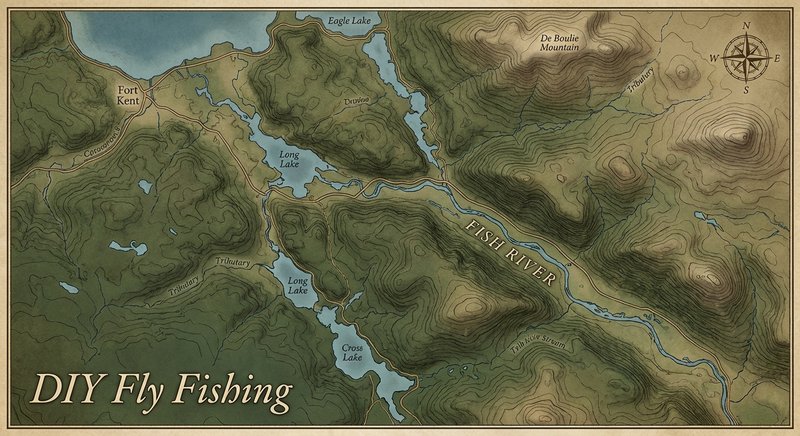
Fish River
Fly fishing in Maine · Intermediate · Best seasons: Summer, Fall
Target Species
Brook Trout, Landlocked Salmon
About This Water
Aroostook County river with brook trout. Remote northern Maine wilderness.
Fishing Recommendations
Welcome to the "Crown of Maine." As a guide, I can tell you that the Fish River in Aroostook County is one of the last bastions of true, wild, north-woods fly fishing. This isn't just another river; it is a vital artery connecting the Fish River Chain of Lakes, offering some of the best opportunities in the lower 48 to land a trophy wild Brook Trout or a hard-fighting Landlocked Salmon.
🎣 Location Overview
The Fish River is the centerpiece of the vast Fish River Chain of Lakes. It flows through a series of "thoroughfares" (short river sections connecting lakes) and longer stretches of moving water before eventually dumping into the St. John River at Fort Kent.
What makes it special is its connectivity. Because the river links deep, cold lakes like Eagle, Square, and St. Froid, it acts as a highway for migratory fish. You aren't just fishing resident river fish; you are often targeting large, nomadic salmon and "Salter-sized" brookies moving between lakes to feed or spawn. The water is tea-colored (tannic) but remarkably clean and cold, characterized by classic pool-and-drop structures, rocky runs, and slow, haunting thoroughfares lined with cedar and spruce.
🐟 Target Species & Behavior
Landlocked Salmon (Salmo salar)
- Behavior: These are landlocked versions of the Atlantic Salmon. They are aggressive, acrobatic, and highly migratory.
- Holding Spots: In the summer, they seek oxygenated water in the heavy riffles and at the heads of pools. In the fall, they move into the river stretches in massive numbers for their spawning run.
- Feeding: They are primarily piscivorous (fish-eaters), focusing on smelt. However, during a hatch, they will readily rise for caddis or mayflies.
Wild Brook Trout (Salvelinus fontinalis)
- Behavior: These are 100% wild, native fish. They are more cautious than the salmon and prefer the edges of the current, deep undercut banks, and the cold "seeps" where springs enter the river.
- Holding Spots: Look for "slack water" behind large boulders or the deep, dark foam lines (the "conveyor belt" of food).
- Feeding: They are opportunistic. They love large stoneflies, terrestrial insects (ants/beetles), and sculpins.
📅 Best Times to Fish
Summer (July – August)
- Condition: This is "Hatch Season." While the midday sun can be bright, the Fish River stays relatively cool compared to southern Maine rivers.
- Window: Focus on "trico" hatches in the early morning and heavy caddis activity in the hour before dark.
- Strategy: This is the best time for dry fly enthusiasts.
Fall (September – Early October)
- Condition: This is the Prime Window. As water temperatures drop, the Salmon and large "Lake-Run" Brookies move out of the deep lakes and into the river.
- Window: All day. Overcast, drizzly days (typical Maine fall weather) are often the most productive.
- Strategy: Aggressive streamer stripping and nymphing deep runs. The fish are territorial and colorful in their spawning "lit-up" hues.
🪰 Recommended Flies & Techniques
Streamers (The Maine Tradition)
Since Smelt are the primary forage, long, sparse streamers are king.
- Patterns: Grey Ghost, Black Ghost, Mickey Finn, and the Herb Johnson Special. For a modern twist, use a Sculpin Helmet or a Bead-head Woolly Bugger in olive or black.
- Technique: "The Swing." Cast 45 degrees downstream, let the fly sink, and pulse it as it swings through the current.
Dry Flies
- Patterns: Elk Hair Caddis (Size 12-16), Royal Wulff (highly visible in tannic water), and the Goddard Caddis.
- Technique: Dead drift. If the salmon are "smutting" (rising for tiny bugs), try a size 18-20 Blue Winged Olive.
Nymphing
- Patterns: Prince Nymph, 20-Incher Stonefly, and Pheasant Tails.
- Technique: High-stick nymphing through the deeper pockets. In the fall, an Egg Pattern or a "Glo-Bug" can be incredibly effective trailing behind a larger nymph.
💡 Pro Tips & Local Knowledge
- The "Thoroughfares": Don't ignore the slow water between the lakes (like the Eagle Lake to Square Lake thoroughfare). While it looks like a pond, there is often a subtle current. Use a boat or canoe to drift these sections; they hold some of the largest Brook Trout in the system.
- Color Matters: In the tea-colored water of the Fish River, fluorescent orange and chartreuse accents on your flies can make a massive difference in visibility.
- The "V-Wake": In the fall, keep an eye out for "V" wakes in shallow tail-outs. These are often large Salmon moving up-river. Cast well ahead of them to avoid spooking.
- Go Big for Salmon: When the salmon are in, don't be afraid to use a 6-weight or even a 7-weight rod. These fish are powerful, and you’ll want the backbone to turn them in the current.
⚠️ Important Information
Access
- Access can be difficult as much of the land is privately owned by timber companies.
- Fort Kent: There is good access near the mouth of the river.
- Soldier Pond: A popular area with decent wading access.
- Canoe/Kayak: The best way to fish the Fish River is by floating it. There are several launch points, but plan your shuttles in advance—it's a remote area with limited cell service.
Regulations & Permits
- License: You must have a valid Maine Fishing License.
- Special Rules: The Fish River has specific length and bag limits that can change by section. Many areas are Fly Fishing Only (FFO) or Artificial Lures Only (S-33).
- Always consult the Maine Open Water Fishing Laws (The "Green Book") before heading out.
Considerations
- Black Flies & Mosquitoes: In the summer, they are relentless. Bring heavy-duty repellent and a head net.
- Wading: The rocks can be incredibly slick (the "Aroostook Grease"). Felt soles (where legal) or studs are highly recommended.
- Wildlife: You are in Moose country. Be alert while driving and while on the water.
Guide's Final Word: The Fish River rewards the patient angler. It’s not about high numbers; it’s about the quality of the fish and the silence of the North Woods. Tight lines!
Bug Hatches & Matching Flies
| Hatch | Type | Peak months | Time of day | Hook sizes | Matching flies |
|---|---|---|---|---|---|
| Hendrickson Ephemerella subvaria | mayfly | May | Afternoon | #12-14 | Red Quill #12-14, Hendrickson Emerger #12-14, Pheasant Tail Nymph #12-14 |
| Grannom Caddis Brachycentrus | caddis | May | Morning/Afternoon | #14-16 | Elk Hair Caddis (Olive) #14-16, Holy Grail #14-16, Peacock Caddis Larva #14-16 |
| Blue-Winged Olive Baetis | mayfly | May, June, September | Afternoon | #18-22 | BWO Sparkle Dun #18-22, RS2 #20-22, WD-40 #18-22 |
| Eastern Green Drake Ephemera guttulata | mayfly | June | Evening | #8-12 | Green Drake Paradox #8-10, Coffin Fly #8-10, Hare's Ear (Large) #8-10 |
| Light Cahill Stenacron / Stenonema | mayfly | June, July | Evening | #12-16 | Light Cahill #12-16, Cream Usual #14-16, Gold Ribbed Hare's Ear #14-16 |
| Giant Black Stonefly Pteronarcys dorsata | stonefly | June | Evening/Night | #4-8 | Kaufmann's Stone #4-8, Stimulator (Black) #6-8, Girdle Bug #6-10 |
| White Miller Ephoron leukon | mayfly | August | Evening | #12-14 | White Wulff #12-14, Ephoron Dun #14, White Miller Spinner #12-14 |
| Golden Stonefly Acroneuria | stonefly | June, July | Morning/Evening | #8-12 | Golden Stimulator #8-12, 20 Incher #8-12, Pat's Rubber Legs (Tan/Yellow) #8-10 |
| Ants and Beetles Formicidae / Coleoptera | terrestrial | July, August, September | All Day | #12-18 | Black Foam Ant #14-18, Crowe Beetle #12-16, Chernobyl Ant #10-14 |