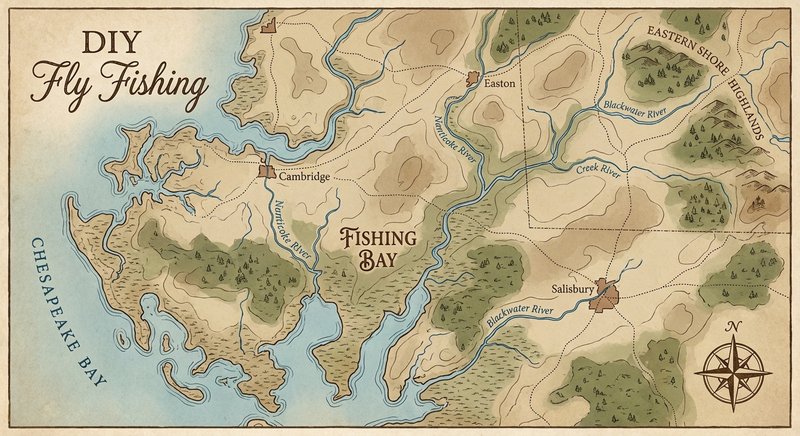
Fishing Bay
Fly fishing in Maryland · Intermediate · Best seasons: Summer, Fall
Target Species
Speckled Trout, Red Drum, Striped Bass
About This Water
Eastern Shore bay with speckled trout and red drum. Coastal fishing experience.
Fishing Recommendations
Tight lines! As an expert guide who has spent countless hours poling the marshy labyrinth of the Chesapeake’s Eastern Shore, I can tell you that Fishing Bay is a crown jewel of Mid-Atlantic saltwater fly fishing.
Located on the edge of the Dorchester County archipelago, Fishing Bay offers a true "Everglades of the North" experience. Here is your comprehensive guide to conquering these brackish flats and tidal creeks.
🎣 Location Overview
Fishing Bay is a vast, relatively shallow embayment bordered by the Blackwater National Wildlife Refuge and the Elliott Island marshes. It is defined by its expansive "skinny water" flats, winding tidal guts, and massive submerged aquatic vegetation (SAV) beds.
What makes it special: This is arguably the best place in Maryland to sight-fish for Red Drum and Speckled Trout. Unlike the open Chesapeake, Fishing Bay is protected by a maze of marsh islands, providing calm water even when the main bay is white-capping. The bottom is a mix of soft "pudding" mud and hard oyster bars, creating a rich nursery for crabs and baitfish.
🐟 Target Species & Behavior
Speckled Trout (Spotted Seatrout)
- Behavior: Known as the "Grey Ghost" of the marsh. They are ambush predators that love moving water.
- Holding Spots: They frequent the edges of grass beds (widgeon grass and eelgrass) and "points" where the tide rips around a marsh corner.
- Feeding: Primary forage includes glass minnows, juvenile menhaden (bunker), and grass shrimp.
Red Drum (Redfish)
- Behavior: These are "puppy drum" (15–28 inches), though "bull" reds occasionally move in during late summer. They cruise the shallowest flats, often "tailing" as they root for crabs.
- Holding Spots: Look for "muds"—clouds of sediment kicked up by feeding fish—on the very shallowest mud flats near the grass line.
- Feeding: They are vacuum cleaners for soft-shell crabs, peeler crabs, and mud minnows.
Striped Bass (Rockfish)
- Behavior: Aggressive and opportunistic. In Fishing Bay, these are typically "resident" fish ranging from 16 to 26 inches.
- Holding Spots: Deep holes in tidal creeks during low tide, and up against the "marsh edge" or under overhanging grass during high tide.
- Feeding: Anything that moves—silversides, bunker, and small blue crabs.
📅 Best Times to Fish
Optimal Seasons
- Summer (July – August): Prime time for Red Drum. The water is warm, and the grass is thick. This is the best window for early morning topwater action.
- Fall (September – early November): The "Golden Era." As water temperatures drop, Speckled Trout activity peaks. Large migratory Striped Bass also begin to move through.
Best Times of Day
- The Low Light Window: The first two hours of daylight are critical. This is when fish move into the shallowest water to hunt before the sun pushes them toward deeper edges.
- Tidal Flow: In Fishing Bay, moving water is everything. The "last two hours of the ebb" and the "first two hours of the flood" are the prime windows. Slack water is often "dead" water.
🪰 Recommended Flies & Techniques
Top Fly Patterns
- Clouser Minnow (Chartreuse/White or Olive/White): The undisputed king of the Chesapeake. Sizes 2 to 1/0. Use sparse bucktail for better action.
- Kwan Fly or Spoon Fly: Essential for Red Drum. These mimic small crabs and shrimp and can be dragged through the grass without snagging.
- Gurgler or Crease Fly: For explosive topwater strikes. White or Silver.
- Half-and-Half: A cross between a Lefty’s Deceiver and a Clouser. Great for larger Striped Bass.
Effective Techniques
- The "Marsh Drag": Cast your fly literally onto the mud/grass bank and gently twitch it into the water. Stripers and Trout often sit inches from the shore waiting for prey to fall in.
- Sight Casting: On bright days, pole or paddle slowly along the flats. Look for the "V" wake of a cruising Redfish. You must lead the fish by 2–3 feet; landing the fly on their head will spook them.
- Blind Casting Edges: If you don't see fish, fan-cast the "drop-offs" where a 1-foot flat falls into a 3-foot channel.
💡 Pro Tips & Local Knowledge
- The "Elliott Island" Factor: The road to Elliott Island (Island Rd) is one of the few places you can access the bay by land, but a kayak or shallow-draft skiff is nearly mandatory to find the best water.
- Wind Direction: A strong West or Southwest wind can "blow the water out" of the bay, making it dangerously shallow. A North/Northeast wind can "stack" water in, making the marsh edges more productive.
- Watch the Birds: In the fall, look for Terns (smaller than gulls) dipping into the water. They are usually over Speckled Trout pushing glass minnows to the surface.
- The "Stink": If you smell a watermelon-like scent, it’s often a sign of a large school of oily menhaden being shredded by predators nearby.
⚠️ Important Information
Access
- Public Landing: The Bestpitch Ferry Boat Ramp and the Elliott Island Public Landing are the primary launch points.
- Vessel Choice: This is "skinny water" territory. Kayaks, paddleboards, and technical poling skiffs are ideal. Standard deep-V boats will be very limited in where they can go.
Regulations & Permits
- License: A Maryland Bay Sport Tidal Fish License is required.
- Check the Creel: Regulations for Striped Bass and Speckled Trout change frequently in Maryland. Always check the Maryland DNR website before heading out.
Special Considerations
- Bugs: The Dorchester County mosquitoes and "biting flies" (deer flies) are legendary and brutal. Wear long sleeves, long pants, and bring high-concentration DEET.
- Mud: Do not try to wade-fish unless you are on a known oyster bar. The mud in Fishing Bay can be thigh-deep and dangerous. Stay in your boat/kayak.
Guide’s Final Word: Fishing Bay rewards the patient angler. It is a wild, silent place where the tide dictates your success. Respect the marsh, watch the tide, and keep your loops tight!
Bug Hatches & Matching Flies
| Hatch | Type | Peak months | Time of day | Hook sizes | Matching flies |
|---|---|---|---|---|---|
| Grass Shrimp Palaemonetes pugio | terrestrial | May, June, September, October | All Day | #4-8 | Veverka's Mantis Shrimp #6-8, Glass Slipper #8 |
| Blue Marsh Damselfly Enallagma civile | terrestrial | June, July, August | Midday | #10-14 | Adult Damsel Dry #12, Marabou Damsel Nymph #12-14 |
| Salt Marsh Midge Chironomidae | midge | March, April, October, November | Morning/Evening | #18-22 | Zebra Midge #18-20, Griffith's Gnat #20-22 |
| Greenhead Fly (Larvae/Adult) Tabanus nigrovittatus | terrestrial | July, August | Afternoon | #8-12 | Deer Hair Horsefly #10, Woolly Worm #8-12 |
| Water Boatmen Corixidae | terrestrial | April, September, October | Afternoon | #14-16 | Prince Nymph (modified) #14-16, Corixa Mimic #16 |
| Common Green Darner Anax junius | terrestrial | August, September | Midday | #2-6 | Dragonfly Popper #4-6, Balsa Dragonfly #6 |
| Marsh Mayfly (Angler's Curses) Caenis spp. | mayfly | July, August | Evening/Night | #20-24 | Caenis Spinner #22-24, Micro-midge Pupae #22 |
| Terrestrial Ants Formicidae | terrestrial | August, September | Afternoon | #12-16 | Black Foam Ant #14-16, Fur Ant #12 |