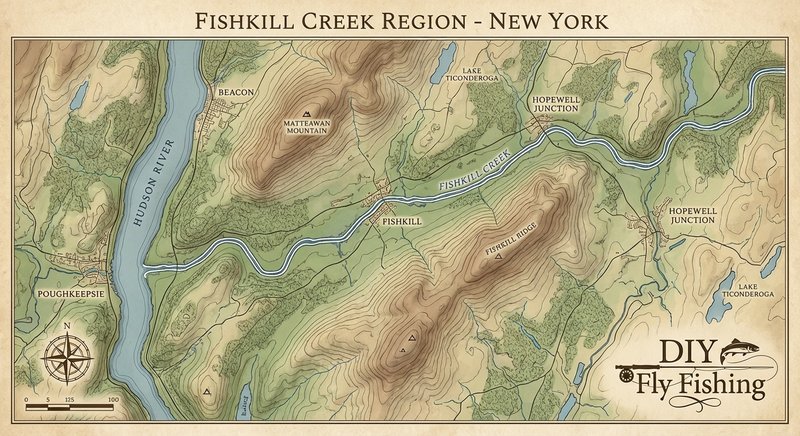
Fishkill Creek
Fly fishing in New York · Beginner · Best seasons: Spring, Summer, Fall
Target Species
Brown Trout
About This Water
Dutchess County stream with wild brown trout. Recovering fishery with good potential.
Fishing Recommendations
Fishkill Creek, located in Dutchess County, New York, is one of the Hudson Valley’s most intriguing and resilient trout fisheries. Flowing from the mountains of Union Vale down to the Hudson River at Beacon, it offers a diverse range of water—from pocket water and plunges to slow, meandering meadow sections.
As your guide, here is the comprehensive breakdown for targeting Brown Trout on the Fishkill.
🎣 Location Overview
Fishkill Creek is a tale of two rivers. The upper reaches near Hopewell Junction and Beekman feel like classic freestone streams, while the lower sections near the city of Beacon take on a more industrial, rugged character before spilling into the Hudson.
What makes it special is its accessibility and productivity. Despite being in a developed area, the creek maintains a healthy population of both stocked and "holdover" Brown Trout. It is a highly fertile stream with a limestone influence in certain stretches, leading to impressive insect biomass. Anglers love it because it offers a "big water" feel in many places, with deep pools that can hide surprisingly large fish for a suburban stream.
🐟 Target Species & Behavior
The primary prize here is the Brown Trout.
- Behavior: Fishkill Browns are notorious for being "shadow dwellers." Because the creek can get quite clear in the summer and experiences significant fishing pressure, the larger fish are extremely wary. They tend to hold tight to undercut banks, submerged logs, and the deep bubbles at the heads of pools.
- Feeding: They are opportunistic but can become highly selective during the major hatches (Hendricksons and Caddis). Large holdover Browns in this system are known to turn piscivorous (fish-eating) once they reach the 14-16 inch mark, making them aggressive toward streamers during low-light conditions.
📅 Best Times to Fish
- Spring (April – June): This is the prime window. The "Special Regulation" section (see below) allows for year-round fishing, but the main hatches kick off in mid-April.
- Summer (July – August): This is the most technical time. Water temperatures can rise, so you must carry a thermometer. If the water hits 70°F, stop fishing to protect the trout. Focus on early mornings (5:00 AM – 9:00 AM) or late evenings near cold-water tributaries.
- Fall (September – November): A fantastic time as temperatures drop. Brown Trout become aggressive and move toward spawning gravel. This is your best chance at a trophy fish.
- Prime Window: The "Golden Hour"—the 60 minutes before dark—is legendary on the Fishkill for the heavy Caddis blizzards.
🪰 Recommended Flies & Techniques
Top Fly Patterns
- Dry Flies:
- Hendrickson (Dark/Light): Sizes 12-14 (April/May)
- Elk Hair Caddis: Sizes 14-18 (Tan or Olive - All season)
- Sulfurs: Sizes 16-18 (Late May/June)
- Terrestrials: Black Ants and Foam Beetles (July/August)
- Nymphs:
- Pheasant Tail: Sizes 14-18 (The gold standard here)
- Zebra Midge: Sizes 18-22 (Red or Black for picky fish)
- Walts Worm: Size 14 (Effective in the deeper, faster runs)
- Streamers:
- Woolly Bugger: Olive or Black, size 6-10.
- Black Ghost: Great for swinging in the lower reaches.
Techniques
- Tactical Nymphing: In the riffles, use a European Nymphing (tight-line) setup. The Fishkill has many "micro-seams" where trout sit; a traditional indicator often creates too much drag.
- The "Caddis Skitter": During the evening hatches, don't be afraid to twitch your dry fly. Fishkill Browns respond well to an active silhouette.
- The Swing: Downstream swinging with a small streamer or wet fly is highly effective in the wider sections near Fishkill Village.
💡 Pro Tips & Local Knowledge
- Focus on the "No-Kill" Section: There is a specific reach in the town of Fishkill/Beekman that often holds the most consistent fish. Look for areas with high canopy cover; the shade keeps the water cooler and the fish more comfortable.
- The "Route 21" Secret: The stretches near Hopewell Junction offer some of the best pocket water. Many anglers stick to the easy-access bridges, but if you hike 15 minutes away from the road, the pressure drops significantly.
- Heavy Tippet for Streamers: If you are fishing streamers in the evening, don't go lighter than 3X. There are submerged shopping carts, old tires, and heavy woody debris in the lower sections. You need the strength to pull a big Brown away from "the junk."
- Stealth is Key: Because the Fishkill is often waded by many, the fish are sensitive to vibrations. Wade slowly and try to cast from a kneeling position if you are fishing the slower meadow reaches.
⚠️ Important Information
- Regulations: New York state recently changed trout regulations. Much of the Fishkill is "Inland Trout Stream," but check the NYSDEC Trout Stream Map for specific "Catch and Release" vs. "Harvest" zones.
- Access: Much of the creek runs through private property. Always look for the yellow "Public Fishing Rights" (PFR) signs. These indicate where the state has purchased access for anglers. Respect all "No Trespassing" signs outside of these zones.
- Permits: A valid New York State Fishing License is required for everyone 16 and older.
- Safety: Be mindful of water levels after heavy rain. The Fishkill drainage is large and can flash-flood or become dangerously turbid quickly. Check the USGS gauge at Beacon or Fishkill before heading out.
Tight lines, and remember: Keep 'em wet! A Fishkill Brown is a local treasure—handle it with care.
Bug Hatches & Matching Flies
| Hatch | Type | Peak months | Time of day | Hook sizes | Matching flies |
|---|---|---|---|---|---|
| Blue Winged Olive Baetis | mayfly | April, May, September, October | Midday | #18-22 | RS2 #20-22, BWO Parachute #18-20, Barr Emerger #20-22 |
| Hendrickson Ephemerella subvaria | mayfly | April, May | Afternoon | #12-14 | Hendrickson Dry #12-14, Red Quill Spinner #14, Pheasant Tail Nymph #12-14 |
| Sulfur Ephemerella invaria / dorothea | mayfly | May, June | Evening | #14-18 | Sulfur Parachute #16-18, Sulfur Emerger #14-16, Comparadun #16 |
| Tan Caddis Hydropsyche | caddis | May, June, July | Evening | #14-16 | Elk Hair Caddis #14-16, Pupa-X #14-16, LaFontaine's Deep Sparkle Pupa #16 |
| Light Cahill Stenacron / Stenonema | mayfly | June, July | Evening | #12-14 | Light Cahill #12-14, Gold Ribbed Hare's Ear #12-14 |
| Slate Drake Isonychia bicolor | mayfly | June, September | Afternoon/Evening | #10-12 | Isonychia Parachute #10-12, Prince Nymph #10-12, Zug Bug #12 |
| Trico Tricorythodes | mayfly | July, August, September | Morning | #22-26 | Trico Spinner #22-24, Griffith's Gnat #22-24 |
| Ants and Beetles Hymenoptera / Coleoptera | terrestrial | July, August, September | All Day | #14-18 | Black Foam Ant #16-18, Cinnamon Ant #16-18, Crowe Beetle #14-16 |