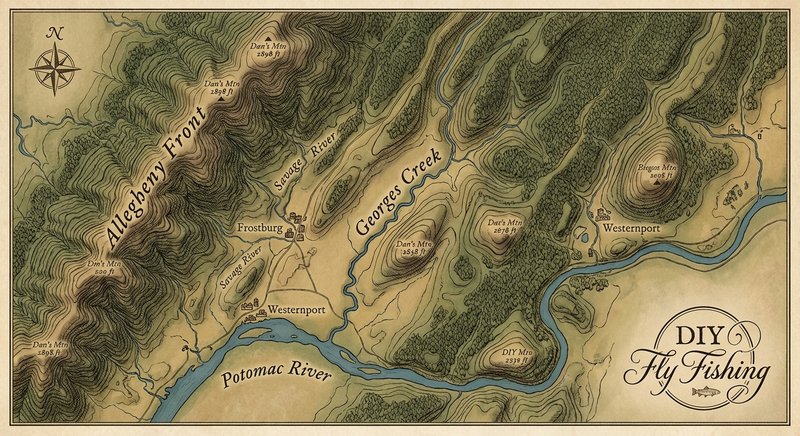
Georges Creek
Fly fishing in Maryland · Beginner · Best seasons: Spring, Summer, Fall
Target Species
Brown Trout
About This Water
Allegany County stream with wild brown trout. Former coal mining region restoration.
Fishing Recommendations
Welcome to Western Maryland. As your guide, I’m excited to talk about Georges Creek. This is a "comeback" stream—a waterway that was once heavily impacted by Maryland’s coal mining history but has seen a remarkable recovery thanks to remediation efforts. For the angler who appreciates a technical challenge and likes to get off the beaten path, Georges Creek offers a unique experience for wild and holdover Brown Trout.
🎣 Location Overview
Georges Creek flows through the narrow valley between Dans Mountain and Savage Mountain in Allegany County. Historically known for Acid Mine Drainage (AMD), significant investment in lime dosers and reclamation has turned this into a productive trout fishery.
What makes it special is its resilience and character. It is a classic Appalachian freestone stream featuring a mix of plunges, tight pocket water, and long, technical pools. Unlike the nearby North Branch of the Potomac (which is large and tailwater-fed), Georges Creek is intimate. It feels "fishy" from the moment you step in, but the high gradient and clear water mean these fish are extremely spooky.
🐟 Target Species & Behavior
The primary prize here is the Brown Trout. You will find a mix of stream-bred wild browns and holdovers from state stocking programs.
- Behavior: These fish are highly opportunistic but wary. Because the stream is relatively nutrient-poor compared to limestone spring creeks, the fish aren't always "selective" about the exact bug, but they are very "selective" about the presentation.
- Where they hold: Look for them in the "cushion" in front of large boulders, in the deep undercut banks, and at the very tail-outs of pools during evening hatches.
- Feeding: They rely heavily on caddis, small stoneflies, and terrestrial insects in the summer.
📅 Best Times to Fish
Optimal Seasons
- Spring (April – June): This is the prime window. Water levels are usually stable, and the major insect hatches (Hendricksons and Sulphurs) occur now.
- Summer (July – August): Fishing remains good due to the canopy cover keeping water temps down, but you must switch to terrestrials and light tippet.
- Fall (September – November): A fantastic time for Brown Trout as they become aggressive before spawning. The colors of the valley are spectacular.
Best Times of Day
- Spring: Mid-day to late afternoon (11 AM – 4 PM).
- Summer: Early morning (dawn till 10 AM) and "the magic hour" at dusk.
- Conditions: Overcast days are your best friend on Georges Creek. The low light brings the larger Browns out from under the rocks.
🪰 Recommended Flies & Techniques
Top Fly Patterns
- Dry Flies:
- Elk Hair Caddis (Tan/Olive, #14-18) – The staple of Western MD.
- Parachute Adams (#12-20) – Works year-round.
- Dave’s Hopper or Chernobyl Ant (#8-12) – Essential for summer.
- Nymphs:
- Pheasant Tail (#14-18) – Mimics the various mayflies.
- Zebra Midge (#18-22) – Critical for low-water conditions.
- Pat’s Rubber Legs (#8-12) – Great for high water in the spring.
- Streamers:
- Woolly Bugger (Black or Olive, #8-12) – Dead-drifted or swung through deep holes.
Techniques
- Dry-Dropper: This is the most effective way to fish Georges Creek. Use a buoyant dry fly (like a Stimulator) and hang a small Pheasant Tail or Hare's Ear 18 inches below it.
- Tight-Line Nymphing: In the high-gradient pocket water sections, keeping your fly line off the water is the only way to avoid drag and stay in the "zone."
- Stealth Approach: This cannot be overstated. Walk slowly, stay low, and cast from behind the fish. If you see the fish, they have likely already seen you.
💡 Pro Tips & Local Knowledge
- Focus on the Lower Sections: The stretch from Barton down to Westernport often holds the most consistent water temperatures and some of the larger holdover fish that move up from the North Branch.
- The "Shadow" Cast: Because the valley is narrow, shadows hit the water early. When the sun dips behind Savage Mountain, the fish lose their inhibions. That 30-minute window of dusk is often more productive than the previous six hours.
- Check the Water Color: If the water has a slight "milky" or orange tint after a heavy rain, it’s a sign of old mine runoff. It’s best to wait 24 hours for the stream to clear and stabilize.
- Gear Recommendation: A 7.5 to 8.5-foot 4-weight rod is the perfect tool. Anything longer will get tangled in the overhanging rhododendron and hemlock.
⚠️ Important Information
- Access: Much of the creek runs parallel to MD Route 36. There are several pull-offs near the towns of Lonaconing and Barton. Always respect "Posted" signs, as some sections run through private backyards.
- Regulations: Georges Creek is generally managed under Statewide General Trout Streams regulations, but always check the Maryland DNR Freshwater Fishing Guide before heading out, as regulations regarding creel limits can change.
- Licensing: You must have a Maryland Non-Tidal Angler’s License and a Trout Stamp.
- Safety: The rocks in Georges Creek are notoriously slippery and "rolly." Wading boots with felt or studs and a wading staff are highly recommended.
Guide's Final Word: Georges Creek isn't about catching 50 fish a day; it's about the beauty of a recovered ecosystem and the satisfaction of a well-placed cast in a tight spot. Tight lines!
Bug Hatches & Matching Flies
| Hatch | Type | Peak months | Time of day | Hook sizes | Matching flies |
|---|---|---|---|---|---|
| Blue Winged Olive Baetis tricaudatus | mayfly | March, April, September, October | Midday | #18-22 | BWO Sparkle Dun #18-22, Pheasant Tail #18-20, RS2 #20-22 |
| Quill Gordon Epeorus pluralis | mayfly | April | Early Afternoon | #12-14 | Quill Gordon Dry #12-14, Hare's Ear Nymph #12-14 |
| Hendrickson Ephemerella subvaria | mayfly | April, May | Afternoon | #12-14 | Red Quill #12-14, Hendrickson Emerger #14, Ephemerella Nymph #12-14 |
| March Brown Maccaffertium vicarium | mayfly | May, June | Afternoon | #10-12 | March Brown Dry #10-12, Gold Ribbed Hare's Ear #10-12 |
| Sulphur Ephemerella invaria | mayfly | May, June | Evening | #14-16 | Sulphur Parachute #14-16, Sulphur Emerger #16, Pheasant Tail #14-16 |
| Grannom Caddis Brachycentrus | caddis | April | Morning/Afternoon | #14-16 | Elk Hair Caddis (Black/Dark) #14-16, Peacock Caddis Larva #14-16 |
| Cinnamon Caddis Hydropsyche | caddis | June, July, August | Evening | #14-18 | Elk Hair Caddis (Tan) #14-18, Hydropsyche Larva #14-16 |
| Little Black Stonefly Capniidae | stonefly | February, March | Midday | #16-18 | Black Stonefly Nymph #16-18, Black Griffith's Gnat #18 |
| Terrestrials (Ants/Beetles) Formicidae/Coleoptera | terrestrial | July, August, September | All Day | #12-18 | Black Foam Ant #16-18, Crowe Beetle #14-16 |