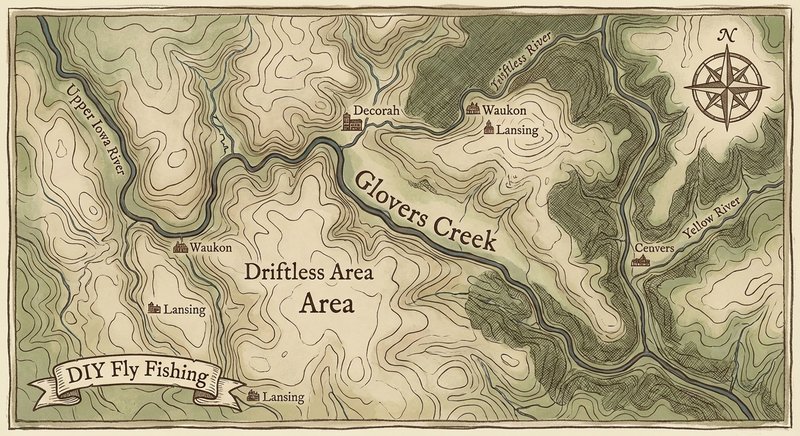
Glovers Creek
Fly fishing in Iowa · intermediate · Best seasons: spring, summer, fall
Target Species
Brown Trout, Brook Trout
About This Water
Winneshiek County spring creek with wild trout. Quality habitat with hatches.
Fishing Recommendations
Glovers Creek, located in Fayette County near West Union, Iowa, is a quintessential Driftless Area gem. While it may not have the name recognition of the Upper Iowa or the Yellow River, it is beloved by local sticks for its intimacy, stunning limestone scenery, and the quality of its wild fish.
As your guide, here is the breakdown for tackling this technical and rewarding spring-fed stream.
🎣 Location Overview
Glovers Creek flows through the heart of Echo Valley State Park. It is a classic limestone spring stream, characterized by gin-clear water, narrow runs, and dramatic bluffs. Because it is spring-fed, the water temperature remains stable—cold in the summer and open (ice-free) in the winter.
What makes Glovers special is its natural reproduction. While Iowa DNR does supplement the stream, it boasts a very healthy population of wild, stream-bred Brown Trout. The stream varies from tight, brushy corridors to open meadow stretches, offering a variety of challenges for the fly angler.
🐟 Target Species & Behavior
- Brown Trout: These are the primary residents. The wild Browns in Glovers are notoriously "spooky." They have excellent eyesight and will bolt for cover at the slightest shadow or heavy footstep. They hold tight to undercut banks, submerged logs, and the "lunker structures" (artificial hides) installed by the DNR.
- Brook Trout: You will find Brookies higher up in the system and near the colder spring inflows. They are more opportunistic than the Browns but require the coldest, cleanest water.
- Behavior: During the day, larger fish stay deep in the pools or under "roofs" (overhanging grass/banks). They move into the riffles to feed during low-light periods (dawn/dusk) or during a heavy hatch.
📅 Best Times to Fish
- Spring (April – May): This is prime time. The Blue Winged Olive (BWO) hatches can be spectacular on cloudy, drizzly days. The fish are hungry after winter and less wary before the heavy summer vegetation grows in.
- Summer (June – August): Focus on the "Trico" hatches early in the morning. As the day warms up, switch to Terrestrials. This is peak "hopper-dropper" season. Avoid mid-day sun; fish the shadows.
- Fall (September – October): The Brown Trout begin to color up for the spawn. They become more aggressive and will often strike larger streamers to defend territory. The fall foliage in Echo Valley is a bonus.
- Time of Day: In the clear water of Glovers, the "Golden Hours" (first and last light) are significantly more productive than mid-day.
🪰 Recommended Flies & Techniques
Top Fly Patterns
- Nymphs:
- The Pink Squirrel (Size 14-18): A Driftless staple. The flash and the pink bead are irresistible here.
- Scuds/Sowbugs (Gray or Olive, Size 16-20): These are the primary food source in Iowa spring streams year-round.
- Pheasant Tail Nymph: Classic profile for matching various mayfly nymphs.
- Dry Flies:
- Elk Hair Caddis (Size 16-18): Great for skittering across riffles.
- Chubby Chernobyl / Foam Beetles: Excellent for the "Hopper" season in late summer.
- BWO Sparkle Dun: For those technical spring hatches.
- Streamers:
- Wooly Bugger (Black or Olive, Size 8-12): Strip these through deep holes or under banks during high water.
Techniques
- Stealth is Mandatory: If you can see the fish, they have likely already seen you. Wear earth tones, stay low, and move slowly. Kneeling while casting is a common practice here.
- The "Hopper-Dropper": In summer, use a buoyant foam terrestrial on top with a small scud or nymph tied 18–24 inches below it.
- Tight-Line Nymphing: Because the stream is narrow, "Euro" or tight-line nymphing is incredibly effective for keeping your line off the complex currents.
💡 Pro Tips & Local Knowledge
- The "Lunker Structures": Look for the heavy wooden timbers built into the banks at water level. These are man-made trout hotels. Drift your nymph as close to the wood as possible—that is where the "wall-hanger" Browns live.
- Work Upstream: Always fish upstream. Because the water is so clear and relatively shallow, walking downstream will send silt and "danger signals" to every fish ahead of you.
- 6x Tippet: Don't be afraid to drop down to 6x fluorocarbon. These fish can be leader-shy, especially in the slow, flat pools.
- Echo Valley Access: The park offers easy access, but don't be afraid to hike. The further you get from the main parking areas and the playground, the less pressured the fish will be.
⚠️ Important Information
- Regulations: You must have a valid Iowa Fishing License and a paid Trout Fee.
- Gear: A 7.5 to 9-foot rod in a 3-weight or 4-weight is ideal. Anything heavier is overkill for these waters and makes delicate presentations difficult.
- Private Property: While the stretch through Echo Valley State Park is public, much of the surrounding land is private. Respect "Fences of Iowa" and look for the "Trout Fishing Access" signs which denote easements on private land.
- Leave No Trace: These ecosystems are fragile. Pack out all clipped tippet and trash to keep the Driftless beautiful.
Tight lines on Glovers Creek—it’s a technical stream, but landing a wild Iowa Brown in the shadow of a limestone bluff is an experience you won't soon forget.
Bug Hatches & Matching Flies
| Hatch | Type | Peak months | Time of day | Hook sizes | Matching flies |
|---|---|---|---|---|---|
| Blue-winged Olive Baetis tricaudatus | mayfly | March, April, September, October | Late Morning/Afternoon | #18-22 | RS2 #20-22, Parachute Adams #18-22, Pheasant Tail Nymph #18-20 |
| Grannom Caddis Brachycentrus | caddis | April, May | Afternoon/Evening | #14-16 | Peacock Caddis #14-16, Deep Sparkle Pupa #14-16, Elk Hair Caddis (Black) #14-16 |
| Pale Morning Dun / Sulfur Ephemerella invaria | mayfly | May, June | Evening | #14-18 | Sulfur Parachute #16-18, CDC Emerger #16-18, Frenchie #14-16 |
| Spotted Sedge Hydropsyche | caddis | June, July, August | Evening | #14-18 | Elk Hair Caddis (Tan) #14-18, Hydropsyche Larva #14-16, Soft Hackle Hare's Ear #14-16 |
| Trico Tricorythodes | mayfly | July, August, September | Early Morning | #20-24 | Trico Spinner #20-24, Trico Dun #20-22, Zebra Midge #20-22 |
| Light Cahill Stenonema ithaca | mayfly | June, July | Evening | #12-14 | Light Cahill #12-14, Gold Ribbed Hare's Ear #12-14 |
| Midges Chironomidae | midge | January, February, March, December | Morning/Afternoon | #18-24 | Griffith's Gnat #18-22, Zebra Midge #18-22, Top Secret Midge #20-24 |
| Grasshoppers / Terrestrials Orthoptera | terrestrial | July, August, September | Afternoon | #8-14 | Joe's Hopper #10-12, Black Foam Ant #14-18, Chernobyl Ant #8-12 |